



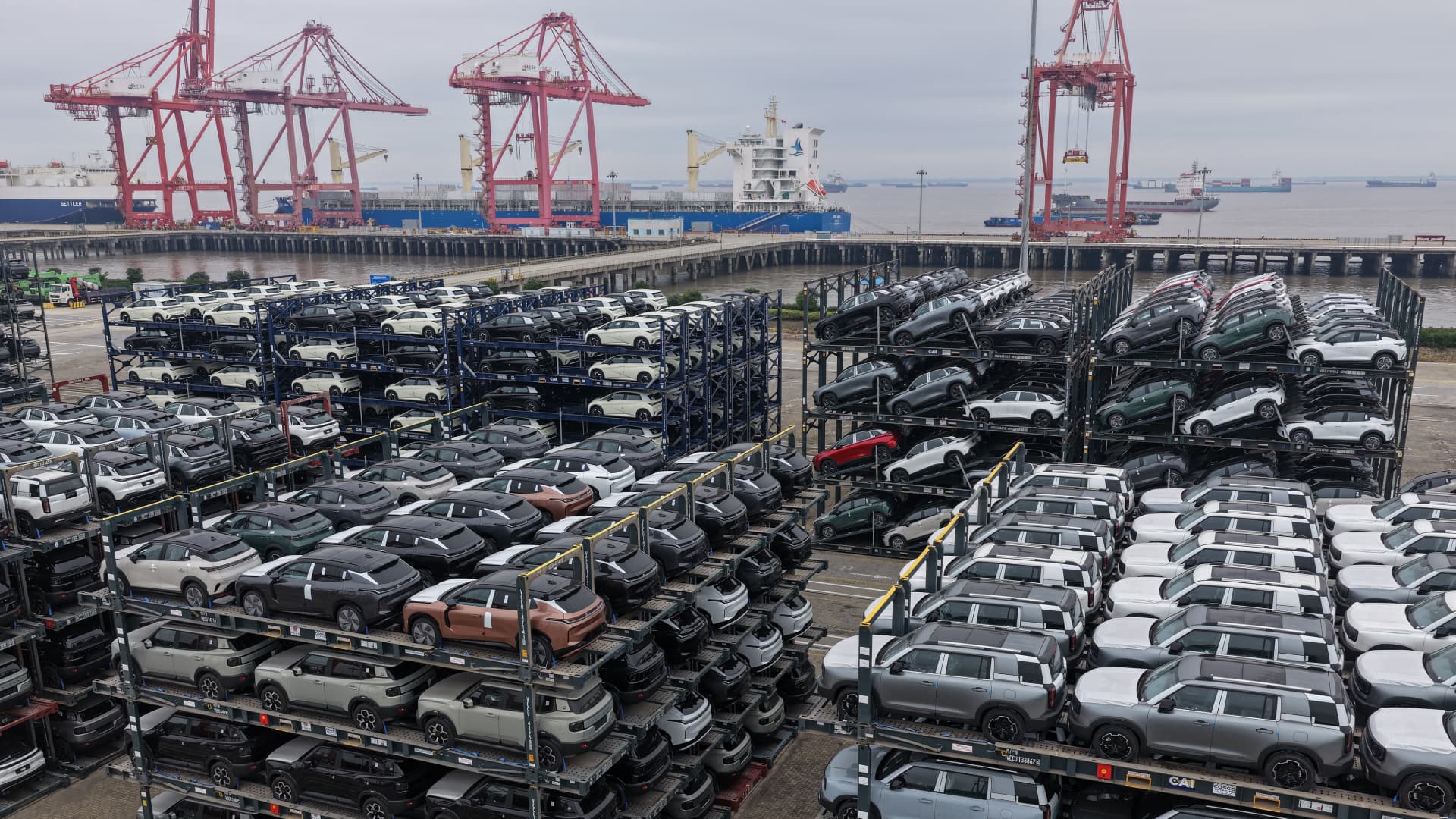
Chinese-made cars are seen in specialised vehicle racks in preparation for loading onto ships for export, at the Taicang Port area of Suzhou Port, in China’s eastern Jiangsu province on October 12, 2026.
– | Afp | Getty Images
BEIJING — China’s exports grew by 36.3% in September from a year ago, their fastest pace since February, according to official data released Wednesday.
Imports climbed by 31%, the fastest increase since June, the data showed, picking up from 28.2% in August.
Both exports and imports exceeded estimates from a Reuters poll, of 25.5% and 24.5%, respectively.
China’s exports to the U.S. grew by nearly 39.6% in September, outpacing the growth of overall exports and sending the monthly trade surplus to the highest since January 2025, according to customs data accessed via Wind Information.
The value of China’s integrated circuit board exports globally surged by 136% in September from a year ago — but the number of units exported only rose by 1%, according to CNBC calculations of official figures.
The volume of China’s crude oil imports fell by double-digits for a sixth-straight month, even as their value rose for the first time since May, according to Wind. China’s crude oil and natural gas imports have both declined in volume since the start of the year.
Earlier this year, China’s exports and imports each grew at their fastest pace in five years.
A surge in demand for China-made parts for data centers to power artificial intelligence has helped fuel exports, along with stabilization in tensions with the U.S., China’s largest trading partner on a single-country basis.
„The resulting trade surplus of $133.5 billion, a record monthly high, underscores the continued strength of China’s external sector despite lingering concerns over domestic demand,“ Hao Zhou, head of research and chief economist at Guotai Junan International Holdings, said in a note.
Global scrutiny on the economic impact of China’s surging exports has escalated in recent years, amid sluggish domestic demand. AI-related demand and a coinciding rise in prices of core products have also helped support import growth.
The U.S. and China last month announced plans to roll back tariffs on $30 billion worth of goods from each country, and extend a broader trade truce by two months to January.
The European Union last week announced China agreed to halve its exports of hybrid-powered cars to the bloc, following high-level trade talks in Beijing.
China’s overall car exports surged by 56.3% in September to 1.18 million vehicles, with the value of those exports climbing by 62%, the data showed.
For the first three quarters of the year, China’s exports grew to every major country tracked by the customs agency. However, imports from Malaysia, Germany and the U.K. fell during that time.
Reflecting the impact of export controls and stockpiling, the volume of China’s rare earths and fertilizer exports dropped during the first three-quarters of this year, while fertilizer imports surged.

