



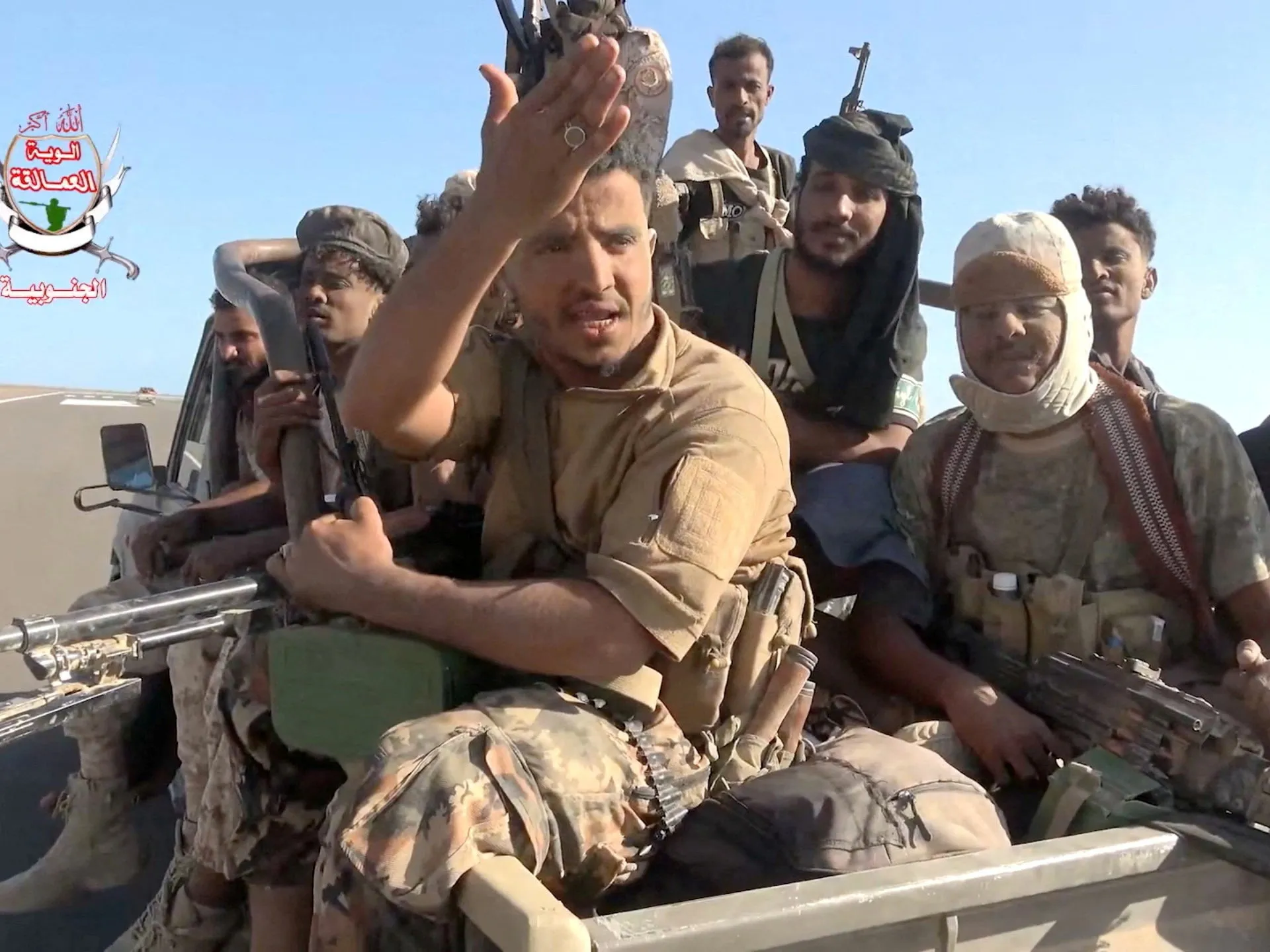
Yemeni government forces say they have made strategic advances into the Marib governorate in north-central Yemen as they push on with operation “Dawn of Yemen”.
The offensive by the Saudi-backed Yemeni government forces, launched just over a week ago, comes after major gains by the Iran-backed Houthis, an armed group also known as Ansar Allah or Supporters of God, in September, when it swept along the country’s Red Sea coast, capturing the strategic port city of Mocha and territory around the Bab al-Mandeb, one of the world’s most important shipping routes.
Rashad al-Alimi, chairman of Yemen’s Presidential Leadership Council, said operation Dawn of Yemen aimed to retake all remaining Houthi-held territory, including the capital, Sanaa, which the group has controlled since 2014, when the war first started.
Meanwhile, intense clashes and Houthi shelling on residential neighbourhoods in Taiz in the southwest of the country have caused dozens of civilian casualties.
![People queue with cooking gas cylinders as they wait to get the refill amid supply shortages in Taiz, which is under siege, in Yemen, on October 5, 2026 [Reuters]](https://www.aljazeera.com/wp-content/uploads/2026/10/2026-10-05T092443Z_148626106_RC2WWNAHYN7T_RTRMADP_3_IRAN-CRISIS-YEMEN-1791890757.jpg?w=770&resize=770%2C432&quality=80)
Operation Dawn of Yemen
In the northwest of Marib governorate, a military source told Al Jazeera that government troops have successfully taken control of strategic, commanding heights surrounding the strategic Maas camp facility in the Medghal district. The source noted this followed intensive attacks that had breached the Houthi group’s fortifications.
On the southern front, forces from the Saba and Bayhan axes announced the capture of the al-Muqailat and Jabal Zajjar positions north of the Harib district. Government forces claimed the fierce clashes resulted in the Houthis retreating and suffering human and material losses.
This field progress coincided with continued violent battles along the front lines in the north and south of Marib. Government forces launched concentrated strikes using warplanes, drones, artillery and rocket launchers, targeting Houthi military positions and reinforcements.
The armed forces’ media centre published footage it said documented drone attacks on Houthi military barracks and vehicles within the scope of the third military region’s operations, noting the destruction of multiple combat vehicles and equipment.
Above: Footage from the battles within the operational theatre of the seventh military region north of Marib: Media centre of armed forces.
Military spokesperson Colonel Majid al-Nuzaili announced on Monday that operations have involved 1,879 precise strikes, neutralising 950 Houthi fighters and destroying 380 military vehicles.
Meanwhile, Houthi-affiliated media reported that air strikes targeted Kamaran Island and the al-Qanawis district in the coastal Hodeidah governorate along the Red Sea and the Harf Sufyan district in Amran, western-central Yemen.
Escalation in Taiz
In the southwestern governorate of Taiz, where the Houthis have the city of Taiz under siege, government forces and popular resistance fighters are engaged in fierce battles across multiple major axes amid a wide-scale field escalation.
On the western fronts, heavy fighting has flared in al-Dhabab, Hathran and Jabal Han as government troops have sought to thwart infiltration attempts and repel Houthi attacks. Sources within the government forces told Al Jazeera that troops captured 81 Houthi fighters in al-Dhabab on Monday afternoon.
In the southern and southwestern countryside, battles have intensified in the al-Shaqb, al-Aqroud and al-Misrakh areas. A field military source told Al Jazeera that government forces are involved in fierce clashes from all directions in the al-Shaqb area of Taiz, with confrontations extending to areas the Houthis seized on Monday in Sabir.
Also in the southwest, a field military source from the Southern Giants Brigades told Al Jazeera that Houthi forces had fired a ballistic missile at the highly strategic mountain range of Jabal Kahboub at midnight. The source confirmed there were no human or material casualties, with damage limited to the missile’s distant impact zone.
Civilian toll rises
The military escalation has severely affected civilian populations. Al Jazeera correspondent Abdullah Qatran reported seeing Houthi mortar shelling targeting the al-Ikhwa residential neighbourhood in the centre of Taiz, resulting in an undetermined number of deaths, injuries and property damage, causing widespread panic.
With Taiz under Houthi siege, civilians there are also suffering severe shortages of fuel and other essential supplies. Yemen’s Ministry of Public Health and Population said on Saturday that medicines, intravenous fluids, medical supplies and fuel at the city’s health facilities were “nearing depletion”.
Compounding this, the Yemeni Network for Rights and Freedoms has documented 43 violations by Houthi forces in Taiz over the past 24 hours, which have killed five civilians and wounded 17. According to a report by Yemen’s state-run Saba news agency, casualties included five-year-old Ahlam Abdulsalam, who died when shelling struck her family’s home in the al-Misrakh district.
The rights group stated that Houthi forces have fired more than 180 projectiles at residential areas, including mortar and artillery shells, Katyusha rockets, tank rounds and drones. The bombardment has damaged seven homes, 12 private vehicles and the al-Saeed Mosque in Taiz city.
Saba also reported that a Houthi attack early on Tuesday struck al-Safwa Hospital, shattering windows, injuring at least one person, and triggering panic among patients and medical staff. This followed earlier Houthi shelling in which five people, including three children, were injured in the al-Dhahra residential area and the nearby Beer Basha district.
The Yemeni Network for Rights and Freedoms warned that continuous shelling and restrictions on supplies are worsening humanitarian conditions, calling on the United Nations and the international community to take urgent steps to protect civilians.

