



Women who rise to the top of political parties are often doing so in circumstances where the odds of success are already stacked against them, according to a University of Calgary political scientist who studies gender and politics.

The phenomenon is often described as a “glass cliff” — a term borrowed from business research that refers to women being elevated to leadership positions when organizations or political parties are already in crisis. But Melanee Thomas says that concept can oversimplify what is happening.
In an interview with Global News Wednesday, Thomas said she prefers the term “gendered political opportunity structure,” arguing that women are not passive participants being set up to fail. Rather, she says they are political actors who recognize that opportunities to lead are often more available when parties are struggling.

Thomas said political leadership positions, particularly those in government, are among the most coveted jobs in politics. Yet when parties are thriving, leadership contests tend to attract a familiar profile of candidates, often men with traditional political resumes. Women, she said, face steeper barriers when competing in those circumstances.
Instead, opportunities frequently arise when parties are electorally vulnerable or attempting to recover from scandal, internal turmoil or voter dissatisfaction.
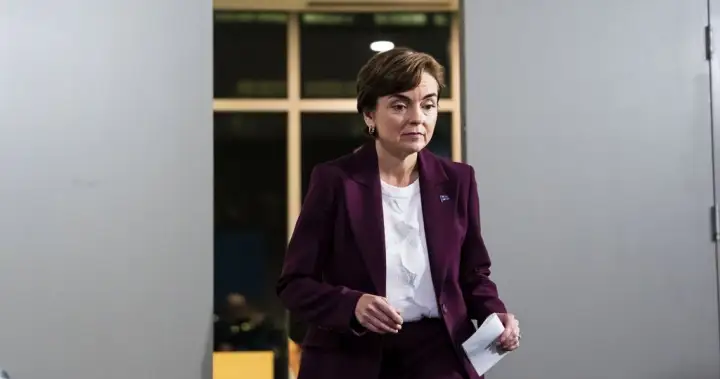
The discussion has resurfaced following the recent election loss and resignation of former Quebec premier Christine Fréchette, who became leader of the governing Coalition Avenir Québec (CAQ) party months before an election after the departure of longtime premier François Legault.
Support for the CAQ was at an all-time low and the party had been plagued by scandals and troubled projects, including the SAAQclic fiasco, a controversial bill to change doctors’ pay, the failed Northvolt project and more.

Get breaking National news
Get breaking Canada news delivered to your inbox as it happens so you won’t miss a trending story.
Thomas said any leader would have faced significant challenges trying to rebrand a party that had been defined for years by scandal and its previous premier.
But she said it would be wrong to ignore the role gender plays in determining who gets selected to lead parties during difficult periods, pointing to former Quebec premier Pauline Marois as an example.
Thomas said Marois had long-standing leadership ambitions and extensive cabinet experience, but only became leader of the Parti Québécois after the party had entered a period of crisis.
“Women want the power jobs in politics,” Thomas said. “I think they are strategic enough to read the room and know what their chances are going to be when things are really good, and know that their only chance might be when things aren’t great.”
She drew comparisons to former prime minister Kim Campbell, who became Progressive Conservative leader and prime minister shortly before the party suffered a historic defeat in the 1993 federal election.
“Was it Kim Campbell’s fault? No,” Thomas said. “But do people still blame her specifically for it? Not everyone, but some absolutely do.”
Research suggests women politicians often face different standards than their male counterparts, Thomas said. She cited experimental studies showing some voters continue to hold stereotypical views about women’s suitability for political office. Other studies have found female candidates are often required to demonstrate stronger qualifications than men to receive similar evaluations.

“Women candidates have to be significantly more credentialed,” she said. “They have to have way better CVs to be evaluated the same way as men.”
Even when women secure leadership roles in favourable political conditions, research suggests they can face greater pressure and are more likely to be pushed out sooner than male leaders, Thomas said.
Still, the political scientist argues that women should not avoid leadership opportunities simply because success is uncertain.
Politics is inherently competitive and most candidates, regardless of gender, do not win, she argued. Participation remains essential to a healthy democracy, she told Global News over the phone.
“I’ve had people be kind of like, why do women put themselves forward if they’re likely to lose? And I was just like, that’s also most men in politics, though, right? […] So are they a failed candidate or are they an essential part of the democratic process?” Thomas said.
She added that young women and girls need to see examples of women bidding for roles, sometimes getting them and succeeding, but also failing, surviving that failure and continuing their careers. “(Women) have to be willing to participate and lose. That is a core feature of democracy.”
“Anybody who wants to do it should go for it.”
Research has shown that as more women are elected, girls and women are more likely to see politics as a space where they belong, she said.
Instead of focusing solely on whether female leaders succeed or fail, the University of Calgary professor said the more important question is why women continue to be viewed differently than men when navigating the same political challenges.
“Many politicians do good things, and many do things people think are dumb. The fact that when women do those things it is seen as a reflection of women as a whole, while men are not seen as a reflection of all men, shows exactly why this pattern persists.”
On Monday, 57 women were elected to Quebec’s national assembly — about 45 per cent of the 127 seats — slightly down from the number elected in 2022.


