



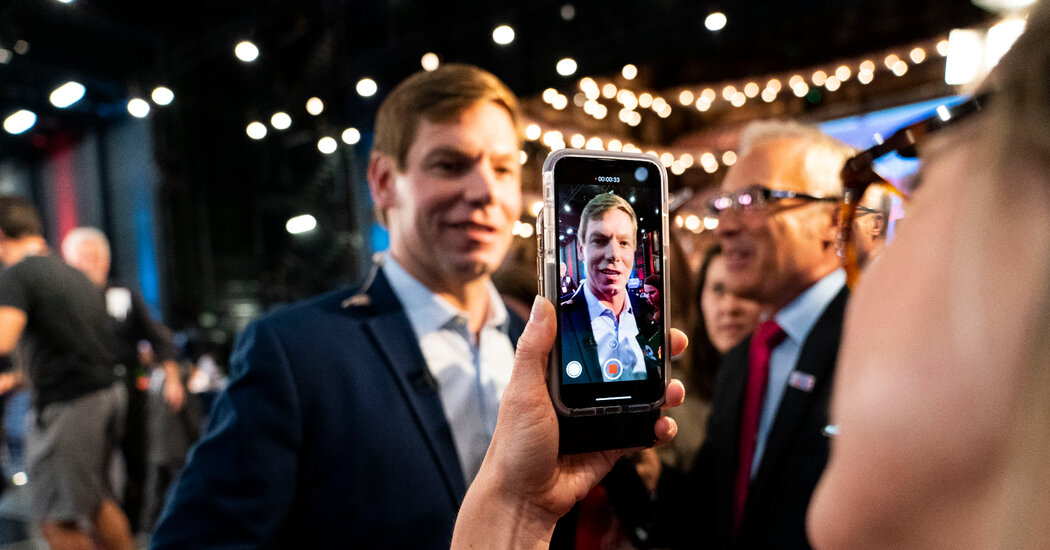
Eric Swalwell was once hailed as “the Snapchat king of Congress” for his prolific use of the app with disappearing messages.
Mr. Swalwell had developed a reputation as a digital native, a person who seemed to have a deep understanding of how to harness the power of social media.
In the end, social media would also play a critical role in his undoing.
It was on social media where early whispers of sexual misconduct accusations against Mr. Swalwell swirled after he entered the California governor’s race last year. After hearing similar chatter and allegations directly from women, two Democratic influencers built a network using some of the same platforms that his accusers said he had used to connect with them.
Cheyenne Hunt, one of the influencers, said she connected some of the accusers with one another. She also told the former aide who eventually alleged in news reports that Mr. Swalwell had sexually assaulted her in a New York hotel that other women were preparing to come forward. The content creators later used social media to collect stories from the women and generate interest online.
On April 10, The San Francisco Chronicle and CNN published the detailed accounts that ultimately ended Mr. Swalwell’s political career after interviewing the accusers for weeks and working to try to verify their allegations.
Mr. Swalwell has denied he committed any sexual misconduct.
The Influencer Network
Mr. Swalwell entered the governor’s race in November, hoping to capitalize on his national image as a Democratic attack dog and his ability to reach voters on social media. He invited several influencers to a kickoff meeting on Zoom last year, recognizing their power in the modern era.
Among the content creators Mr. Swalwell won over was Arielle Fodor, known online as “Mrs. Frazzled.” Ms. Fodor, a former teacher who posts about Democratic politics, promoted Mr. Swalwell to her audience, hailing him as “a politician who acts like a normal human and not a robot.”
Almost immediately, Ms. Fodor received several private messages warning her to stay away from him, she said in an interview. She said she wanted to find out more.
She heard rumors of sexual misconduct as she began inquiring among Capitol Hill staffers, political acquaintances and a member of Congress, whom she declined to name.
For months thereafter, the chatter lingered but largely went nowhere. Mr. Swalwell, meanwhile, was gathering endorsements in California and assuaging the fears of potential backers by emphasizing that there had been no news reports with allegations.
Eventually, at the end of March, Ms. Fodor decided to post on Threads about Mr. Swalwell. Behind the scenes, a top Swalwell aide, Yardena Wolf, messaged Ms. Fodor and blamed a vengeful ally of an opposing candidate for the rumors, Ms. Fodor said.
Other people were watching, too.
Annika Albrecht saw the posts and reached out to Ms. Hunt, a friend of hers, to describe her own experience with Mr. Swalwell.
Ms. Albrecht said she had met Mr. Swalwell on a trip to Washington as a college student in 2019. Later, on Snapchat, he invited her to meet him at a hotel. She did not oblige. Sara Azari, a lawyer for Mr. Swalwell, disputed Ms. Albrecht’s account and said her story was uncorroborated.
Ms. Fodor said she heard that Ms. Hunt was planning to post about Mr. Swalwell, too, and reached out to her in an Instagram direct message in March. Though they had never met, the two women, with Ms. Albrecht, began bringing together other women and directing them to a lawyer and, finally, to reporters at CNN, they said.
In a statement, the network said, “CNN always maintains its editorial independence while obtaining information from a multitude of sources through a rigorous editorial process.”
At the same time, reporters at The San Francisco Chronicle were talking to a former Swalwell staffer, who told them that the congressman had sexually assaulted her, including at a New York City hotel in 2024. The Chronicle explained afterward that it had independently found the woman and gained her trust over several weeks, and that it had looked for witnesses, public records and contemporaneous conversations to try to verify her claims.
The newspaper also said that “the influencers’ posts lent urgency to our efforts,” spurring them to investigate and contact the influencers themselves.
The parasocial relationships influencers cultivate with their followers may have helped some women feel comfortable with contacting Ms. Hunt and Ms. Fodor before going to a media outlet.
“Content creators build their platforms on being so accessible,” said Jessica Maddox, an associate professor at the University of Georgia who researches social media. “That accessibility makes people think they are closer to them than they actually are, or, even, that if they reached out, they could be heard.”
The Accusers and the Influencers
One of the women who spoke to CNN was a woman in her late 20s who said she ended up in a hotel room with him during a night of drinks in March 2025. She was also talking to Ms. Hunt before the article went public.
The woman, speaking anonymously for fear of retribution, told The New York Times that she first connected with Mr. Swalwell on Instagram at the beginning of last year. The two discussed politics and, later, Mr. Swalwell asked her to text him. She provided screenshots of the messages to The Times.
In March 2025, he asked her to meet up while he was visiting her city. An aspiring law student, she thought Mr. Swalwell could be a good professional connection. Over the course of the night, she said, Mr. Swalwell ordered her multiple drinks. Later, Mr. Swalwell touched her and kissed her, she said. She pulled away and he became defensive.
She does not remember parts of that evening, but said she recalled ending up in Mr. Swalwell’s hotel room and leaving early the next day, a departure captured by an Uber receipt she provided to The Times. She later told her partner about what happened that night, which her partner confirmed in an interview.
The woman said that she was ready to talk about her experience last month after seeing Ms. Hunt’s posts. Through Ms. Hunt, who connected her to a lawyer, she realized that she would not be alone in bringing forth her allegations.
The night before the CNN report published, one of Mr. Swalwell’s lawyers had sent the woman a cease-and-desist letter. Ms. Azari, a lawyer for Mr. Swalwell, said this week that he and the woman had a consensual interaction and that her statements were false.
In another instance, Ally Sammarco, then 24, was working as a field organizer for the Democratic Party of Virginia in August 2021 when she reached out to Mr. Swalwell on Twitter on a whim. She had talked to Ms. Fodor and CNN before the news reports were published, and gained confidence knowing that other women were ready to go public with their allegations.
Over the course of months in 2021, he asked to move their conversation to Snapchat, where he told her she was attractive and asked her personal questions. Mr. Swalwell also sent photos, including images of him laying in bed with suggestive messages, like “what would you do if I was with you,” Ms. Sammarco told The Times in an interview. She provided early messages she exchanged with Mr. Swalwell, but did not have the Snapchat conversations, which disappeared long ago.
On Snapchat, Ms. Sammarco said he sent her an unsolicited photo of his penis. Multiple other women told The Times that they had received similarly explicit messages.
Ms. Azari said that Mr. Swalwell engaged in consensual activities with Ms. Sammarco, and that he “categorically denies any sexual misconduct or nonconsensual contact.” She said he could not respond to anonymous allegations of other messages without seeing them.
Mr. Swalwell is still using Snapchat. As recently as this week, Mr. Swalwell communicated directly with a former intern on the app and asked her why she had taken a screenshot of their chat history, based on images provided to The Times, though the messages were not sexual in nature.
In early April, Ms. Hunt began posting about her conversations with women who alleged that they had been sexually harassed or abused by Mr. Swalwell. She did not name individuals or describe specific instances, but suggested that a news report was imminent.
As they began posting in vague terms about what they were being told in private, Ms. Hunt and Ms. Fodor said they took out umbrella policies to increase their liability insurance for fear of potential lawsuits. As news outlets prepared to publish, Ms. Hunt continued teasing a forthcoming news report on social media.
Ms. Hunt said she recognized the gray area that she and Ms. Fodor, who are not journalists and thus not bound by the same professional ethical codes, were occupying. They felt they could make vague insinuations that most journalists could not, but they said they also lacked the reach of mainstream news organizations. Ms. Hunt said they preferred that a reputable outlet break the story.
“Otherwise it was not going to have the intended effect, not for these women who wanted to remain anonymous and whose credibility really mattered, and not for the ultimate goal, which was keeping a predator out of power,” Ms. Hunt said.
The Chronicle and CNN published their reports within hours of each other on April 10.
Two days after those reports, Mr. Swalwell suspended his campaign for governor. Two days after that, a model named Lonna Drewes said in a news conference that Mr. Swalwell had drugged and raped her in a West Hollywood hotel in 2018. The Times has not confirmed her account. Mr. Swalwell faces an investigation by the Special Victims Bureau of the Los Angeles County Sheriff’s Department into her allegations.
He also faces an investigation by the Manhattan district attorney’s office into the allegation of sexual assault in a New York hotel in 2024.
Mr. Swalwell “categorically and unequivocally denies each and every allegation of sexual misconduct and assault that has been leveled against him,” Ms. Azari said last month.
Julie Tate contributed research.

