



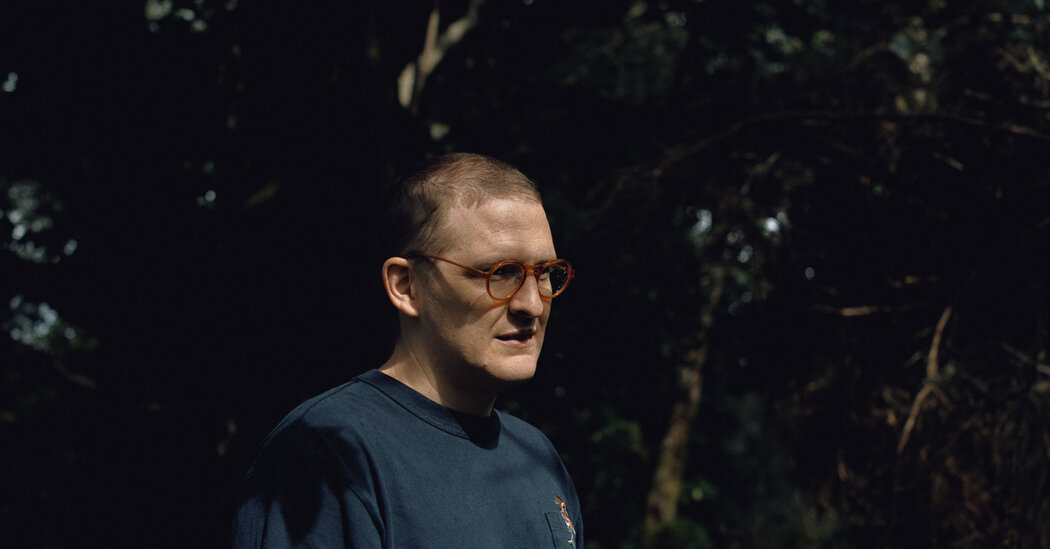
But the harder-edged climaxes of “Mere Mortals” represent new ground for Shepherd. After years of making music characterized by assiduous control, there are moments that feel, for the first time, untamed.
SHEPHERD GREW UP in northwest England. As a boy, he was a chorister at Manchester Cathedral, then studied piano and composition next door at Chetham’s School of Music. On his lunch breaks, he would walk to record shops like Piccadilly Records and Vinyl Exchange to go crate-digging, at a time when music fans were offloading their LPs and embracing CDs. “I cleaned up,” he said.
While at Chetham’s, Shepherd discovered many of his influences, including Messiaen, Debussy, Bill Evans and, of course, Dutilleux. He considered studying composition further, but landed on pharmacology at University College London. “It was a time when I thought jungle was the best thing ever,” he said, referring to the fast dance music style that had become popular in the 1990s. This musical world of Goldie and LTJ Bukem seemed incompatible with studying Bach chorales.
In London, Shepherd started making electronic music and building a collection of vinyl records and musical hardware. He also began partying, and was drawn to Plastic People, a small basement club in Shoreditch with a fabled sound system.
In “Aftershock,” Lauren Martin’s recent oral history of dubstep, the low-end-heavy genre that emerged in Croydon around the millennium, the D.J. Kode9 (whose real name is Steve Goodman) described Plastic People’s heavy yet crystal clear Funktion-One system as both the catalyst and generator of the dubstep sound. “You could get away with producing such minimal tracks,” Goodman said in the book. “Barely a snare and a hi-hat, with loads of sub bass in between. That wouldn’t have worked on any other system.”
At the club, Shepherd played influential dubstep nights like one called FWD>>, though the early dance music he produced leaned toward house and jazz, with influences from boogie and disco swirled in. Plastic People was formative for him. His belief that rooms shape the music you make, his interest in acoustics and his passion for building beautiful-sounding experiences outside a D.J. set — all that stem from there.

