



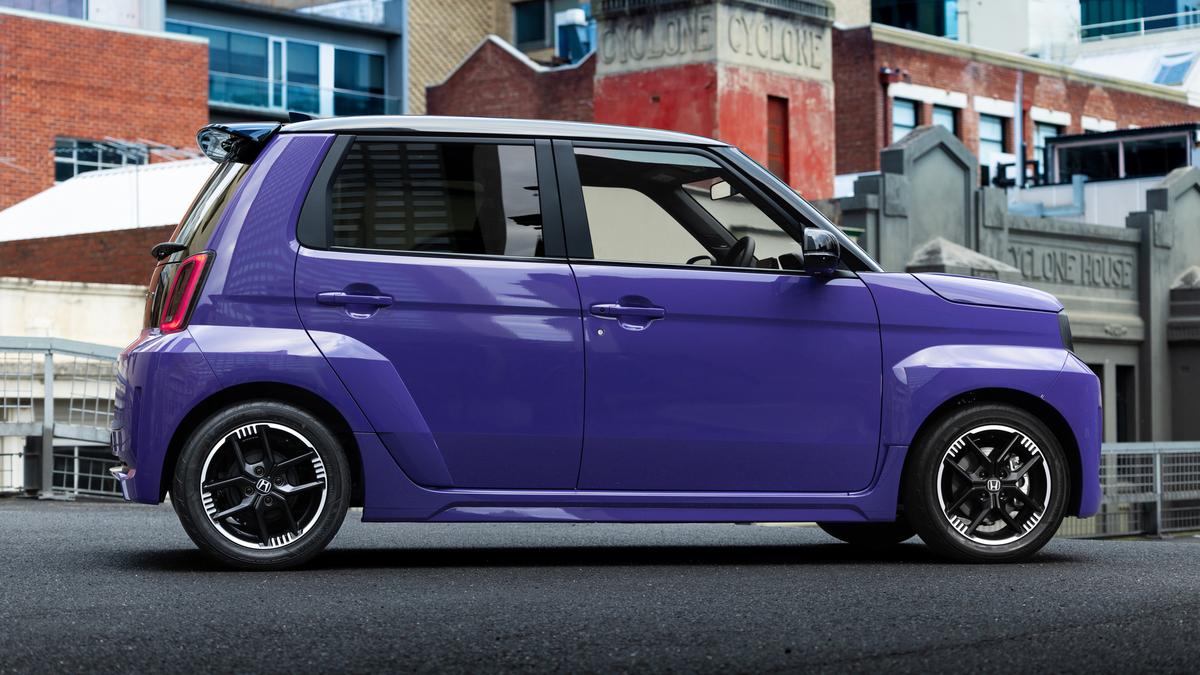
Freo fans took over Melbourne ahead of last Saturday’s AFL grand final —and Honda’s Super-One electric car was out in, err, purple, buzzing around city streets to show the motoring media pack exactly what this cheeky little runabout can do.
Hells Bells! It was looking like a dead cert for the Dockers on the day — but they triggered Wharfie Time too soon, with the Brisbane Lions scoring four goals in the final minutes to win by seven points.
Heartbreaking.
And yeah, looks like Kylie pocketed $3 million for her 20-minute pre-game gig.
The Super-One is Honda’s first EV in Australia and looks best in purple — which Honda calls Boost Violet Pearl — though you can get Crystal Black and Luminous Grey, as well, plus two-tone Boost Violet Pearl with Crystal Black roof — if you’re prepared to wait.
By all accounts, it sold out as soon as order books opened in August, with the initial allocation of 130 cars snapped up within hours. First deliveries were due to start on October 1.
More are on the way as Honda Australia targets 500 sales over the next 12 months, acknowledging it is a niche market, with the Super-One’s quirky design based on Japan’s kei car concept — though it’s not a kei car.
What’s a kei car?
Kei is short for short for kei-jidosha, a class of ultra-compact cars unique to the Japanese domestic market, with strict conditions on body size and engine outputs. They must be less than 3396mm long (the Super-One is 3582mm), 1475mm wide (the Super-One is 1573mm) and 2000mm tall (the Super-One is 1616mm). Engines can’t exceed 0.66 litres (petrol and hybrid), with a maximum power output of 47kW.
They account for half the country’s sales thanks to tax benefits, cheaper insurance, and parking exemptions in many rural areas.
Honda’s N-Box has been the top-selling kei car in Japan for several years.
Drive-away pricing
Forget about specs. There are two Super-One grades based on colour combo.
+ Mono — Crystal Black, Luminous Grey or Boost Violet Pearl: $36,900
+ Two-tone: Boost Violet Pearl with Crystal Black roof: $37,400
What’s it like?
It’s a five-door hatch with four seats and weighs in at just 1093kg — which makes it about 310kg lighter than similarly sized cars.
Of course, little cars have big ideas, so this one features Honda’s signature “magic seats” at the rear that fold flat and flip up to maximise storage with 18 configurations — and more cargo capacity than an SUV with seven passengers: 967 litres with the second row down, loaded to the roof (otherwise it’s 162L).

Front sports seats look good in two-tone fabric and leather, but I find the cushion bolsters make them feel a bit narrow through the hips and thighs.
Exterior styling draws inspiration from the 1980s Honda City Turbo II, with sustainability in mind. Notably, Honda has collected, smashed and recycled bumpers from its discarded cars to use in the front end.
There are also various recycled materials inside, a leather-wrapped steering wheel with blue stitching, buttons for temperature and air flow, a lovely eight-speaker Bose sound system, a 9.0-inch touchscreen that’s easy to navigate, plus a 7.0-inch instrument cluster, both wired and wireless Apple CarPlay and wireless Android Auto, Google Built-in.
It also has a three-year subscription to Honda Connect Gen 2 that has digital key functionality via a smartphone, automatic collision detection and lets you check things like battery status, schedule charging or set a geofence alert.
The drive
It starts from the back rooftop carpark — renamed Izakaya Honda for the day — in Federation Square.
We do 26km in just over an hour split between two drivers, most of it at snail’s pace in peak-hour CBD streets, driving straight through Chinatown and alleys cluttered with bins, past Orica House (formerly the ICI building), and along the outskirts of Melbourne’s historic brothel district “Little Lon” because this is pitched as a city car, after all. I also manage to get in a 100km/h run coming back into town.

Luckily, there are no hook turns, a Melbourne idiosyncracy that takes a right from the left lane to stop cars from blocking trams that travel down the middle of the road.
The Super-One has a single motor producing 47kW and 162Nm as standard to drive the front wheels using a (nominal) 29.6kWh lithium-ion battery.
Range is 202km WLTP.
There are five drive modes — Eco, Normal, Sport, City and Boost — which is a lot for a little car. Flick it into Sport, and it growls obnoxiously, which is all sound effects through the speakers, so no one thinks you’re a hoon.
The Boost button is on the steering wheel and increases peak output to 70kW, with a rev counter and fake gear shifts as the instrument cluster turns from blue to purple.
Oh, there’s a G-force meter, as well.
Really, Boost is the only way to travel on highways, and makes you appreciate how agile and responsive the car is.
City mode is fine crawling through traffic, and lets you engage one-pedal driving, making it possible to largely stay off the brake.

Specs list only the turning radius: 5.2m. This is not the same as the turning circle, which works out at 10.4m — and that’s more than I would expect from a little nipper.
Claimed energy consumption is 12.1kWh/100km, but various people have taken out the ones on test here and we come back with 145km range on an 85 per cent charge and energy consumption averaging 18.2kWh/100km — which is high for something this size on 15-inch wheels when a Tesla Model 3 RWD on 18-inch wheels uses 12-14kWh/100km in mixed driving.
What this means for real-world driving, I’m not sure, given it’s generally not encouraged to charge a lithium-ion battery to 100 per cent all the time. I guess if you’re prepared to keep it topped up to, say, 80 per cent, it will do the job as a city car.
Plugging into a standard 10-amp socket overnight should be enough, otherwise the onboard charger — technically an AC to DC power converter — has a maximum charging capacity of 10kW. Typically, you’d be looking at around four hours to charge from 15 per cent to 100 per cent using a 6.6kW single-phase wallbox, or about three hours with a 10kW three-phase set-up.
Otherwise, Honda estimates a 50kW DC charger will take about 30 minutes to get from 15 to 80 per cent.
Is it safe?
The Super-One has not been crash tested by ANCAP or Euro NCAP.
It comes with six airbags, front and rear parking sensors, a reversing camera and Honda Sensing active safety that includes, among other things, forward-collision warning, traffic-jam assist, adaptive cruise control, post-collision braking, lane-departure warning and a lane-keep assist system (activated by pressing a button on the steering wheel).
Warranty and servicing
The Super-One has a five-year, unlimited-kilometre warranty; five years of premium roadside assistance; and five years of capped-price servicing costing $199 each time. The warranty and roadside assist can be extended by three years if the car has been serviced by Honda. Servicing is every 12 months/15,000km, and the high-voltage battery comes with an eight-year/160,000km warranty.

