



Season 3, Episode 6: ‘Faceless Men’
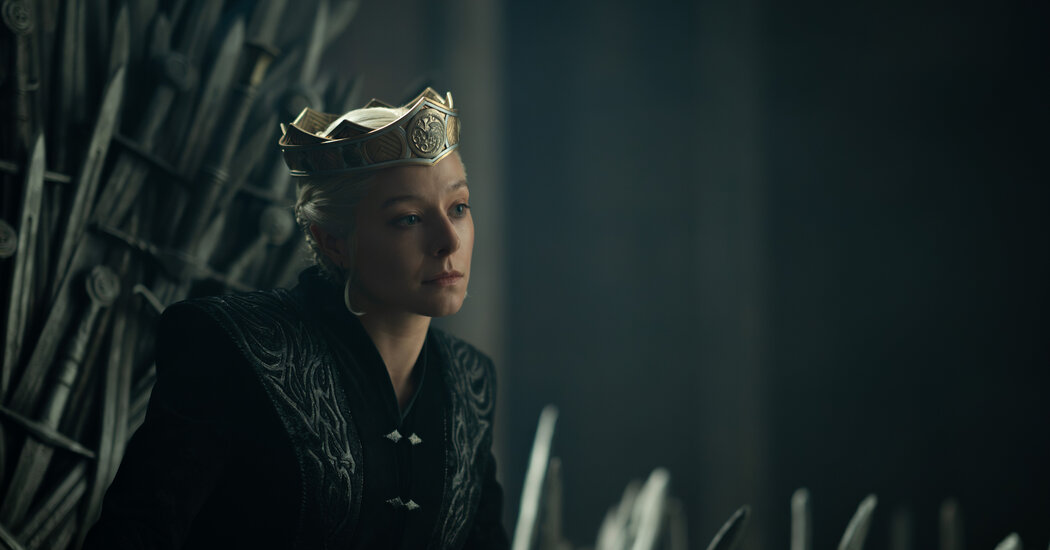
Rhaenyra Targaryen has the better claim to the Iron Throne of Westeros than her rival half brother Aegon. She is the better human being, not that this is a high bar to clear. But is she any better at the job?
This is the trick “House of the Dragon” has pulled, on both the realm and the audience. Everyone’s focus, including Rhaenyra’s own, has been on the fact that she is a good person (relatively speaking) with a good claim. Neither, however, guarantees she will be a good queen. As it turns out, she’s kind of terrible at it.
After her decision to leave the gold cloaks unpaid, they begin resigning their posts en masse to find work elsewhere. Meanwhile, the funds she redirected from the City Watch to the small folk have run dry. Now her people are both starving and defenseless against banditry in the city streets. (Some become enemy agents out of sheer refusal to bend the knee to this woman, or possibly any woman.) Rhaenyra storms out in the middle of hearing their petitions, giving the impression that she simply doesn’t care. She even cuts her hand on the Iron Throne, as if the symbols of power themselves are rejecting her.
Rhaenyra’s small council continue to bicker among themselves, most recently over Daemon’s demand that they burn the loyal city of Tumbleton in order to punish its occupant Lord Ormund for the killings he is funding inside King’s Landing. Rhaenyra overrules Daemon and puts him in charge of the City Watch, which disintegrates immediately — a direct hit on the Rogue Prince’s public image.
When Rhaenyra’s entreaties to the powerful House Baratheon lead nowhere, she takes their ambassadors’ clothing, dresses assassins in it, and sends them to take out Ormund under false pretenses. The assassination fails when Ser Gwayne, still exhausted from his ordeal in the Riverlands, realizes what’s happening and leaps into action.
Ormund retaliates by sending a squad of his own to take out Lord Corlys Velaryon. Corlys had been getting his hands dirty, stringing up the corpses of enemy pirates to hang from the trees in the episode’s eeriest visual. It’s easy to imagine him dying under those same trees. But until we see a body, I’m considering the Sea Snake captured rather than killed.
Rhaenyra saves her worst decision-making for her oldest frenemy. She orders Alicent and Helaena confined to their quarters after their latest botched escape attempt, even though she knows Helaena is mentally fragile. Helaena is also pregnant with a potential rival for the crown, and Rhaenyra, who finds out from Alicent, can’t risk anyone else learning. A sensitive soul, the captive Helaena begins hurting herself with a knitting needle.
Then comes a choice that crosses the line from illogical to insane. (Or, arguably, clumsy writing.) Alicent approaches Rhaenyra with intel gleaned from Helaena’s psychic dreams: Aemond, the realm’s most wanted man, is at the ruined castle Harrenhal, separated from his dragon. This leaves him vulnerable to the right blade in the right hand, and Rhaenyra chooses … his mother, Alicent, to wield it. The threat to Helaena, her daughter and her unborn baby if Alicent betrays Rhaenyra is implicit but unmistakable.
Yet so much can go wrong here. Vhagar could return. The valuable queen dowager could fall into enemy hands. Alicent could also simply refuse not to murder her own son, and then what? Frankly, it’s hard to imagine Rhaenyra making good on her implied threat, even in her diminished mental condition.
Her primary rival at the moment is Prince Daeron, the boy Ormund would make king … although no one has come flocking to his banner yet. The moment he is left alone with his uncle Gwayne, Daeron lets him know he finds his sexist, snobbish, treacherous mentor Lord Hightower repulsive.
“You know what he is!” Daeron says, angry with Gwayne for riding away with Criston and leaving him with a man they both know is a monster in disguise. If Gwayne leaves again, and if Daeron refuses to be Ormund’s puppet king, there will be no one to protect him. All the prince can do is pine for the mother he never truly knew.
Daeron’s brother Aemond One-Eye has been nursed back to health by the witch Alys Rivers. Alys believes his dragon, Vhagar, flew away to help keep him hidden while he recuperated, and she convinces Aemond not to leave. Fresh from killing a stableboy who recognizes Aemond, Alys presents him with a clutch of five dragon eggs that have been hidden in Harrenhal for a century.
She also offers him herself. “I will be the Lady of the Water,” she says (the capitalization is audible), “and you will be the dragon lord by my side.” Their touch warms the dragon eggs as they kiss with surprising carefulness.
They are not the only people in Westeros to make a perhaps ill-advised love connection in this episode. Weary from her continuing hunt for Vhagar, the dragon rider Baela Targaryen bonds with her uncle Alyn of Hull over their distant, violent fathers. Then she gets up and kisses him, with more brazen heat than Alys and Aemond do. It’s hard to see whatever is happening here sitting well with Alyn’s dragon-riding kid brother, Addam, who all but proposed to elope with Baela last time we saw them together.
When Ser Hugh Hammer sneaks into Tumbleton and finds his wife, Kat, his romantic overtures are rejected outright. Kat is furious rather than elated to see her husband. While he was off riding dragons and hanging out with queens, she was living alone, terrified and victimized. She didn’t ask Hugh to build some great life for them by becoming high and mighty. She just wanted the man she loved and depended on, and he chose not to be there. As far as Kat is concerned, there is nothing more for them to discuss.
Elsewhere, Hugh’s complaining counterpart, Ser Ulf White, is caught outside the palace grounds by Daemon, who beats and humiliates him in the street in front of dozens of onlookers. When I talk about Rhaenyra’s bad decisions, I in no way mean to imply Daemon is making better ones. Does anyone remember this man he’s slapping around controls a dragon?
But you don’t need to be a dragon rider to die for the House of the Dragon. Criston Cole’s long march through the Riverlands finally comes to an end, when his men are ambushed by soldiers playing dead under real corpses. It’s a shocking gambit, a viscerally filmed battle … and a mere distraction. While Ser Criston and his men defeat the decoy dead, they are completely encircled by the Rivermen and Northmen under Rhaenyra’s black banner.
Criston knows right away he is facing certain death, which has been his goal for a while. But he is denied his blaze of glory, his valiant last stand. Just after he wraps Alicent’s kerchief around his sword hilt and challenges the enemy leaders to a duel, he gets shot full of arrows Prince Jace-style and drops dead. His men are slaughtered in an offscreen battle known in George R.R. Martin’s source novel as the Butcher’s Ball.
The end of Ser Criston, the man they call Kingmaker for his hand in putting Aegon II on the throne, feels fitting. Minstrels will compose no heroic ballads for him. If he is remembered at all, it will be as a kingsguard who broke his vows, betrayed the realm and helped cause the deaths of tens of thousands. No songs of glory are sung about any of them. His personal grievances and inadequacies drove the realm to ruin. Why should the architects of such widespread misery be spared the inglorious fate of the lives they helped destroy?

