



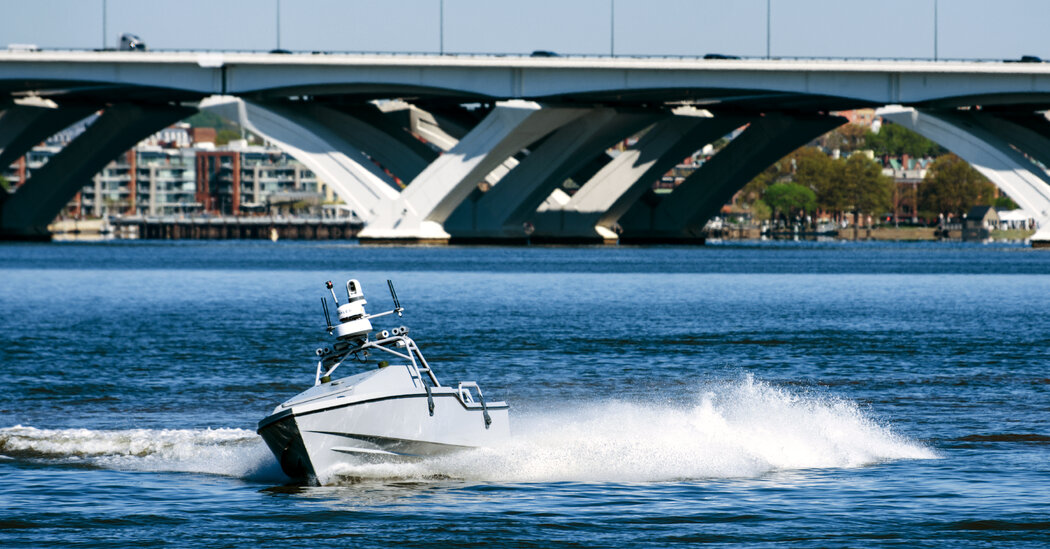
The dramatic sea rescue of two stranded military aviators last month near the Strait of Hormuz was a demonstration of why the Navy sees drone boats as promising new technology.
On June 8, the Navy rushed in an unmanned vessel called a Corsair to pick up the pilots, whose helicopter had been downed by a drone explosion nearby, zipping them to safety without risking other lives.
“Autonomous systems changed the lives of several pilots and their families forever,” Rebecca Gassler, the Navy portfolio acquisition executive running robotics and autonomous systems, said at an industry event the next day.
Back in the United States, though, a clash was erupting over which companies would get access to the huge sums the Pentagon is throwing at emerging technologies.
As warfare is being transformed by rapid advances in drones, artificial intelligence and other fields, the Defense Department is trying to adapt by developing the equipment that it needs faster and more efficiently. It is a push that many defense contractors and the military believe is long overdue.
But the shift has ignited a furious competition within a new generation of military contractors. The contest to build advanced drone boats for the Navy is a vivid example of how those firms are scrambling for advantage, spawning accusations of contracting violations and political favoritism along the way.
At stake are chunks of the $2.1 billion that Congress set aside last year to fund a new fleet of medium-size autonomous Navy vessels.
Over the past year, the Navy asked vendors for proposals, announced the winners, then scrapped the process and started anew.
On May 29, the Navy announced a winnowed list of seven vendors under consideration to build the larger cousin to the Corsair.
Some of those selected, including Saronic Technologies, the maker of the Corsair, had ties to President Trump, his family or his administration. Others, including some whose connections to the Trump world were weaker, fell off.
However, Anduril, one of the best-connected firms in Trump-era Washington, also failed to make the cut.
In the aftermath, some jilted bidders complained about the process. Some told contacts at the Pentagon or in Congress they believed the Navy gave Saronic preferential treatment.
Two companies even sued the government in late June over the selections, according to court filings whose details are not yet publicly available.
Anduril has not taken its complaints to court. But executives there take issue with the Navy’s assessment process, which it believes stymied competition.
“I would think the Navy would want to increase its options, not limit them,” Christian Brose, Anduril’s president, said in a statement.
A Saronic spokeswoman pointed to the company’s focus on innovation and support of the Navy’s mission as reasons for its success. And the Defense Department has rejected suggestions that it favored politically connected companies in the competitions.
But questions about influence peddling have been swirling around Pentagon procurement competitions of late — especially as the Trump family and others with connections to the administration have taken stakes in investment firms that see huge opportunities in outfitting the military with weaponry.
One case in point: a $620 million loan to a small North Carolina defense company that counts 1789 Capital, where the president’s son Donald Trump Jr. is a partner, as an investor. The loan was made last year after a White House official intervened with the Pentagon, ProPublica reported.
“While politics has always been a factor in defense procurement, what we are seeing in the way companies are navigating the second Trump administration is very different from what we have seen in the past,” said Hunter Stires, who was the Navy secretary’s maritime strategist until last year.
In an interview at the Pentagon, Jason Potter, the Navy’s senior acquisition executive at the time of the solicitations, said the choices had been driven strictly by merit.
Powerful Investors
Navy officials had been trying to develop an unmanned vessel program for years. But the program had been riddled with delays and budget overruns.
As the Navy attempted to simplify its purchasing processes and embrace the new sea drones — which had been used successfully by Ukrainian fighters and were being adopted by other U.S. allies — Saronic was positioning itself to help fill the product gap.
The company, based in Austin, Texas, offered a cutting-edge craft with its Corsair and an ability to ramp up production quickly. But it also knew that influence in Washington was critical to breaking through.
“Not only did we have to build the best technology,” Dino Mavrookas, Saronic’s chief executive, said in a podcast interview last year. He added: “But we also had to build a government lobbying company.”
By the time Mr. Trump returned to Washington, Saronic had established close links to both the Navy and the White House.
The venture-capital firm Andreessen Horowitz, by then a major investor, had given millions to MAGA Inc., Mr. Trump’s super PAC. Its co-founder, Marc Andreessen, had also advised Mr. Trump during his transition. (On June 29, Defense Secretary Pete Hegseth named him to a defense policy board that advises the Pentagon on strategic planning and national security.)
Got a confidential news tip? The New York Times would like to hear from readers who want to share messages and materials with our journalists.
Charles Johnson, one of the largest shareholders in Franklin Resources, had along with his wife given $700,000 to Mr. Trump’s 2020 campaign. Both Franklin, the public money management company, and its venture arm have invested in Saronic, according to records tracked by the data firm PitchBook. The owners of Point72 Ventures and Trousdale Ventures, also shareholders in Saronic, had donated $1 million apiece to Mr. Trump’s inaugural committees.
Steve Cohen, the owner of Point72’s parent company, wrote in an email: “I don’t interact with the administration as a matter of policy.”
Phillip Sarofim, chief executive of Trousdale Ventures, wrote: “I do not view political support as a way to help portfolio companies win government business, and I would not want any company we back to win business that way.”
At least one Saronic investor was also formulating a business with the president’s son-in-law, Jared Kushner: the venture capitalist Elad Gil, who helped build an A.I. start-up that later became known as Brain Co.
Last April, during the annual Sea-Air-Space gathering — a trade fair for shipbuilders and other manufacturers held near Washington — Mr. Mavrookas met privately with John Phelan, a friend of Mr. Trump’s who had become the Navy secretary, according to three people with knowledge of the meeting who requested anonymity to discuss private conversations.
At the event, Saronic gave Mr. Phelan a water demonstration of the Corsair, for which Saronic was seeking a Navy contract, the people said.
Chatting with vendors at Sea-Air-Space is standard for the Navy secretary, according to current and former military officials. But the secretary’s busy schedule means that he or she can typically only accommodate a few meetings. So Mr. Phelan’s time with Saronic meant that the company had extra access to a key Navy decision maker that others did not.
Ultimately, Saronic won a $392 million contract from the Navy for the Corsair.
A Flawed First Round
During the same period late last year, Saronic and two dozen other companies were preparing to share their plans with the Navy for the medium-size sea drones.
The Navy imagined three different types. The most complex had to travel at least 29 miles per hour while navigating moderate ocean waves and carrying about 28 tons of cargo.
If a vendor’s plans were approved, it would host the Navy for a shipyard inspection. If all went well, the vendor would advance to a sea trial.
The Navy was reorganizing itself at the same time. The old system, which Mr. Hegseth had disdained as a sprawling, inefficient bureaucracy, was replaced by new units organized by product and led by a “portfolio acquisition executive,” a new job.
Ms. Gassler, a longtime acquisitions manager, was put in charge of the unit that included the unmanned vessel programs.
Late last year, the Navy notified half a dozen companies that they were eligible to advance to a sea trial. Among them were Anduril; Blue Water Autonomy, a Boston start-up; HII, a large shipbuilder based in Newport News, Va., with a long history of Pentagon contracts; and Saronic.
Anduril was greenlit to move forward on a smallish craft, executives recalled.
But it still got disappointing news. Its bid on the largest craft had been selected but not funded by the Navy, they said. That typically means a company can win the contract only if more budget money becomes available — a scenario Anduril was reluctant to accept.
So executives made a counterproposal: Anduril would pay for its own test boat if the Navy would let it into the sea trial.
Anduril was a known player in Washington. Its investors included 1789 and Andreessen Horowitz. But executives said they never received a response from the Navy.
Then, on March 26, seemingly out of the blue, the unmanned-vessel program was abruptly canceled — and replaced.
Under the new approach, the Navy would require the contractors to pay for their own test craft. The Pentagon could then purchase or lease the vessels it liked.
“That stair-step approach was going to take us a lot of time,” said Rear Adm. Derek Trinque, who helped set the parameters of the new solicitation.
It is not clear how much sway, if any, Anduril’s proposal had, but it was the precise change Anduril had sought.
Regardless, the restart was bad news for some bidders.
For a company like Blue Water, which had already spent $10 million or more constructing a test vessel, it risked that money going to waste. Contestants would also have to adapt their designs to meet new parameters.
And there was no guarantee they would be chosen again.
Winners and losers
Late in May, the Navy announced a new shortlist of companies who could compete in its second planned sea trial.
Saronic and HII survived. Blue Water and Anduril did not.
After receiving detailed feedback from the Navy as to why they had been passed over, some of the companies believed that the Pentagon had made decisions based on presumptions instead of asking them for the relevant facts.
The government is “encouraging industry-driven solutions, private capital investment, and rapid capability delivery — but the Navy’s execution” of the program rejects those things, wrote Austin Gray, Blue Water’s co-founder, in a June 29 email to legislators.
Blue Water and Saildrone, an Alameda., Calif., shipbuilder that had also been barred from the upcoming sea trials, filed suit that same week.
The Navy stands by its decisions.
“In most cases, proposals that did not advance to the at-sea testing phase had multiple deficiencies,” a service spokesman said.
In addition to Saronic, at least two other firms with connections to the president, or his prominent allies, also fared well.
One was Havoc AI, a Providence, R.I., artificial intelligence company that partnered with the Hawaii-based shipbuilder PacMar Technologies.
Havoc counted Trousdale Ventures, the venture capital firm run by a Trump inauguration donor, as an investor. Devin Nunes, a former Republican congressman who had led Mr. Trump’s media company and now heads the president’s intelligence advisory board, is a Havoc director.
Paul Lwin, Havoc’s chief executive, said his company had “amazing investors” who helped by networking on Havoc’s behalf and alerting it to upcoming contract opportunities.
Mr. Nunes, Mr. Lwin said, is there “to provide us advice and direction using his knowledge.” Mr. Nunes had not intervened with the White House or the Navy on Havoc’s behalf, “and we would never ask,” Mr. Lwin said.
Another vendor who made the cut, the Gulf shipbuilder Galliano Marine Service, is run by Gary Chouest, who, along with his wife, has given at least $925,000 to President Trump or groups supporting him since 2017, according to campaign filings.
Galliano officials did not respond to requests for comment.
To some of the bidders, though, no company sat in quite the same sweet spot as Saronic.
They pointed to a tell in the online paperwork the Navy had sent out for the second round of a bidding. Buried in the document’s fine print was the title “Saronic Corsair Production.”
It could have been an honest mistake, and the Navy fixed it quickly. But in the view of several rival contractors, it suggested that the Pentagon wanted whatever Saronic was offering.
Eric Schmitt Andrea Fuller and Karen Yourish contributed reporting.

