



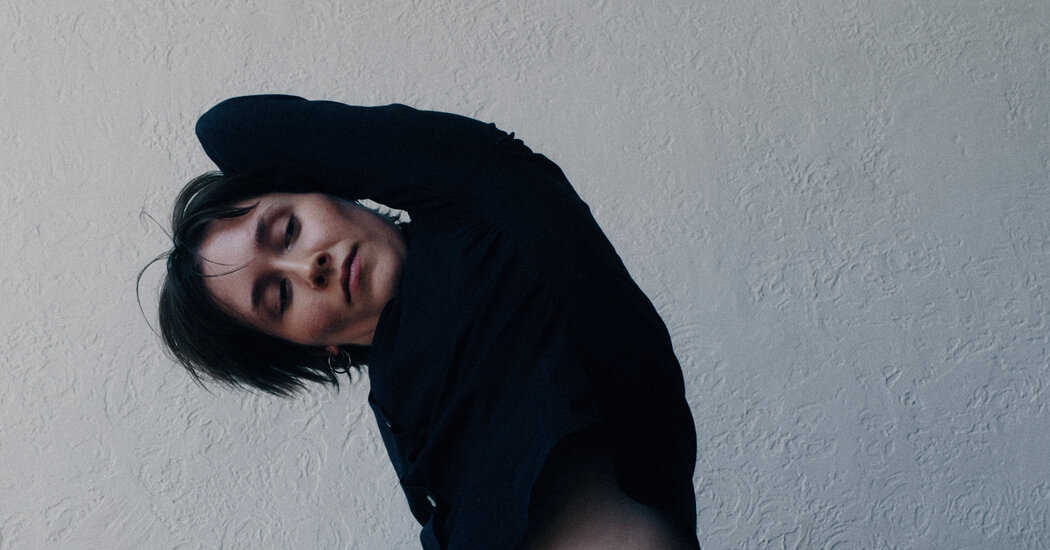
As the dancers collapsed to the floor, their bodies landed hard and sharp, like hail lashing against glass. Jade Manns, the choreographer of “Falling,” was delighted.
“Cool,” she said. “It sounds like it’s raining rocks.”
Throughout “Falling,” a trio, dance scenarios shift from one texture of movement to the next in ways that make it seem like time is both lingering and disintegrating. It’s uncanny. There are sharp descents and slow, hard-fought-for extensions and balances. Dancers stare as though they’re able to see landscapes invisible to the naked eye.
Manns is part of a post-Covid generation of dance artists whose works lean into the body as a vessel of sensorial and theatrical force. Pageant, the Chocolate Factory Theater, Kestrels — these are some of the spaces where new dance is thriving.
It’s both an exciting and challenging time for contemporary dance. Traditional spaces to perform are harder to find, yet the talent is there. At 28, Manns is one of several gifted choreographers to emerge from Pageant, an artist-run space in East Williamsburg, Brooklyn, that has become a prime incubator of new work.
A Pageant founder, Manns creates dances that sneak up on you as they evoke, in hushed yet vivid ways, the natural world. There are no lighting tricks, no sets or images to suggest a forest floor. Manns is a choreographer who paints a stage with sensation. Her tool is movement.
Manns grew up in Calgary, Alberta. Camping was part of her childhood. “We would be in the car all summer driving through the mountains,” she said. “And I would be choreographing little dances in my head.”
Until now, her way of creating movement was triggered by images. (For “Kingdom,” in 2024, she used animal pictures from National Geographic.) Recently she started to think something was missing. She wanted to shake her patterns up, to home in on a stringent and strange dance language — physical yet full of suspense.
“I always seem to find my inspiration from nature or from forces or feelings that feel large or mystical,” she said. “I think the work references a kind of existential grandeur.”
“Falling,” which premieres on Thursday at Pageant, is told in three sections in which different movement vocabularies “have their own sort of distorted virtuosity and also an energetic brutality,” she said.
The score, by Derek Baron, helps set the scene with a mix of sounds from nature documentaries, machinery and atmospheric strings. In the first section, led by Noa Rui-Piin Weiss, the dancers pass through slow, contortion-like shapes that explore extremes as their body parts pull apart or press together.
Weiss is joined by Kalliope Piersol and Maxi Hawkeye Canion. “They’re kind of like these grotesque, morphing contortions,” Manns said of the dancers’ gradual, creeping phrases that spill across the stage.
Here, in the opening section, she said, they move in ways that are “continuous and geologically slow shifting.”
Weiss pulls his arms overhead, stretching his torso like taffy while latching the tips of his fingers together like interlocking claws. Suddenly, gravity pulls his elbow down sharply. Here, his body becomes a kind of terrain in which imperceptible geological shifts give way to sudden cracks.
Manns refers to the movement in the second section as “spilling”: The dancers, shifting through abstract animal movements, are driven by internal compulsions.
In this middle movement, there is a way of suspending the body that gives the sensation of floating in space. The dancers try, in other words, to stay in the spill. Piersol, bending and swaying — it’s like her bones are soft, but her flesh is taut — contorts, spilling out into the atmosphere around her.
Her wingspan is breathtaking as the undulations of her spine begin not with her arms but deeper, within the depths of her torso.
For the final section, “falling,” Manns invented a new way of slipping: the drops. “Aren’t they so weird?” she said. “I found the idea in my body first and then wrote a score for the dancers to experiment with. We improvised with the idea for months to find the quality before setting each dancer’s dropping sequences.”
The movement begins with a clarified shape, which then breaks down as dancers drop, one body part after another, until hitting the floor. Here, Canion demonstrates.
When contact is made and there’s nothing left to collapse, the dancers roll to their feet and start over. “The rules are that each drop needs to go straight down,” Manns said. “The other parts of the body can’t react and the drops can’t have any reverb or softening.”
“Falling,” like all of Manns’s works, creates an otherworldly aura, at once prickly and calming.
Manns wants the sense of an interior world that exists on two levels: for the viewer and for the dancers themselves. “I don’t want it to be too internal that it’s like folding in on itself, and I don’t want it to be so external that it’s really performative and presentational,” she said. “I want an exchange between inside and outside.”
Cinematography by Jared Christiansen.

