



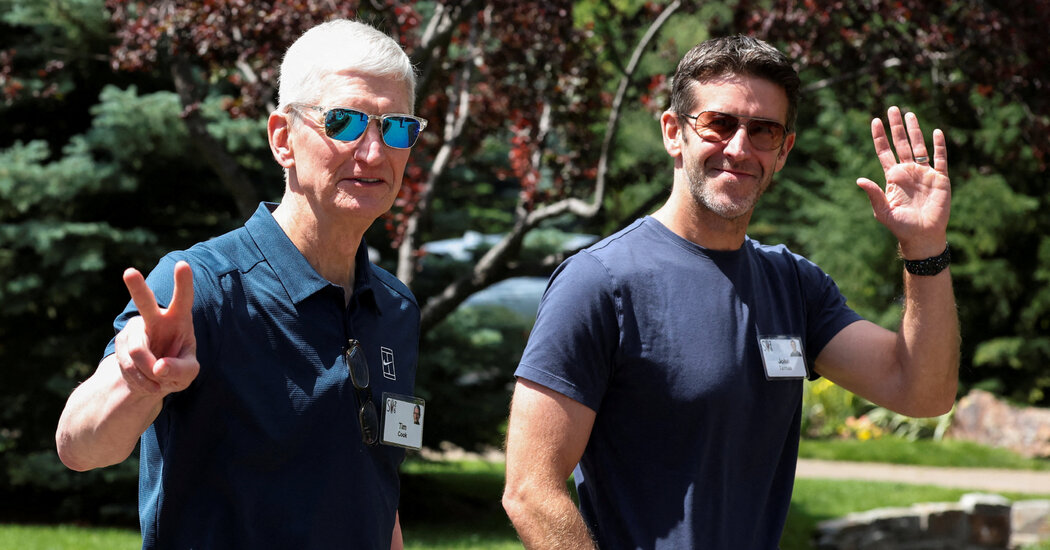
John Ternus became Apple’s chief executive on Tuesday, succeeding Tim Cook, the company’s leader for the last 15 years. The long-anticipated handoff, Mr. Cook has said, will be “perfectly smooth.”
But the changing of the guard could still have some bumps. Mr. Ternus will have to guide Apple through an unusual amount of leadership churn. He will have to stem an exodus of talent to companies like OpenAI. And he will have to distinguish himself from Mr. Cook, who will remain at Apple as its executive chair.
Most of all, Mr. Ternus will have to perform a balancing act: displaying the financial predictability and discipline that have been a hallmark of the Cook era while showing that Apple can still create new products that capture the imagination of consumers.
Mr. Ternus will have to do so while steering Apple through arguably the biggest technology shift in a generation. At its annual hardware event this month, Apple is expected to introduce a foldable iPhone — its most significant change in 19 years to its most important product. The company is also taking another stab at weaving artificial intelligence through its products.
“Apple is going to have to face this idea of ‘What’s next?’” said Michael Gartenberg, a consumer technology analyst who worked as a product marketer at Apple from 2013 to 2016. The task for Mr. Ternus, he added, is to “bring Apple back to being a cool brand even though it’s a multitrillion-dollar company, show that you are able to innovate.”
Apple, which has waffled over how aggressively to embrace A.I., will tackle those questions with a changing management team. Over the past four months, Mr. Ternus, 51, has started to install his own executives, mixing a roster of Apple veterans with newcomers.
“Apple is a company that’s used to having a consistent brain trust,” said Jennifer Chatman, the dean of the Haas School of Business at the University of California, Berkeley, and a director of its Center for Workplace Culture and Innovation. “The challenge there is, are you getting enough new ideas in?”
Apple declined to comment.
This summer, Apple hired Nate Gatten from American Airlines to lead government affairs, replacing Kate Adams, who will retire this year. Laura Legros, a hardware engineering vice president and deputy of Mr. Ternus’s before retiring from Apple in 2022, has rejoined the company, three people familiar with her hiring said, speaking on the condition of anonymity. Ms. Legros, who reports to Mr. Ternus, could act as his adviser and emissary to various parts of the company, the three people said.
More new leaders could soon join Mr. Gatten and Ms. Legros. Nearly half of Mr. Ternus’s executive team is nearing the traditional retirement age, although none of the members have publicly said they are looking to step down. There have been executive departures in addition to Ms. Adams, including Jennifer Bailey, the head of Apple Pay, who will retire this year. She joined the company in 2003.
A number of the management changes go to the heart of Apple’s important hardware organization, which was restructured in April. When Apple named Mr. Ternus as its next chief executive, the company also promoted Johny Srouji, a chips leader, to chief hardware officer. Apple’s hardware engineering team, which Mr. Ternus led and works on devices like the iPhone, has since merged with its hardware technologies teams, which Mr. Srouji led.
Mr. Srouji’s ascent coincided with departures from the hardware organization. Brian Lynch, who led hardware for Apple’s smart home products, joined the smart ring maker Oura in March. Paul Meade, who led hardware for Apple’s augmented and virtual reality products, joined OpenAI in July.
Bloomberg previously reported on aspects of the transition at Apple.
Apple has seen a rash of rank-and-file departures, as well. More than 400 of its former employees work at OpenAI, according to an intellectual property lawsuit that Apple filed against OpenAI in July.
Many of those exits happened in the months after OpenAI acquired IO, a design studio co-founded by Apple’s former longtime design chief, Jony Ive. OpenAI’s hardware division, led by another former Apple executive and IO founder, has hired scores of engineers from Apple, according to the lawsuit. OpenAI moved to dismiss the lawsuit in August.
(The New York Times has sued OpenAI and Microsoft, claiming copyright infringement of news content related to A.I. systems. The two companies have denied those claims.)
Mr. Ternus will also have to define himself as chief executive, even with Mr. Cook as executive chair. Apple has said Mr. Cook, 65, “will assist with certain aspects of the company, including engaging with policymakers around the world.”
Silicon Valley companies have long had chief executives step down and remain as board chairs, though the setup has yielded mixed results, said David Yoffie, a professor at Harvard Business School who has written case studies about Apple.
The test for Mr. Ternus and Mr. Cook, Mr. Yoffie added, will come if they diverge on strategy or their vision for Apple. For example, Mr. Ternus could decide to invest more deeply in A.I.; to restart Apple’s car project, which Mr. Cook killed in 2024; or to end Apple’s work on the Vision Pro, the mixed-reality headset released in 2024.
“The question is, is Tim going to be comfortable with those changes?” Mr. Yoffie said. “Will John feel uncomfortable doing those things because Tim is still there?”
So far, Mr. Cook and Mr. Ternus appear to be on the same page. In July, they attended the Sun Valley Conference in Idaho, a gathering of finance, media and technology leaders. That month, at Apple TV’s season premiere of “Ted Lasso” in Los Angeles, they both wore nearly matching navy suits with yellow pins on the right lapel.
“We really set this bar for the transition to be the best ever,” Mr. Cook said in an interview during the premiere. “We want it to be a textbook example, and that is exactly how it’s going. I feel so great about how it’s going.”

