



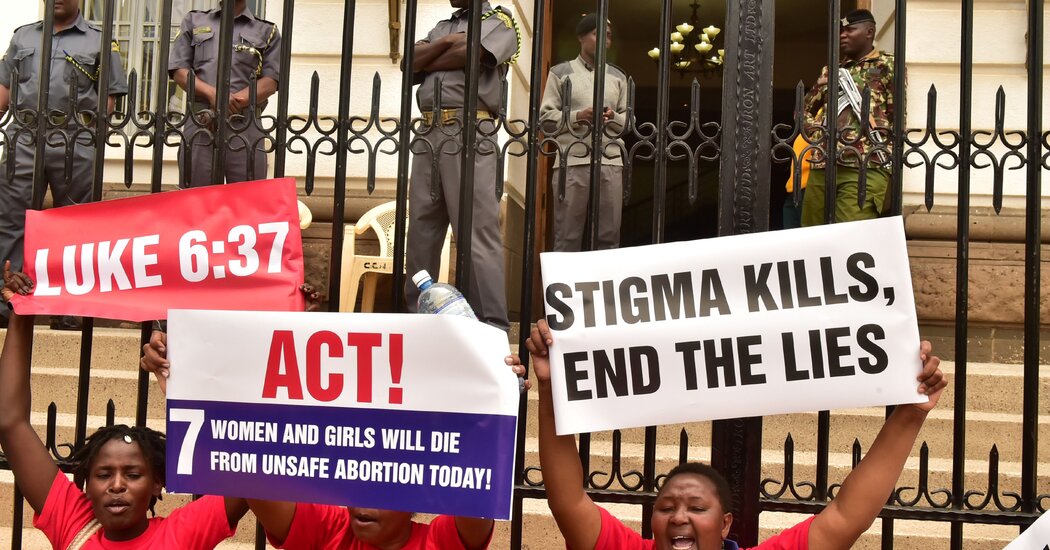
A court of appeal in Kenya on Friday struck down a ruling that had affirmed the right to an abortion, dealing a blow to reproductive rights in a country where thousands of women die each year from unsafe abortions.
The decision, which is likely to be appealed to Kenya’s supreme court, holds that abortions deprive unborn children of the “right to life,” which it said begins at conception. “Abortion is not a fundamental right guaranteed under the Constitution,” the judges wrote in their ruling.
The decision overturned a 2022 ruling, which focused on a teenager who had received emergency medical care after an abortion in 2019. The court ruled then that the arrests of the teenager and her doctor were unconstitutional.
Those criminal proceedings were reinstated by the appeal court’s Friday decision, which said that lower courts had to investigate whether the treatment carried out was indeed a medical emergency.
The Center for Reproductive Rights, a New York-based rights group, called the ruling “deeply disappointing” and a “setback” for reproductive rights in the country, and said it would challenge it in the supreme court.
As part of the overturned 2022 decision, judges instructed Kenya’s Parliament to pass a law protecting access to abortion and clarifying how the country’s 2010 Constitution allows the treatment. The Constitution holds that abortion is prohibited in Kenya, unless a doctor deems it medically necessary or if another statute expands access (for example, allowing abortion in cases like rape).
Judges cited that article of the Constitution in their ruling on Friday in arguing for a narrower interpretation. They wrote that abortion is not an “absolute right,” and that the Constitution is designed to prohibit it except for “limited circumstances when it may be permissible.”
In practice, Kenya’s penal code had not been updated to reflect the 2022 ruling, which sought to make abortions easier to get. A 1963 law continues to criminalize abortion in Kenya, a measure that rights groups say is often used to intimidate women from seeking reproductive care and medical professionals from providing abortions.
“This case forms part of a broader pattern in which individuals seeking or providing reproductive health care face criminal sanction, despite constitutional guarantees of dignity, health, and freedom from cruel, inhuman, and degrading treatment,” the Center for Reproductive Rights said in a statement.
Every year, at least 2,600 women die from unsafe abortions in Kenya, and 21,000 more are hospitalized because of abortion complications, according to the group. A 2023 study by the African Population and Health Research Center found that over 300,000 women in Kenya had to seek care for post-abortion complications.

