



The next major stop in the fight between moderate and progressive Democrats will come in Minnesota, where a competitive Senate primary on Tuesday has been shaped by the Trump administration’s deadly immigration crackdown and a fraud scandal that rocked the Democratic-run state government.
The race between Representative Angie Craig, a moderate who represents a purple suburban district in Congress, and Peggy Flanagan, Minnesota’s progressive lieutenant governor, will offer the latest test of left-wing energy in the Democratic Party as it strives to flip the Senate.
The contest, which has become one of the most expensive Senate primaries in state history, comes a week after Dr. Abdul El-Sayed eked out a victory in Michigan’s Senate primary, giving a lift to progressives.
Like that race, the Minnesota primary reflects the identity crisis that has shaken the party since it lost control of the White House and the Senate in 2024.
After unseating a Republican incumbent in 2018, Ms. Craig, 54, has comfortably held on to her seat by working across the aisle and by wielding significant influence over agriculture policy. That record, she says, makes her the strongest bet to keep the seat of the retiring Senator Tina Smith in Democratic hands.
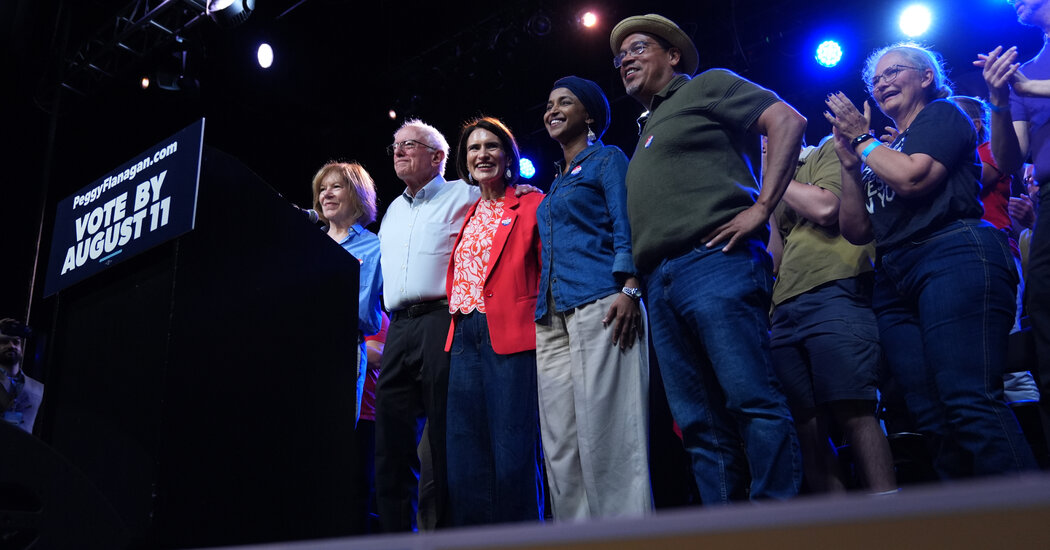
Ms. Flanagan, 46, who is backed by Ms. Smith and by progressive leaders like Senator Bernie Sanders of Vermont, has staked out positions that appeal to the party’s liberal flank, including cutting military aid to Israel and establishing the single-payer health care system known as Medicare for all. She has billed herself as the candidate who favors sweeping change over incrementalism.
“It’s been a very tense race, and this one will sting for people,” said Jeff Hayden, a Democratic strategist in Minnesota who is neutral in the contest. “People probably will take a little while to get their friendships back together after this is over.”
Republicans have not won a statewide race in Minnesota since 2006, having failed to put forward candidates with broad appeal in a closely divided state. The winner of the Democratic primary is expected to face an unusually well-known Republican, Michele Tafoya, a veteran sports broadcaster who has staked out relatively moderate positions on issues like abortion.
Ms. Craig’s supporters have argued that the congresswoman would be a safer choice for Democrats in November. “Electability is probably the No. 1 factor,” said Joe Radinovich, a Democratic strategist in Minnesota who is not involved in the race but views Ms. Craig as the better general-election candidate.
But progressives, emboldened by Dr. El-Sayed’s victory in Michigan, see an opportunity to expand their reach in the Midwest. They say the Democratic establishment underestimates voters’ frustration with the political system and their desire for far-reaching change. Representative Ilhan Omar, a Minnesota progressive who is supporting Ms. Flanagan, said she saw little difference between Dr. El-Sayed’s winning populist message and Ms. Flanagan’s.
“We need to bring hope back into politics,” Ms. Omar said. “There’s been too many people in Washington that got lost in the politics of Washington and forget the hope that they carry — the hopes and dreams of the people that send them there.”
Immigration enforcement has been a dominant issue in the Democratic primary after the Trump administration’s wintertime crackdown in Minnesota, which led to mass roundups of migrants, violent protests and the deaths of two American citizens shot by federal agents.
Ms. Craig faced criticism for having been the only Minnesota Democrat to vote in favor of the Laken Riley Act, the first piece of legislation that Mr. Trump signed into law last year. The bill gave Immigration and Customs Enforcement broader authority to detain immigrants charged with certain crimes.
At the height of the crackdown in Minnesota, Ms. Craig initially defended her vote while lamenting the deportation push it helped fuel. But in March, she backtracked, saying she regretted the vote.
While neither candidate has endorsed the movement calling to abolish ICE outright, both say they would push for a major overhaul of the immigration agency.
“Whatever word you want to use, it can’t exist like this anymore,” Ms. Flanagan said in an interview. “We have to rip ICE apart and start over.”
Ms. Craig called the conduct of immigration agents in Minnesota “truly horrific,” and said she wanted to bar agents from wearing masks and force them to use body cameras. “What my community is asking is for immigration authorities just to use proper law enforcement techniques,” she said in an interview.
While Ms. Craig has been on the defensive over her immigration record, Ms. Flanagan has faced scrutiny for a scandal involving fraud in state-run safety-net programs.
Minnesotans across the political spectrum have faulted Gov. Tim Walz for failing to build stronger safeguards in recent years as fraudsters stole hundreds of millions of dollars from programs designed to feed low-income children, treat minors with autism and help people at risk of homelessness.
“State fraud is the No. 1 issue as Minnesota voters go to the polls in November,” Ms. Craig said. “Fairly or not, the lieutenant governor has a unique vulnerability as our statewide Senate candidate because she’s been helping run the state for the last eight years.”
Asked if she took responsibility, Ms. Flanagan said the governor had been leading the response and had taken decisive action over the past year. “He said the buck stops with him and he’s done that work,” she said, while acknowledging that Minnesotans “have the right to be angry about fraud.”
U.S. military aid to Israel is a major point of divergence between the candidates.
Ms. Flanagan has assailed Ms. Craig for voting against a measure last month that sought to eliminate all of the $3.3 billion in military and humanitarian aid that Washington provides to Israel annually. Nearly half of House Democrats backed the measure.
“American taxpayer dollars should not be used to fuel the horrific violence and suffering that’s being experienced there,” said Ms. Flanagan, who has said she believes the actions of the Israeli government in Gaza meet the legal definition of a genocide.
Ms. Craig has called the debate over that term unhelpful. But she said a wholesale reset in the U.S. relationship with Israel was overdue.
“I think the best thing that could happen for U.S.-Israel relations is for Benjamin Netanyahu to lose his next election,” she said, adding that such a turning point would make it easier to re-evaluate security assistance going forward.
The American Israel Public Affairs Committee, the country’s leading pro-Israel group, has provided significant support in Ms. Craig’s past races. In a sign of how wary Democrats have become of being seen as linked to the group, Ms. Craig said she had asked AIPAC not to fund her Senate campaign directly. AIPAC, though, has helped her Senate bid indirectly by hosting fund-raisers.
Disputes over AIPAC are part of a broader debate in the race about the role that outside groups are playing. Ms. Flanagan calls her campaign “the many versus the money,” chiding Ms. Craig for accepting money from corporate and industry groups that do not need to disclose their funders.
Ms. Craig, who has raised significantly more money than Ms. Flanagan, said the lieutenant governor’s slogan rang hollow because she had also benefited from so-called dark money raised by the Democratic Lieutenant Governors Association PAC.
While both favor tighter campaign finance regulations, Ms. Craig said that it would be foolish to reject support from outside groups while Republicans took advantage of permissive rules.
“If we want to stop Donald Trump, we have to win elections, and we can’t win elections by tying one hand behind our back,” Ms. Craig said.
As the midterm elections loom, many Democrats are debating whether Senator Chuck Schumer, the Democratic minority leader, should pass the baton. Ms. Craig stopped short of saying she would push for his ouster, but she said Senate Democrats had failed to rein in a president many see as authoritarian and impulsive.
“Frankly, I’m tired of a bigger focus on decorum than on democracy in the United States Senate,” Ms. Craig said.
Ms. Flanagan was unequivocal, saying Democrats needed a new Senate leader.
“People want big, bold change,” she said. “They are sick of nibbling around the edges.”

