



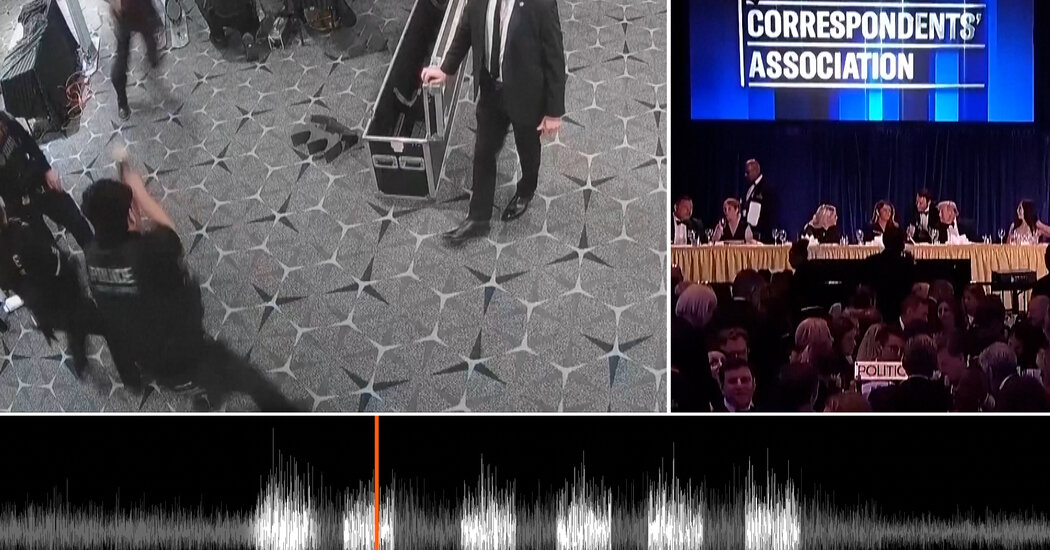
New video footage released Thursday night by the F.B.I. of the apparent assassination attempt on President Trump at the April 25 White House Correspondents’ Association dinner helps clarify how the episode unfolded by more clearly showing the gunman’s actions and the responses of Secret Service officers.
A frame-by-frame assessment of the footage — combined with new analysis of audio of the gun blasts captured in another video of the event — suggests that the assailant fired his weapon at a Secret Service officer as he ran into a secured area a split second before the officer returned fire.
Cole Tomas Allen, 31, of Torrance, Calif., is facing charges that include attempted assassination.
Since the April 25 episode in Washington, D.C., questions and confusion have swirled around what exactly happened: Did the gunman fire a shotgun, as officials stated in an affidavit? Did he shoot toward a staircase after running past the officer, as court papers subsequently claimed? Did he even fire his weapon at all?
Initial hotel security footage shared by President Trump on Truth Social was too grainy and fragmentary to reveal much.
But the higher-quality version of the footage from inside the Washington Hilton hotel that the F.B.I. released helps firm up the sequencing. The New York Times also was able to synchronize that footage, which did not have audio, with audio captured by another camera from inside the dining room. Together, the analysis indicates that the gunman fired first at a Secret Service officer.
The footage of the attack starts by showing the gunman sprinting through a security checkpoint armed with a shotgun that he aims at a Secret Service officer. The officer is seen firing four shots at the assailant as he runs through the area. The officer appears to fire a fifth shot as they step out of view of the camera.
Public defenders for Mr. Allen have argued in a court filing that the original, lower-resolution video appears to not show a muzzle flash from Mr. Allen’s shotgun — the implication being that he didn’t fire his weapon.
The new footage does not clearly show a muzzle flash from Mr. Allen’s gun either. This could be because security cameras record fewer frames per second than, say, a cellphone. This can create small gaps in the footage.
But other details — including dust in the ceiling lights, the officers’ reactions and an audio analysis — are more conclusive that the gunman fired at the Secret Service officer, which comports with what Trump administration officials have said.
In the moments before the gunman passes through the security checkpoint, nothing peculiar is evident around the ceiling lights. The agents standing around are at ease.
In the video frame after the gunman aims his weapon at an officer, the dust in the ceiling lights gets disturbed and begins to fall, most likely a result of the concussive force of a shotgun blast in an enclosed space. A black cloth draped over a table beside Mr. Allen to the left of screen begins to flap. And officers standing by begin to flinch.
By now, the Secret Service officer has not yet fired.
As the gunman appears to fire, the Secret Service officer’s head dips and his torso recedes and twists. Jeanine Pirro, the U.S. attorney for the District of Columbia, asserted in a social media post Thursday night that the assailant shot the officer in his protective vest. But so far, officials have not charged Mr. Allen with shooting a federal officer, only with firing a weapon.
In the next moments, the officer fires at the gunman for the first time and a muzzle blast emerges from their handgun. Dust continues to disperse below the ceiling lights.
The officer continues to fire at the gunman as other officers now begin to respond and draw their weapons. None of the shots hit him. Officials say he was brought down and disarmed at the top of a staircase leading down to the floor where President Trump, government officials and journalists were dining.
These visual details when combined with additional audio evidence further help corroborate what happened.
While the security camera footage doesn’t itself have audio, the shots can be heard in Reuters video of the gala event. By synchronizing the two, a clearer picture emerges — a loud blast is heard as the gunman runs through the security barrier and fires his shotgun, followed immediately by several shots as the officer returns fire with his handgun.
Officials say the officer fired five shots at the gunman. Four of these are clearly heard in the recording from the gala. The officer’s first shot is most likely drowned out by the sound of the louder shotgun blast, as they happened almost instantaneously — there was just a fraction of a second between them.
An analysis of the videos by Rob Maher, a gunfire acoustics expert at Montana State University in Bozeman, Mont., broadly comported with The Times’s analysis. Mr. Maher detected audio spikes in the sound wave that corresponded with six likely gunshots. He noted that the first shot, which under The Times’s analysis would have been from the assailant’s weapon, was “quite a bit louder” than the subsequent ones, and that he would “expect that to have been a different firearm.” He also said that timings of the subsequent shots matched the muzzle flashes seen coming from the officer’s gun.
Devlin Barrett, Devon Lum and John Ismay contributed reporting.

