



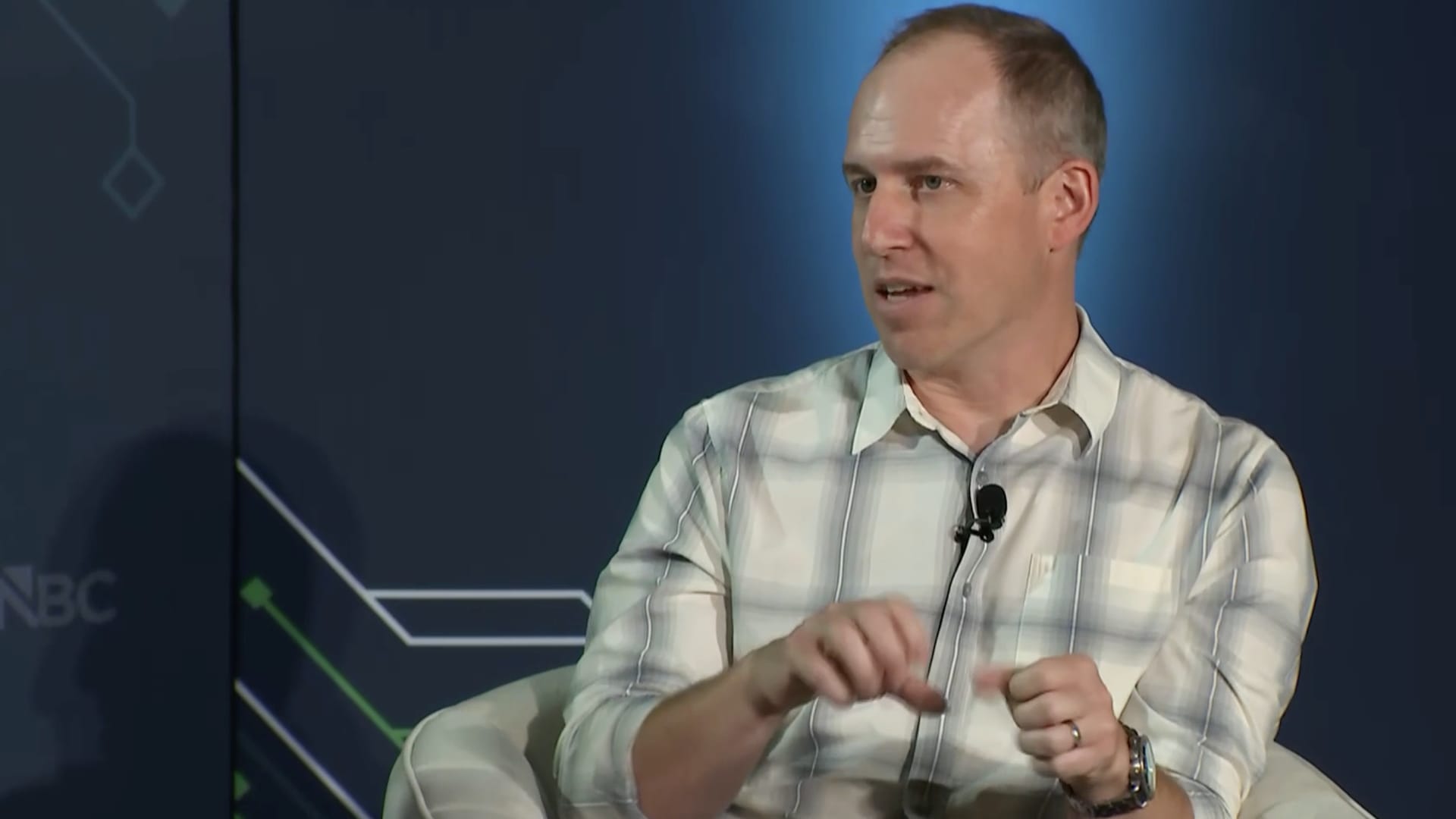
Rochefort’s Kyle Bass: Restrict China’s access to U.S. frontier AI models
Kyle Bass, Rochefort Asset Management Founder & Co-CEO, speaking at the CNBC AI Forum in Dallas, Texas on Oct. 1st, 2026.
CNBC
The drumbeat pushing for an AI slowdown has grown across the U.S. as risks across the board are being raised by developers, politicians, and the general public.
But Kyle Bass, Rochefort Asset Management Founder & Co-CEO, told CNBC’s Scott Wapner at the CNBC AI Forum that the anti-data center push is being funded by China.
„If we slow, China wants us to slow down. That’s exactly what they want,“ Bass said. „There’s no doubt that they’re behind the funding of many of the groups that have been pushing the anti-data center narrative in America, and China would love us to slow down because they will not slow down.“
Bass said that while he believes slowing down „is a terrible idea,“ he added that ‚how we move forward is another thing altogether.“
Director of National Intelligence Jay Clayton said Wednesday on CNBC that „super intelligence is a national security issue,“ and argued against pausing U.S. companies‘ development of artificial intelligence models, despite leaders of some of those same companies calling for a slowdown because of fears about the technology’s risks.
Bass said he agrees with Clayton and said it’s a national security issue to ensure that the technology is safe. That may mean restricting access to the frontier models, while also restricting China’s access to U.S. AI technology.
„Wherever China is today, they’re going to be today, and wherever they can innovate from the base that we’ve given them, they can innovate from there,“ he said. „But on new releases, maybe we should treat it with export controls like we do with sensitive technologies or weapon systems.“
„And I believe AI is a weapon,“ he said.
—Ian Thomas
AT&T’s Andy Markus weighs in ROI on AI at CNBC AI Forum

AT&T’s Chief Data & AI Officer Andy Markus talks with CNBC’s Contessa Brewer at the 2026 CNBC AI Forum about how he is thinking about ROI when it comes to companies using AI.
-Colleen McKown
Energy investor John Arnold on how the dialogue around data centers has changed in the U.S.
Ann McCoslin assembles „no data center“ signs to place along a county road next to the proposed Crusoe data center, in Jewett, Texas, July 28, 2026.
Antranik Tavitian | The Washington Post | Getty Images
Texas has become one of the biggest data center hubs in the U.S., with more than 600 either operating or planned to come online in the state.
But data center backlash is roiling across Texas, shaping the upcoming midterm elections and the race for governor between incumbent Republican Greg Abbott and Democratic challenger Gina Hinojosa as concerns over increasing energy costs grow.
John Arnold, legendary energy trader and Arnold Ventures co-founder, told CNBC’s Julia Boorstin that there is „real concern about the costs of power.“
„There have been a number of expert studies that have looked at this and kind of concluded from a variety of perspectives that the cost increase that consumers are seeing in their power rates, a very small part of that is allocable to the data centers,“ Arnold said. „But it is true that if it’s greater than zero, then that’s a problem, and consumers are responding to that and communities are responding to that.“
That is quickly shifting public perception on data centers, Arnold noted. A year ago, a survey found that 44% of respondents would be open to having a data center in their community. Now that sits at 15%, he said.
He also noted how those energy concerns are cascading with other issues, such as impact on jobs, aversion to big tech, and promises from companies and industries regarding community benefits not always paying off.
„The politics have changed, and there are two ways politicians have responded, particularly ones who are incumbents and in tight races who have been more and more aggressive about talking about moratoriums,“ he said. „The other set of politicians have come out and say ‚here are things you have to do as developers.'“
Arnold said part of that challenge falls directly on the hyperscalers, who need to better explain how these data centers offer real benefits.
„The tax revenue is real. Not a lot of jobs, but for many communities that are smaller or economically depressed, having 50 or 100 well-paying jobs is significant, and it can drive associated industry as well,“ he said.
„We went from a year ago where communities were kind of competing for this to now where the hyperscalers have to be very aggressive about communicating the benefits, so that’s a wake-up call,“ Arnold said.
—Ian Thomas
The politics of data centers: Arnold Ventures‘ John Arnold shares his analysis at the CNBC AI Forum

Arnold Ventures Co-founder & Co-Chair John Arnold talks to CNBC’s Contessa Brewer about the politics of data centers and why they have become such a divisive topic ahead of the midterm elections.
–Colleen McKown
OpenAI Chairman Bret Taylor and Wells Fargo’s Saul Van Beurden on how leaders can figure out where AI has greatest impact

Sierra Co-founder & OpenAI Chairman Bret Taylor and Wells Fargo Co-CEO of Consumer Banking & Head of AI Saul Van Beurden weigh in at the 2026 AI Forum about the ways business leaders can think about how where AI can drive the most value.
-Colleen McKown
How AT&T is managing the usage of 45 billions of AI tokens a day
Andy Markus, AT&T Chief Data & AI Officer, speaking at the CNBC AI Forum in Dallas, TX on Oct. 1st, 2026.
CNBC
As AT&T moved further into generative AI, Chief Data & AI Officer Andy Markus said the telecom giant first focused on making sure the technology could prove to be valuable in driving value for the company and customers.
Then, Markus told CNBC’s Scott Wapner at the CNBC AI Forum, as AI started to „put points on the board,“ AT&T had to optimize its usage for its massive scale to avoid token cost issues that have plagued other companies.
„I used the analogy of an action hero on a movie set, and there’s a disaster behind them and you’re just running just in the nick of time to get out in front it,“ Markus said. „But we did see it.“
Earlier this year, Markus said, 90% of the company’s AI budget was focused on closed-source models. Over time, the company recognized that it had to make a change and started moving to other models.
„Our whole goal was to protect that ROI even though we’re delivering value,“ Markus said.
The decision on what to shift to cheaper open-source models came down to three factors, Markus said: Can those models deliver the accuracy needed for the use case? Can it deliver the speed of response required for the use case? Can it do it at a cost that preserves the ROI?
„We’re doing 45 billion tokens a day on average to support the use cases,“ Markus said. „Even at that level, we’re still getting a return on investment, but we have to control that cost.“
Markus said AT&T has put controls in place to manage that, including what he called an „AI gateway“ that token usage flows through. That gateway also has a wallet where each user has their own budget, and if they use all of their tokens, it requires manager override.
„It allows us to control the cost,“ Markus said. „So even though we’re running ahead of the disaster, we’ve never been in the disaster. We’ve always protected the ROI. That’s been the number one charge we’ve had from the very beginning.“
—Ian Thomas
OpenAI’s Taylor on Hugging Face incident: We have an obligation to make AI safe
OpenAI chair Bret Taylor said he doesn’t want to learn the Hugging Face lesson twice, months after a swarm of OpenAI agents broke out of a training environment and hacked the open-source software developer platform this summer.
„They’re building a technology we know is powerful, and we have an obligation to make it safe,“ he told CNBC’s Julia Boorstin. „It’s a demonstration of what can happen when models are misaligned, and even during training processes, the risks associated with them.“
Since the incident, the debate around the threats AI poses to humanity has exploded in recent weeks, with multiple big tech CEOs, including OpenAI’s Sam Altman and Anthropic’s Dario Amodei, agreeing with calls for an industry-wide slowdown in the technology’s development.
To Taylor, researchers‘ efforts around slowdown talks seem authentic, he said.
„I think we should all be very happy the labs are asking themselves these hard questions, which is how do we continue to maintain our global leadership position in AI, which is absolutely vital for the national security of this country, and how do we ensure that in doing so, we don’t increase the risk,“ he said.
„It’s an incredibly hard problem,“ he added. „My uncomfortable truth is we need to win on the science; we need to win on the science of alignment as much as we win on the science of AI, because if don’t lean on the science of alignment, we won’t be able to actually have the pace of innovation we need to in the models.“
— CJ Haddad
How Wells Fargo is thinking about ROI when it comes to AI
The price tag around AI is continuing to grow, and that is pushing Wells Fargo to put what Saul Van Beurden, Wells Fargo Co-CEO of Consumer Banking & Head of AI, said at the CNBC AI Forum was an „enormous focus on what we call the high impact use cases.“
„We were chasing a lot of ants, small little animals, instead of hunting elephants and just the big use cases that drive a lot of ROI, whether it’s cost savings, whether it’s revenue,“ he told CNBC’s Julia Boorstin.
„Cost is just an outcome of something that is bigger and higher in terms of purpose, and that’s ROI,“ he said. „That’s also how we prioritize our book of work; that’s how we prioritize all the use cases.“
Van Beurden acknowledged that some of that analysis is assessing which model is best for which task, as it is crucial to „drive the best cost for the best model in terms of use for that case.“
Wells Fargo has been doing a full token spend report to track AI spending that encompasses the whole company, including personal productivity platforms, agents, and other models, Van Beurden said. It also has placed some spending limits on employees, and it also has AI contracts that vary between usage and seats that it has to manage.
„When you start to look at all that, it’s not like we faint or anything like that. We don’t have a horror story on spend,“ he said.
Van Beurden said that there has been a „top-down message to the whole organization“ when it comes to AI investments: „If we want to invest in AI, you need to come and stick out your neck.“
„Make sure that you are chipping in as a leader, because only if you chip in and you have a great ROI, you will get the money,“ he said. „That is the way to do that and manage cost.“
—Ian Thomas
OpenAI’s Bret Taylor talks outcomes-based pricing
Bret Taylor Co-founder of Sierra and Chairman of OpenAI speaks during CNBC’s AI Forum in Dallas, Texas on Oct. 1, 2026.
CNBC
OpenAI Chairman Bret Taylor dove deeper into why his artificial intelligence startup Sierra uses outcomes-based pricing, in a conversation with CNBC’s Julia Boorstin and Wells Fargo’s Saul Van Beurden Thursday.
„People are willing to spend more the more they know it converts into a sale,“ Taylor said. „So, the closer you get to an outcome that’s economically valuable, the easier it is for companies to understand that value.“
Taylor said that getting paid only when the products work is riskier, but that the new model would be a „really healthy thing“ for businesses.
„AI agents can perform jobs autonomously. You should pay for a job well done, and I think it is a new era of software,“ he said.
— CJ Haddad
Wells Fargo’s Saul Van Beurden on keeping „optionality“ when it comes to AI vendor deals
Saul Van Beurden, Wells Fargo’s Head of AI and Co-CEO of Consumer Banking and Lending speaks during CNBC’s AI Forum in Dallas, Texas on Oct. 1, 2026.
CNBC
Wells Fargo Co-CEO of Consumer Banking & Head of AI Saul Van Beurden said the financial services firm is keeping „optionality“ when it comes to what AI models, agents and vendors it is striking deals with so that it can „make the right choices.“
„Nobody can predict what happens in six months from now, a year from now; nobody can predict which model will be winning or not,“ Van Beurden told CNBC’s Julia Boorstin. „You see us doing multiple deals with multiple companies for shorter terms than would normally be the case, given that we’re in an environment that nobody can predict what is going to happen in six months from now.“
Van Beurden, who appeared on stage alongside OpenAI Chairman Bret Taylor, said OpenAI is „one of the two horses in a race that we have around agents,“ but keeping that optionality is „super important.“
„That means that we disappoint sometimes people where they want to have a big deal with us and a commitment for three years and an exclusive deal,“ he said. „But that means we have multiple horses in the race all the time, because in this era you cannot say, ‚Okay, we go for you, and we go for you.'“
—Ian Thomas
Who is speaking at the 2026 CNBC AI Forum
Kyle Bass, Founder of Conservation Equity Management, speaking on CNBC’s Squawk Box on Feb. 29th, 2024.
CNBC
In addition to OpenAI’s Bret Taylor and Wells Fargo’s Saul Van Beurden, CNBC has convened several executives, thought leaders, entrepreneurs, and researchers to talk about the wide-ranging impact of AI.
That includes:
- Andy Markus, chief data & AI officer at AT&T, who will join CNBC’s Contessa Brewer for a conversation about the economics of AI, managing token usage and how companies can spend strategically on the technology.
- John Arnold, co-founder & co-chair of Arnold Ventures, who will speak with CNBC’s Julia Boorstin about Texas‘ statewide AI boom, the massive infrastructure required to power that boom and how data centers have become a lightning rod topic ahead of the midterm elections.
- Mike Fey, Island co-founder, and Navrina Singh, Credo AI founder & CEO, who will join CNBC’s Contessa Brewer for a conversation about the challenges of keeping pace with AI risks and ways to safeguard against threats in the age of rogue agents and AI-powered human hackers.
- Kyle Bass, Rochefort Asset Management founder & co-CEO, who is talking with CNBC’s Scott Wapner about the threat of China gaining a technological and military advantage with AI and whether America can afford to hit the brakes.
- Ben Lamm, Colossal Biosciences co-founder & CEO, who will talk to CNBC’s Julia Boorstin about the science of de-extinction, the possibility of AI bringing back long-extinct creatures like the woolly mammoth and the debate surrounding the science.
—Colleen McKown
OpenAI Chairman Bret Taylor to speak at CNBC’s AI Forum
Bret Taylor, co-founder and CEO of Sierra, speaking to CNBC at the World Economic Forum in Davos, Switzerland on Jan. 22nd, 2026.
Oscar Molina | CNBC
OpenAI Chairman Bret Taylor is one of the most anticipated speakers at the CNBC AI Forum in Dallas.
Taylor, the co-founder of AI startup Sierra, will be joined on stage by Saul Van Beurden, Wells Fargo co-CEO of consumer banking & head of AI, for a conversation with CNBC’s Julia Boorstin about how organizations can scale AI to create value.
It’s been a big week for OpenAI: the company held its annual DevDay developer conference Tuesday, where the AI company unveiled a number of new products and developer tools.
This year’s DevDay took place amid intense pressure on OpenAI to address safety concerns after it disclosed several incidents where models behaved in unintended ways.
—Colleen McKown
The latest on AI regulation
US President Donald Trump, from center left, US House Speaker Mike Johnson, a Republican from Louisiana, and Jensen Huang, chief executive officer of Nvidia Corp., speak to members of the media following a meeting with tech executives on artificial intelligence at the White House in Washington, DC, US, on Tuesday, Sept. 29, 2026.
Tierney L. Cross | Bloomberg | Getty Images
At the CNBC AI Forum last year in Nashville, Senator Marsha Blackburn kicked off the event, pushing for federal regulation of AI, saying that her constituents were growing increasingly concerned about safety and privacy.
However, now a year later, no such federal regulation has emerged, even as concerns have escalated over the rapid pace of AI development as cases of agent-driven attacks grow and major researchers have raised warning signs about the serious consequences for humanity.
The White House hosted several tech leaders this week, and U.S. President Donald Trump told reporters that he’s „seeing tremendous self-policing“ from the AI industry. Trump also continued to maintain that the government would not halt AI development.
„There’s a belief that there should be tremendous self-regulation, and we automatically have regulation with the Department of Justice, the FBI, all of that,“ he told reporters after the afternoon luncheon, flanked by CEOs. „But the self-regulation is very important.“
—Ian Thomas
Welcome to the 2026 CNBC AI Forum
CNBC is hosting its second annual AI Forum today in Dallas, Texas — highlighting that Dallas has become a hub for enterprise-minded AI development.
Dallas now boasts one of the country’s largest tech workforces, driven by local universities‘ focus on expanding AI and engineering programs and by Texas’s lower cost of living, which has been drawing talent away from Silicon Valley. Meanwhile, key industries, from telecom to healthcare to financial services, are embedding AI into existing infrastructure in Dallas or setting down new roots to build AI systems that can solve real-world problems for their customers.
—Ian Thomas

