



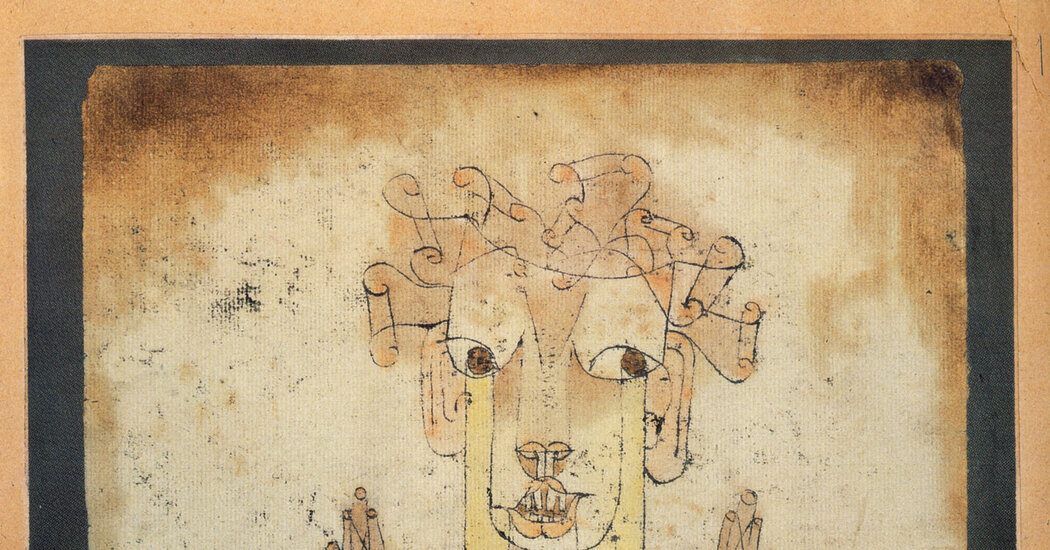
It is not every day that an angel flies to New York. But Paul Klee’s “Angelus Novus” — a small, fragile drawing of a straggly angel that survived the ordeals of Nazism to become an emblem of heroic resilience — has just arrived from Jerusalem, according to James S. Snyder, the director of the Jewish Museum in New York.
Never exhibited in New York before, “Angelus Novus” is scheduled to go on view at the museum on Monday morning, belatedly joining the exhibition “Paul Klee: Other Possible Worlds” (on view through July 26).
The drawing, which made headlines when its transport was delayed by the war in the Middle East after the United States and Israel attacked Iran, has lately overshadowed other works by Klee, the Swiss-born, German-educated master known for modestly scaled paintings that conjure imaginary worlds.
This is not to suggest that “Angelus Novus,” which is Latin for “new angel,” is a virtuosic drawing. It’s not even one of Klee’s best works. Some scholars believe the artist made it mainly to entertain his young son.
It depicts, in Klee’s typically wiry, scratchy black lines, an angel who looks less like a chubby-cheeked celestial being than a dazed adolescent — a walleyed boy afloat in the air, with small wings and a head of curls shaped like paper scrolls. His mouth hangs open, revealing widely spaced front teeth that could benefit from orthodonture.
What makes the drawing a work of such supreme interest is its provenance. In 1921, Walter Benjamin, the German-Jewish philosopher, was strolling through Munich when he spotted the drawing at a gallery. It was reasonably priced, about $30, but Benjamin, then in his 20s and living with his parents, didn’t have a pfennig to spare. He borrowed the money from a philosopher friend, Ernst Bloch, hung the drawing in his apartment and proclaimed it his most prized possession.
In 1933, Adolf Hitler became chancellor of Germany, prompting Benjamin to flee to Paris with his beloved drawing. He entrusted it for safekeeping to Georges Bataille, a French writer and librarian at the Bibliothèque Nationale, who hid the drawing in the library until the end of the war.
Benjamin would not live to see it again. In September 1940, in a thwarted attempt to escape the Nazis, he headed for Spain on foot. Stopped at the Spanish border, and lacking a proper visa, he was ordered back to France. The night before his scheduled return, he took his own life, swallowing morphine to avoid capture.
Most of his writings would appear posthumously, including his now-legendary “Theses on the Philosophy of History,” an opaque, poetic essay whose points are numbered from 1 to 18. When it was published in English in the United States, in 1968, it became an instant academic classic.
The Museums Special Section
The essay rechristened the “Novus Angelus” as the “angel of history,” a symbol of human catastrophe. The drawing, Benjamin contended, shows an angel who is about to turn away and fly off after contemplating the darker hours of history, which belonged not to a timeline of once-upon-a-time events, but rather to a massive “pile of debris” growing skyward in front of him.
Can we trust Benjamin’s interpretation of the drawing? Did Benjamin, as he ran for his life, see something that wasn’t there? Or, was it possible that Klee’s seemingly playful drawing possessed a fierce moral undercurrent that Benjamin recognized, and which art historians have overlooked?
I would argue for the moral undercurrent, at least to judge from “Paul Klee: Other Possible Worlds,” an incisive and boldly revisionist exhibition that brings us a newly vulnerable Klee. Consisting of about 100 paintings and drawings, the exhibition spans his career but zeros in on his disastrous late years, 1933 to 1940, when he endured illness, exile and Nazi persecution. Was Klee Jewish? No, but “he might as well have been given his particular denunciation by the National Socialists in Germany,” notes the curator Mason Klein in his catalog for the show.
Indeed, in 1933, Klee, who had first earned fame teaching at the Bauhaus, was falsely branded a Jew and a “degenerate” and booted from his latest job, at the Düsseldorf Academy of Fine Arts. Although he had lived in Germany since his art-school days in Munich, his works were removed from the walls of German museums. He and his wife, Lily, a piano teacher from Bavaria, fled to Bern, Switzerland, near his birthplace. Turned down for Swiss citizenship, he stayed on as an exile. He was home but stateless.
Who was Paul Klee? A pipe-smoking intellectual, he liked to paint at his kitchen table, often pausing to prepare an ambitious meal. He loved his cat, Bimbo, and once painted an irresistible portrait of an orange-faced tabby dreaming of a bird.
He remains one of the most misunderstood of 20th-century masters. His work is often described as charming and whimsical — adjectives that imply he lacked the bravado and transgressive derring-do of his better-known European colleagues. Compared with Picasso and Matisse, with their voluptuous nudes lolling about in French rooms, Klee constructed a more chaste and toylike world.
He painted jugglers and cyclists, crescent moons and skies traversed by alphabet letters. He painted luminous checkerboards and arrows that point at air. He created a world that lies beyond the reach of ordinary vision, and which combines such disparate traditions as Cubist fragmentation, the rigorous linearity of German graphics and the enchantments of children’s art.
Nothing is simple in Klee. His angels especially, which he drew and painted throughout his career, are impressively complex personalities with human flaws. One of the earliest works in the show, “The Hero With the Wing” (1905), a meticulously rendered etching done by a 26-year-old Klee, shows a hybrid figure, a one-winged man whose quixotic attempts at flight have endowed him with visibly broken limbs. Klee intended the etching to be funny, but its theme — the gap separating our aspirations from bitter reality — also informed his later works, which are the opposite of humorous.
Among the works making their debut in the United States are an important collection of drawings that openly mock the National Socialists, such as “Crawling Man,” a rough, scribbly clump of pencil lines from which emerge a man on all fours, his eyes filled with anguished disbelief.
The paintings, by contrast, continue Klee’s novel experiments with art materials. Although diagnosed with scleroderma, an autoimmune disease that causes the skin to harden and that limited his manual dexterity, Klee adapted by developing a new painting style that was blunter and less atomized than his earlier work. His once pin-thin lines grew thick and caterpillar-furry.
Consider “Revolution of the Viaduct” (1937), a two-foot-tall vertical painting that brilliantly satirizes the Nazi obsession with the construction of triumphalist monuments. It shows 12 marble arches — each fruit-colored and outlined in black against a solid gray ground — brought to frightening life. They march in unison toward the viewer, inexplicably long-legged and as baleful as a band of thugs.
Menace is everywhere. In “Protected Children” (1939), an ironically titled painting set amid winding city streets, three schoolchildren, rendered in the shorthand of stick figures, are caught in a rainstorm. They’re struggling unsuccessfully to keep their umbrellas from blowing over. Painted on burlap and grittily textured, the painting captures the feeling of helplessness — in the face not only of a downpour, but also of a whole ruined world.
In “Angel Applicant” (1939), a sad ghost with a blocky head and a bullish snout gazes out from beneath a crescent moon, achingly aware that he won’t be admitted to heaven. It’s not his fault; it’s just that the members of the admissions committee are no doubt corrupt or otherwise compromised. The piece may betray the influence of Picasso’s “Guernica” (1937), with which it shares somber newspaper hues of black, white and gray and the urgency of a wartime headline.
Klee died in June 1940, at the age of 60. His death came just three months before Benjamin’s suicide at age 48. The two men never met, but their lives are forever linked by a drawing of an angel that passed from the hands of one man to the other. It couldn’t save either of them, but the angel’s staring, slightly fearful eyes do serve as a portent to the living, reminding us that the catastrophes of the past are never really past.
Paul Klee: Other Possible Worlds
Through July 26. The Jewish Museum, 1109 Fifth Avenue; 212-423-3200, thejewishmuseum.org.

