



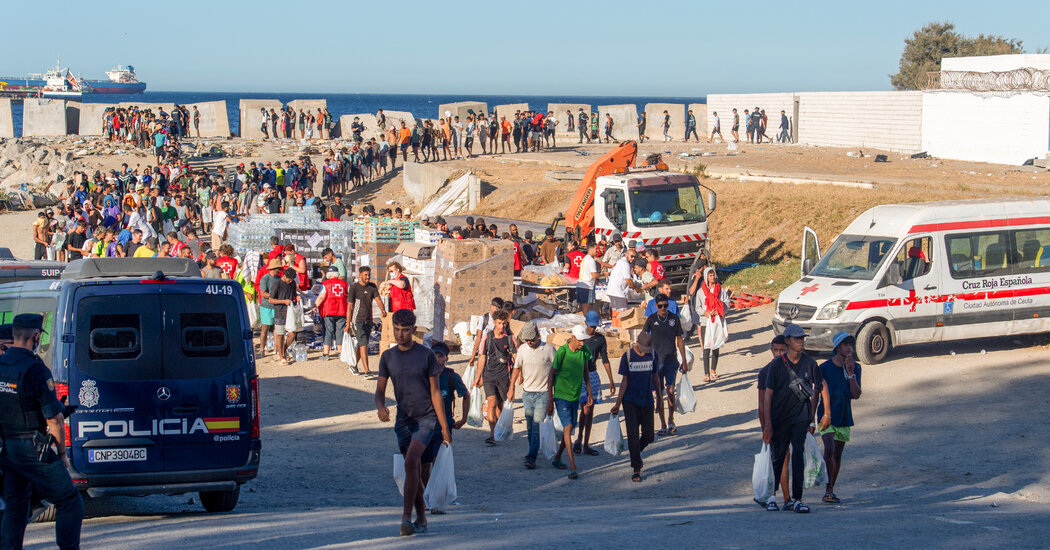
Prime Minister Pedro Sánchez of Spain said on Monday that 5,000 migrants remained in Ceuta, weeks after more than 70,000 people surged from Morocco into the Spanish territory in North Africa.
Although most of the migrants returned home quickly, the continued presence of several thousand newcomers in a territory of just 84,000 legal residents has heaped pressure on Mr. Sánchez’ government, inflamed local tensions and served as a flashpoint in the global debate about migration.
Mr. Sánchez, speaking on the radio network Cadena Ser, said that 1,200 minors were among the remaining migrants and that his government had reached an agreement with the local authorities to build facilities to house them while officials assessed their asylum requests. The territory’s administration has a higher estimate: It says that around 9,000 migrants remain in Ceuta and it has accused the national government of failing to do enough to resolve the problem.
The territory’s migrant center is overflowing, and makeshift shelters have been built to house up to 1,500 migrants, according to the national government. Residents have called that housing insufficient because hundreds of migrants have established tents in Ceuta’s surrounding hills or on its beaches. Videos published by the Spanish news media showed that some of the migrants have staged wrestling matches to pass the time.
As Mr. Sánchez spoke, local media showed footage of Spanish police officers in riot gear watching as hundreds of migrants, almost all young men, jostled with one another on Monday morning to get a spot in one of the shelters.
Last week, groups of angry Spaniards took matters into their own hands, rampaging through the beach shanties, burning several down. Others locals have tried to block Red Cross trucks carrying food to migrants. Some migrants have pelted a military jeep with rocks and forced soldiers to flee.
The rising tensions have forced the police to disperse crowds with tear gas.
The local authorities have rejected some of the government’s plans to get migrants off Ceuta’s streets. The city’s mayor-president, Juan Vivas, from the opposition conservative party, opposed a plan to house migrants in the town’s sports center, saying the government would have to first forcibly remove him from the facility.
“How far are we going to take this?” he asked during a news conference on Wednesday, urging the government to expedite expulsions rather than house the migrants on Spanish territory.
Protests in solidarity with Ceuta are planned across the Spanish mainland and in Ceuta on Sept. 2, the day the territory celebrates a holiday to mark the appointment in 1415 of its first European governor, following its capture from North African rulers. During the weekend, dozens of boats flying Spanish and Ceuta flags sailed toward the territory in solidarity. Residents applauded from shore.
Accusations remain rampant in Spain that Morocco had a hand in causing the crisis, despite Madrid’s insistence that a misinformation campaign by human smugglers in Morocco caused the surge. On Monday, Mr. Sánchez reiterated that no evidence pointed to Moroccan involvement and that Morocco, he said, offered “instant cooperation.” More than 90 percent of the migrants returned to Morocco within 48 hours of crossing the border, Mr. Sánchez said.
After the surge occurred, Mr. Sánchez said, Russia, Israel and a global far-right network waged a misinformation campaign against the Spanish government.
His office said his accusations were based on the remarks of a European Union spokesman, who had said on Aug. 6 that the organization had picked up on Russian-associated accounts “rapidly trying to amplify the Ceuta situation.” The spokesman made no reference to Israel.
Mr. Sánchez said that his opponents were retaliating against Spain’s support for Ukraine, its criticism of Israel’s military campaign in Gaza and to his pro-immigration policies.
Gideon Saar, Israel’s minister for foreign affairs, responded on X, accusing Mr. Sánchez of “lying shamelessly” by accusing Israel of “disseminating misleading information” and seeking to distract from his “failure to manage his country’s affairs.”
Asked for comment, Maria Zakharova, the spokeswoman for Russia’s Foreign Ministry, said that it “has become fashionable for Western democratic regimes to level charges for which there is no evidence.”
The Spanish government declined to provide evidence for Mr. Sánchez’ claim against Israel.
David M. Halbfinger contributed reporting from Jerusalem and Paul Sonne from Berlin.

