



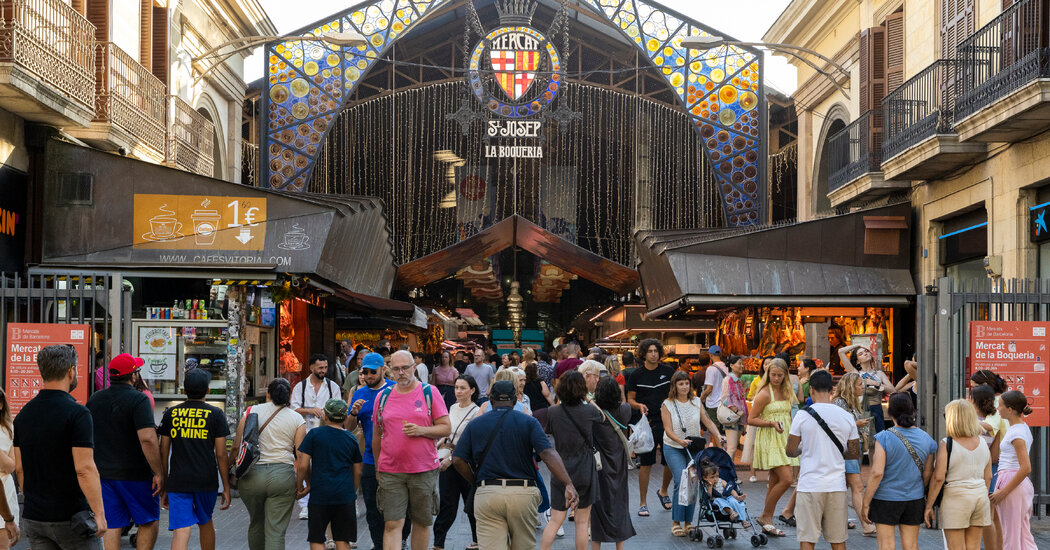
Barcelona’s Boqueria market is so crowded with visitors these days that many stalls that once sold fresh vegetables, fish or meat to home cooks now offer takeaway cups of cut fruit or fried shrimp to tourists instead.
Convinced the market is no longer meant for them, many locals have given up on it. José Antonio Donaire, a neighborhood resident, however, still shops there, albeit strategically. “Normally the back of a market is less attractive; it’s where the products are unloaded,” he said. “But at the Boqueria, it’s the reverse. We locals always enter through the back to avoid the traffic jam at the front.”
As Barcelona’s new commissioner for sustainable tourism, Mr. Donaire is developing strategies to diminish the impact of the nearly 16 million tourists who visit the Catalan capital annually. Created last year, his position builds on the work the municipal government started nearly a decade ago when it enacted its first policy aimed at restraining the overtourism that has contributed to rising housing prices; overwhelmed public transport; and turned historic areas into dens of tatty souvenirs and microwaved paella. Other initiatives have since followed, including a tourist tax on accommodations and a ban on vacation rentals that goes into effect in 2028.
Mr. Donaire, a professor of tourism studies at the University of Girona and a former member of the regional parliament, wants not merely to check overtourism, but to reverse it. Under his guidance, Barcelona is aiming to restore residential life in neighborhoods hit hardest by tourism’s negative effects. That includes a plan to make the Boqueria a place where Barcelonans again want to shop — and maybe even enter through the front gates.
This conversation has been condensed and edited for length and clarity.
Barcelona has been addressing overtourism for nearly a decade, yet visitor numbers continue to rise. Does the creation of your position mean those policies haven’t worked?
Barcelona began rethinking tourism with innovative measures like the moratorium on new hotel construction back in 2017. It’s true that the measures have been incremental. It’s a learning process, and many of the measures will take time before they have an impact. But the message of the city now is: not one tourist more.
What does ‘not one tourist more’ mean?
That the city has decided to fix a flat horizon on a curve that otherwise rises infinitely. We don’t want to grow more. We want the tourists that the city already has. There were 15.7 million tourists in the city in 2025 — that’s the threshold. Sixteen million is the maximum.
But isn’t the tourism board still promoting tourism?
We are not coming at this from an anti-tourist position. But we need to manage tourism in an orderly way, and the first management objective is to change the kinds of tourists who come. Right now, two-thirds are leisure tourists; we want the makeup to be a third business travel, a third cultural travel and a third leisure. So we are doing promotions directed at those niches that are interested in cultural experiences — not just elevated ones, like going to the Liceo, but also popular ones, like live music or festivals.
If you look at the tourism website, you’ll see the slogan has changed from “Visit Barcelona” to “This Is Barcelona,” from telling people to come to see the sights to telling them who we are as a city.
You can’t prevent leisure tourists from coming, can you?
That’s the effect of setting the limits. The demand can’t grow if there’s no accommodations for them. Already this summer we’re seeing that there are people who can’t come because they can’t find a place to stay. We’re not going to respond to growing demand.
The mayor has also just announced a proposal to eliminate cruise ships that only stop for the day. We want zero day-tripping cruise passengers, and to achieve that we’re going to ask the regional authorities to raise the tax on them to the maximum allowed. We want it be so high that it doesn’t make sense to come into the city.
Is the tourist tax on accommodations also an attempt to dissuade tourists?
The more important part is that it allows the city to offset the expensive costs of tourism. We want to be able to say to residents that all the services that tourists use — security, sanitation, electricity, transport — are subsidized entirely by the tourist tax. We believe that a resident should not have to be responsible for the services that a visitor borrows.
We want to invest these resources in strategies designed to recover the city’s identity. In some ways, you could say that tourists are financing the “detouristification” of Barcelona.
What does recovering the city’s identity look like?
It’s important to us that any resident can buy a loaf of bread, a book or a screw in their neighborhood. That’s what makes someone feel emotionally connected to their city. We also believe that tourists will be more interested in a city where urban space isn’t entirely souvenirs, phone cases and kebabs.
So the city is subsidizing some kinds of shops?
Yes, we have different kinds of support for shops that are clearly directed at residents. And there is a strict usage law that prevents the number of tourist establishments from increasing. For me, the best example of this process is the Boqueria.
We have worked with the vendors on a new agreement that will notably increase the number of stalls that are dedicated to products that are not for immediate consumption. It’s not that we don’t want tourists in the Boqueria — they are welcome. What we’re saying is that the market has to continue being a market.
Barcelona gets 13 percent of its revenue from tourism. How do you respond to critics who say these measures will threaten prosperity?
We have to have a hierarchy of priorities. And at the top of our order is the citizen’s right to live in the city. We want a city where everyone can prosper.
Are you suggesting that even after a neighborhood has lost its residential character to tourism, it can be recovered?
Exactly. It’s happening in very important areas like Las Ramblas, which is the heart of the city. Our research shows that citizens have stopped going to Las Ramblas because they no longer consider it their space. So our strategy is centered on recovering it, and we’re using measures like reducing the number of outdoor cafes and changing its commercial makeup. Our greatest goal is that the people of Barcelona return to Las Ramblas to go for a stroll or just to hang out.
Repairing the residential fabric of the historic center requires a lot of different initiatives working together, but all of them are founded on a basic, inalienable principle, which is the right for residents to stay in the city. A city cannot function without its citizens.
Two years ago, images of locals squirting tourists with water guns were seen around the world. What can visitors expect this summer?
I want to emphasize that we are a very hospitable city. We are honored that people want to visit us. I believe that anyone who comes to Barcelona will feel that. But I also believe that we are in a context in which we all know, residents and tourists, that we have to get along.
Follow New York Times Travel on Instagram and sign up for our Travel Dispatch newsletter to get expert tips on traveling smarter and inspiration for your next vacation. Dreaming up a future getaway or just armchair traveling? Check out our 52 Places to Go in 2026.

