



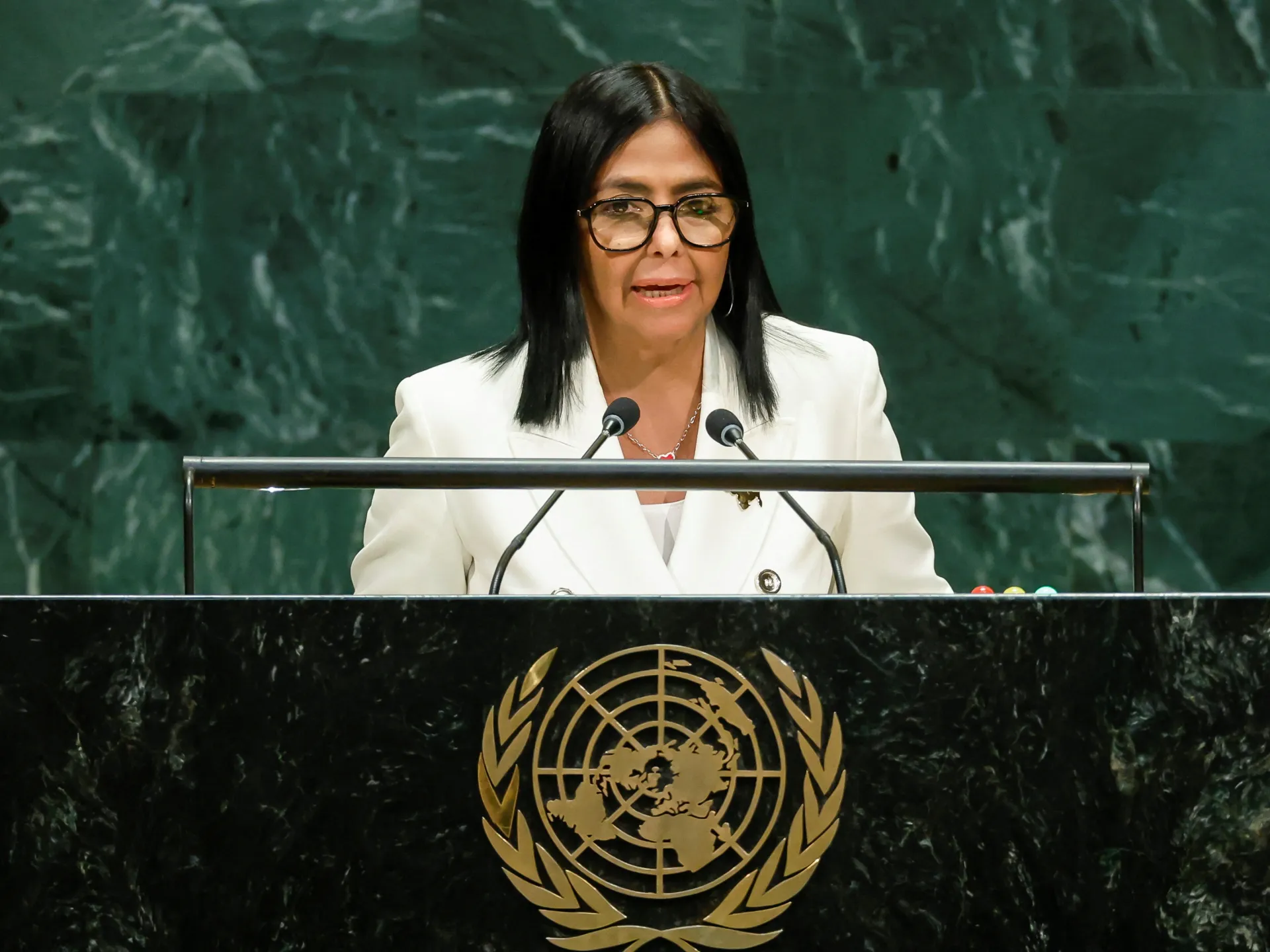
Venezuela’s interim President Delcy Rodriguez took to the stage yesterday at the United Nations General Assembly meeting in New York City to deliver a rather bland speech, in which she thanked United States President Donald Trump for resuming “diplomatic relations and cooperation” with Venezuela.
This was a different vibe, to be sure, than the one she opted for at the same venue in September 2019, when, as vice president under Nicolas Maduro, she accused the US of perpetrating “economic terrorism” that did not require the use of bombs “but rather through banks and insurance companies”.
Denouncing the global superpower’s militarisation of international relations and punishment of millions of innocent people “in order to apply regime change doctrines and steal other nations’ resources”, the Rodriguez of 2019 went on to cite Venezuelan economic losses to the tune of $130bn between 2015 and 2018 alone on account of US sanctions.
She additionally offered her opinion that the domination of the US political system by “plutocratic minorities” made the country unqualified to impose its model on other countries.
Seven years later, US plutocracy is going strong with Trump at the helm – the same Trump alongside whom a grinning Rodriguez appeared in a photograph taken in New York on Tuesday, less than nine months after he oversaw regime change in Venezuela by kidnapping Maduro.
The kidnapped president is now also in New York, albeit in jail, and is scheduled to stand trial in June 2027. This despite his attempts to remind everyone that, as a sitting head of state, his prosecution in a foreign court contravenes international law.
Then again, abducting other countries’ presidents is also pretty glaringly illegal. But Trump has made it clear that he alone is in charge of deciding what is and is not permissible on any given day.
The abduction took place on January 3, when the US military launched air attacks on Venezuela, killing some 100 people and whisking Maduro and his wife away.
He is accused of an array of misdeeds, including being the leader of the “Cartel of the Suns” – which, mind you, does not actually exist – and engaging in “conspiracy to possess machineguns and destructive devices”.
This is quite the accusation coming from the country that just used all manner of destructive devices to bomb Venezuela and kill a bunch of people.
Anyway, bald-faced hypocrisy is nothing new in the land of the “plutocratic minorities”.
Now, the waning corporate media interest in Maduro’s fate amounts to another coup for US impunity, as folks go about more or less forgetting that there is a foreign head of state sitting in a Brooklyn prison.
But Maduro’s disappearance works out well for Rodriguez, as she goes about enabling the very theft of resources she once decried.
Rodriguez took the stage at the UN the day after Trump, who used the platform to pat himself on the back for the trampling of Venezuelan sovereignty that conveniently culminated in last month’s announcement from the White House of the “biggest oil deal in world history”, securing US majority control of more than 65 billion barrels of Venezuela’s proven oil reserves.
Speaking to his international audience, Trump boasted: “To the victor belong the spoils. You’ve all heard that.”
Never mind that you’re not technically supposed to admit that you attacked a country just to get its oil. (You’re also not, in polite company, supposed to threaten to annihilate Iran – another of Trump’s UN talking points.)
Since January, the US has lifted many coercive economic measures against Venezuela (including against Rodriguez herself), easing the brutal sanctions regime that as of 2020 was estimated to have already killed 100,000 Venezuelans, according to former UN independent expert Alfred-Maurice de Zayas.
But trading sanctions for de facto colonialism isn’t a great deal, either.
Meanwhile, Trump’s continued manic bombing of vessels in the Caribbean and Pacific, which a recent UN report warned may constitute crimes against humanity, suggests the US is nowhere near to kicking its old habit of terrorism – and is all the more reason that Rodriguez might have refrained from thanking the US leader for his “cooperation”.
As Gregory Wilpert, founder of the Venezuelanalysis website and author of Changing Venezuela by Taking Power, diplomatically put it to me: “One cannot help but wonder whether Delcy Rodriguez is over-complying with Trump in some aspects of her negotiations with him.”
Noting that Rodriguez is “in a highly vulnerable position”, Wilpert ran through a few of the options she faces, such as “the possibility that the Trump administration could treat her as it treated Maduro – by attempting to kidnap her – or as it treated Iran, by targeting the country’s highest levels of government”.
Or, Wilpert said, there is always the Cuba approach, which would entail “the kind of economic siege” that is undertaken “with the aim of starving an entire country”.
In her UN address, Rodriguez promised that Venezuela would hold elections at some unspecified point in time – not that the US, for its part, really cares about democracy as long as the right people are in power.
And although it’s still too early to tell, Rodriguez might just be one of those people.
The views expressed in this article are the author’s own and do not necessarily reflect Al Jazeera’s editorial stance.

