



When President Trump campaigned in 2024, he promised a trade agenda that would hit China harder than any other economic partner, expanding on actions he had taken in his first term.
Mr. Trump talked about imposing a tariff of 60 percent or more on the country, and proposed stripping China of the preferential trade relations given to it when it joined the World Trade Organization. The rest of the world would be subject to tariffs too, but they would be much lower, at 10 or 20 percent.
More than a year into Mr. Trump’s first term, the picture looks dramatically different. Though U.S. tariffs on China are higher overall when the tariffs from Mr. Trump’s first term are added in, other countries have faced punitive levies that were nearly as high, and higher for some products.
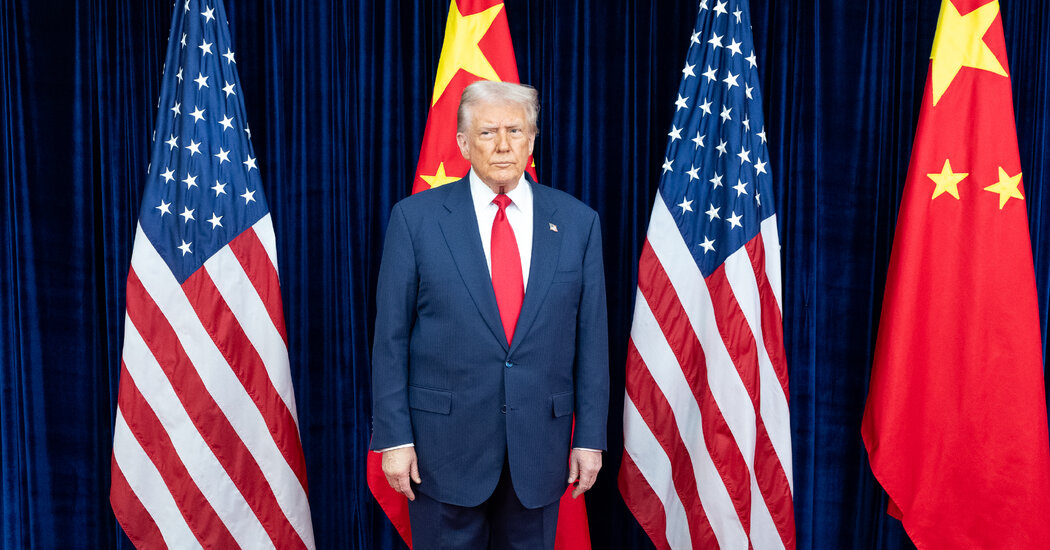
The Trump administration has saved its most caustic criticism for allies in Europe and Canada, while approaching China with more cautiously. And as Mr. Trump heads to Beijing this week for a summit with the Chinese leader Xi Jinping, expectations for its outcomes are limited.
Rather than pushing China for broader structural changes to its economy, as Mr. Trump’s aides did in his first term, the focus now is largely on maintaining stable relations between the countries, while restoring or increasing U.S. sales of products like airplanes, ethanol, soybeans, beef and sorghum.
The remarkable shrinking of Mr. Trump’s Chinese ambitions is the result of the events of the last year, when China responded to Mr. Trump’s tariffs by cutting off the supply of rare earth minerals and magnets needed by American companies making everything from cars and weaponry to power tools.
Facing the prospect of shuttered U.S. factories and widespread economic damage, the Trump administration appears to have given up the idea of a more ambitious deal with China — widely acknowledged as America’s most problematic trading partner — even as it presses less troublesome partners more aggressively than ever before.
Myron Brilliant, a senior counselor at DGA-Albright Stonebridge Group, a consulting firm, said this week’s summit in Beijing would be “high on strategic distrust and high on symbolism but low on ambition.” Last year was a tumultuous period for U.S.-China relations, he said, and both sides “are in risk management now.”
“Each side seeks stability, and deliverables will be largely short-term in nature,” he said. Mr. Brilliant said the outcomes could include agricultural and airplane purchases, and agreements to curb fentanyl exports.
U.S. officials have talked about the creation of a new “board of trade” that would oversee the agreed purchases, which could run to tens of billions of dollars. Others have suggested the meeting could result in lower tariffs on more general products, to spur their sales.
While Mr. Trump’s global tariffs have been repeatedly struck down by the courts, the administration is preparing two new trade investigations that are likely to result in more levies on dozens of countries this summer, including China. Chinese officials are expected to press U.S. officials to keep those tariffs low.
Analysts said Chinese officials also appeared likely to push for the relaxation of U.S. technology controls or a change in U.S. posture on Taiwan, a self-governing island that China claims as its own.
Kurt Campbell, a former U.S. deputy Secretary of State, said the Chinese side would be looking, wherever possible, to get the United States to relent on economic actions like tariffs. But the most important priority for China is to get Mr. Trump to depart from traditional approaches when it comes to Taiwan.
“If there are deals to be made on Chinese substantial purchases of agricultural or beef products, pork or Boeing, they will expect things in return for that,” he said.
U.S. officials have said they don’t expect to see any changes with regard to policy on Taiwan. In a briefing with reporters Sunday, Anna Kelly, a spokeswoman for the White House, said that Mr. Trump had refocused U.S.-China relations “on what matters most, rebuilding the safety, security and prosperity of Americans.”
“During this visit, President Trump will continue doing what he has done over the past year, rebalancing the relationship with China and prioritizing reciprocity and fairness to restore American economic independence,” she said.
Despite Mr. Trump’s aggressive talk during the campaign, his advisers say his goal was never a decisive decoupling with China. Instead, he envisioned his trade threats as a way to push Beijing into a bigger trade deal that would tilt the balance in the relationship to benefit the U.S. economy and help ensure global peace.
The problem was the execution. When Mr. Trump tried to force China into making concessions last year by threatening extreme tariffs, the tactic backfired, forcing the U.S. to pare back its goals.
“They did move to be more aggressive on China,” Mary Lovely, a senior fellow at the Peterson Institute for International Economics, said of U.S. officials. “What happened was China decided to invoke its significant choke-points of its own and countered the U.S. in ways that it hadn’t done before.”
“I have no idea why they didn’t anticipate that,” she added.
As the situation escalated again last fall, top officials including Scott Bessent, the Treasury secretary, and Jamieson Greer, the trade representative, assembled a list of actions they could take to strike back, including restrictions on things like software, semiconductor manufacturing equipment and visas, that might force Beijing to back down.
But ahead of a meeting with Mr. Xi in South Korea in October, the president told his advisers instead to try to push for a truce. The United States ended up shelving a variety of actions on China, including a delay in the imposition of a sweeping technology restriction that would affect Chinese companies, and new fees on Chinese ships aimed at building up the U.S. shipbuilding industry.
In recent months, the United States and China have maintained a tentative truce. Many exports of Chinese rare earths have resumed to companies not linked to the military, though U.S. companies remain intensely concerned about their longer-term access to minerals. The administration has taken steps to try to increase the domestic supply of rare earths, including creating a critical minerals stockpile, but U.S. industry remains heavily reliant on China for the materials that will be critical to the U.S. economy going forward.
After Mr. Trump met Mr. Xi in South Korea, both sides talked enthusiastically of meetings to come between the leaders in the following year. A meeting was planned for April, but then rescheduled for May because of the Iran conflict.
Christopher Padilla, a former trade official in the George W. Bush administration, agreed that there would likely not be “a lot of big outcomes.” He added, “They’re going to agree we buy some of this, they buy some of that, and then they’ll have a party and call it a day.”
U.S. officials say their talks will result in a fairer trade relationship with China, and argue that they still have an edge. But the Chinese government seems more determined than ever to match any offensive U.S. measures step for step, in ways that could be deeply harmful for the U.S. economy.
China has issued regulations in recent months to investigate and punish foreign companies that stop using Chinese suppliers in response to foreign pressure. And after the United States penalized several Chinese refineries for purchasing Iranian oil, the Chinese government took the unorthodox step of ordering its companies not to comply with the sanctions.
Ms. Lovely of the Peterson Institute said China had been building out the legal foundation for measures to counter foreign sanctions for a decade. “Now they feel confident enough to use them,” she said.

