



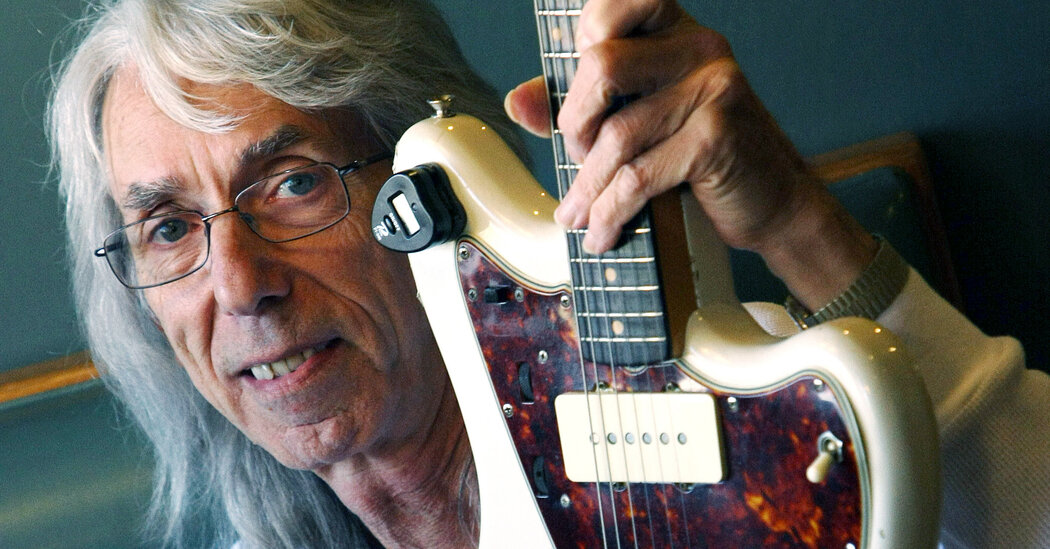
Wayne Moss, a prolific guitarist and producer who played on landmark Nashville recordings by Roy Orbison, Tammy Wynette and others before helping to expand the reach of country music as a member of the experimental country-rock groups Area Code 615 and Barefoot Jerry, died on Monday at his home in Madison, Tenn. He was 88.
His death, from chronic obstructive pulmonary disease, was confirmed in a statement from his family.
A member of Nashville’s A-Team of first-call studio musicians, Mr. Moss played on recordings by luminaries like Patsy Cline, Loretta Lynn, Charley Pride and numerous others in the 1960s and ’70s.
He was one of the three guitarists who played the indelible staccato riff that ignites Mr. Orbison’s “Oh, Pretty Woman,” a chart-topping pop single in 1964. He also improvised the filigreed guitar phrasing on Bob Dylan’s “I Want You,” a Top 20 pop hit in 1966, and the atmospheric guitar part on Dolly Parton’s “Jolene,” a No. 1 country single in 1973.
“Listen carefully,” Mr. Young added, and “you’ll hear innovative electric lead parts that drew attention to Nashville’s world-class musicianship.”
A nimble bass guitarist as well, Mr. Moss laid down the funky groove on “The Chokin’ Kind,” a Grammy Award-winning pop hit for the soul singer Joe Simon in 1969, and got in the woozy Salvation Army marching band mood of “Rainy Day Women #12 & 35,” a Top 10 pop single from Mr. Dylan’s 1966 album “Blonde on Blonde.”
Working with Mr. Dylan, Mr. Moss said, brought out the best in him and his fellow Nashville musicians.
“We used to think of Nashville sessions as being relaxed, but Dylan changed our whole approach,” he was quoted as saying in Frye Gaillard’s 1978 book, “Watermelon Wine: The Spirit of Country Music.” “He was so relaxed and laid-back that your creative juices took on an entirely different aspect. Anything we wanted to try, have at it.”
Increasingly, Mr. Moss wanted to spend less time on the records of others and more on Barefoot Jerry, the improvisational Southern rock band he started in 1971 with other members of the A-Team.
He also wanted to focus more on producing records at Cinderella Sound, the recording studio he built in 1961 in a converted two-car garage outside his home. Perhaps Nashville’s oldest continuously operating independent sound studio, Cinderella Sound would go on to host projects by Linda Ronstadt, Mickey Newbury, the Steve Miller Band and others.
Wayne Moss was born on Feb. 9, 1938, in South Charleston, W.Va., one of four children of Brodie and Mattie (Carr) Moss. His father worked as an engineer for Carbide Chemical, and his mother was a seamstress and homemaker.
Wayne started playing guitar at 8 and was touring with his own rock ’n’ roll band, the Versitones, by the time he was a teenager. He had no intention, he said in a 2018 interview with the Nashville radio station WMOT, of staying in West Virginia.
“There was nothing to do up there but work in a chemical plant or a coal mine,” he said. “My dad worked at Carbide, and I didn’t want black lung, so I got out of there.”
In 1959, he moved to Nashville, where an audition with Chet Atkins, then head of the local division of RCA Records, was unsuccessful. After a stint with Brenda Lee’s touring band, Mr. Moss began to secure studio work in Nashville. By 1962, he had played on his first No. 1 hit record: “Sheila,” by the pop singer Tommy Roe.
In 1969, after years of session work, Mr. Moss formed the country-rock band Area Code 615 — named for Nashville’s area code — and, two years later, Barefoot Jerry. An early Southern rock band, Barefoot Jerry released six albums in the 1970s but was perhaps best known for the enthusiastic mention the group received on the Charlie Daniels Band’s single “The South’s Gonna Do It,” a hit in 1975.
His survivors include his wife of 10 years, Dee (Moeller) Moss, and five children from two earlier marriages that ended in divorce, John Moss, Sheila Pearson, Patricia Harvey, Elizabeth Moss and Amanda Wolters.
For all of his musical acumen, Mr. Moss could not read music. He nevertheless was instrumental in the establishment of the Nashville number system by which musicians transcribe music by using numbers, not words, to represent chords. Mr. Moss borrowed it from the notation that the vocal group the Jordanaires used to chart its harmonies as it backed Elvis Presley.
Charlie McCoy, a fellow West Virginian and noted Nashville instrumentalist, said in his 2013 speech inducting Mr. Moss into the West Virginia Music Hall of Fame, “His curiosity about the numbers that the Jordanaires would use to shorthand their music led us to develop what has become the standard with Nashville studio musicians, the Nashville number system.”

