



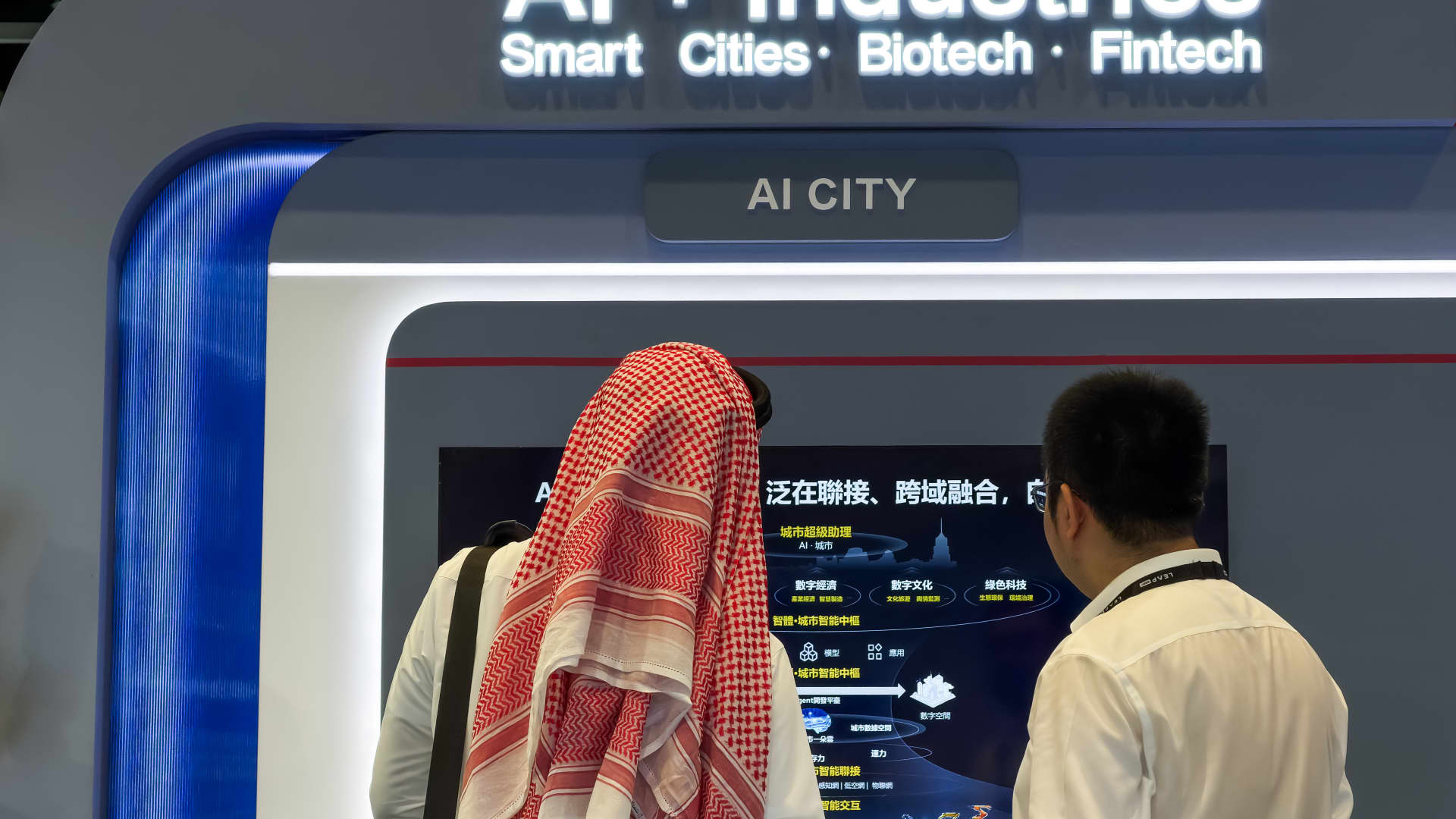
HONG KONG, CHINA: Hong Kong has emerged as a major biotech fundraising hub, attracting dozens of Chinese biotech firms to list in the city.
Cheng Xin | Getty Images News | Getty Images
For years, Chinese companies such as Alibaba and Baidu headed to the U.S. to list their shares, citing its deeper capital markets and higher valuations. Now, one American biotech firm is betting on doing the opposite.
Axiom Biosciences, a San Diego-based developer of regenerative and genetic medicines, plans to go public in Hong Kong in 2027, followed by a secondary U.S. listing in 2029. The company says the „contrarian“ move will open the door to sophisticated, biotech-focused investors while bringing it closer to clinical and commercial partners across Asia.
„Some of the most important science in the world is being built in the United States, but the way it gets funded hasn’t kept pace,“ said Remo Moomiaie-Qajar, founder and CEO of Axiom.
The Hong Kong exchange’s stricter listing standards compared to the U.S. point to a mature biotech ecosystem, Moomiaie-Qajar told CNBC, while noting that recent biopharma listings in the city have outperformed those on the Nasdaq.
Public markets offer an alternative way to raise money as biotech firms face a tougher fundraising environment, he said. While clinical trials become more expensive as they progress, the pool of venture investors willing and able to write large checks gets smaller – especially for companies that did not secure major backers early on, he added.
Chinese biotech firms have flocked to the city’s bourse amid a government push and as innovative drugmakers‘ financing needs grow. The Hang Seng Biotech Index in Hong Kong has climbed more than 75% since January 2025, surpassing the roughly 40%-50% gains in the ICE Biotechnology Index and the Nasdaq Biotechnology Index, tracking U.S.-listed firms during the same period, according to LSEG data.
„The U.S. remains the deepest and most institutionalized biotech capital pool in the world,“ said Danny Xiang, founding partner at the life science-focused private equity firm Fontus Capital. „That depth is precisely why the most fundable, globally competitive assets still raise and list in the U.S.,“ and why it’s rare for a purely American biotech firm to choose Hong Kong as its primary venue, he said.
What’s changed, however, is Hong Kong’s growing appeal as one of the world’s largest biotech fundraising hubs, with more than 70 listings in the sector and reforms introduced last year that streamlined their IPO process, Xiang said.
Global biotech firms are increasingly drawn to the city’s expanding biopharma investor base and its proximity to Chinese pharmaceutical partners, which could help speed up clinical trials and lower costs.
Still, Xiang said, local investors tend to favor companies with a clear China connection, backing assets where they see opportunities to co-develop, manufacture or sell products with Chinese partners.
George Wu, a Hong Kong-based partner at law firm DLA Piper, said the Hong Kong biotech sector’s lower valuations, relative to the Nasdaq, have also attracted more international investors seeking upside potential.
The U.S. is also on track for its strongest run of biotech IPOs in years, with both Parabilis Medicines, a clinical-stage cancer drug developer, and Kailera Therapeutics, an obesity-drug maker, soaring around 60% on their debuts earlier this year, after raising more than $600 million each. The SPDR S&P Biotech ETF (XBI) rallied 76% over the trailing year as of Tuesday.
Inventing vs. scaling
Biotechnology has been a long-term priority for Beijing, which has spent decades funding basic research, reforming drug regulation, and attracting experienced scientists and executives trained abroad, including the U.S., back to China.
Lower labor and manufacturing costs, a deep pool of science graduates, access to large datasets, targeted uses of AI in areas such as drug design, and China’s vast population – with many patients concentrated at major hospitals that can aid clinical-trial recruitment – have helped China advance in biologics, genomics and drug development, experts say.
However, a survey by the Cure Innovation Index in June found that despite leading in clinical development and supply chains, China still lags the U.S. in the quality, commercial reach and cutting-edge strength of its biomedical science.
„The U.S. leads ‚0-to-1‘,“ in breakthroughs in foundational science and novel biology, Xiang said, while China increasingly leads „1-to-100,“ meaning fast, capital-efficient implementation to reach patients.

Axiom is co-developing a therapy with South Korea-based biopharma firm Medinno for newborns with severe brain injuries linked to high death rates. The therapy has received two U.S. Federal Drug Administration designations for rare pediatric diseases, and a Phase 1 trial involving nine newborns in South Korea has been completed.
Axiom also plans to study the treatment as a possible therapy for adults who have suffered strokes.
„Because there are no regenerative therapies for these brain injuries, it’s imperative that we move through clinical trials as rapidly as possible. And I think Asia is the right place to do that,“ Moomiaie-Qajar told CNBC.
China closing in
In December, a bipartisan U.S. legislative commission warned that China was beginning to outpace the U.S. in some areas of biopharmaceutical innovation, building on „advantages gained from non-market practices and brute force economics“ – a term used by some in Washington to describe China’s state-led push for leadership in strategic industries.
The commission urged coordinated action across the public and private sectors to retain – and in some areas regain – U.S. biotechnology leadership.
Washington has moved against prominent Chinese biotech firms in recent years.
The Commerce Department has imposed export restrictions on several entities linked to genomics giant BGI Group, while the Pentagon last month added the pharmaceutical company WuXi AppTec to its list of firms that it alleges have ties to the Chinese military. WuXi sued the Department of Defense days later, seeking to overturn what it called an erroneous designation.
While Nasdaq and the New York Stock Exchange allow biotech firms to apply for a listing before they generate revenue or begin human testing, Hong Kong requires at least 12 months of research and development and a core product past the concept stage.
„A U.S. IPO is generally faster for a company that qualifies, and Hong Kong’s review times have stretched as applications piled up,“ Xiang said.
— CNBC’s Evelyn Cheng contributed to this report.

