



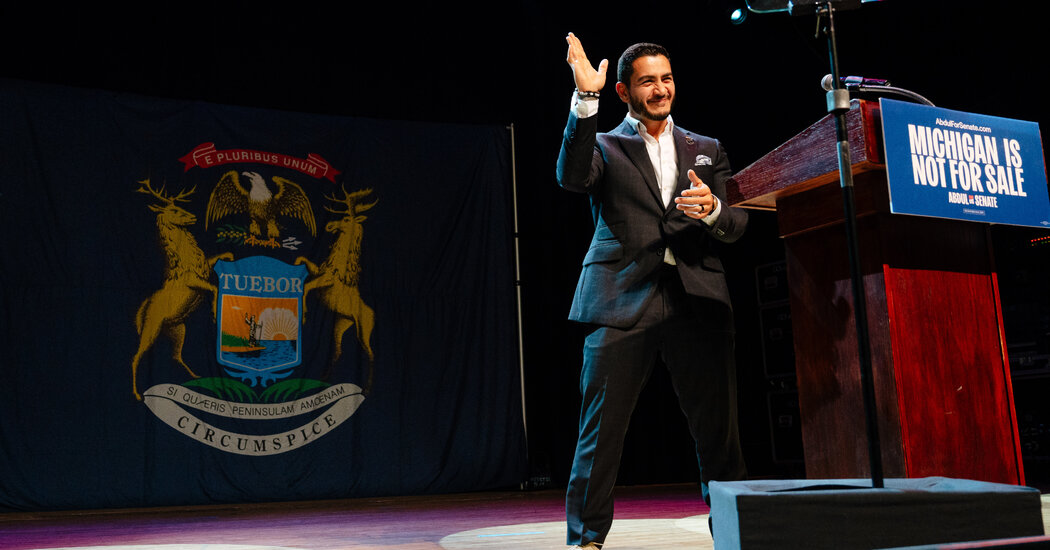
Senator Tommy Tuberville called Dr. Abdul El-Sayed a “terrorist.”
Representative Nancy Mace described “every single Muslim holding public office in America” as “a threat to both national security and our republic.”
And on Monday, President Trump said that there were “jihadists being elected all over the place.”
In the days since Dr. El-Sayed’s victory in Michigan’s Democratic Senate primary, Republican leaders have embraced Islamophobic attacks and falsehoods like those three comments to portray him as an anti-American extremist. The onslaught is being fueled in part by Republican Party officials and has quickly become a central aspect of the strategy to beat Dr. El-Sayed in the fall. Few officials in the Republican Party have publicly tried to tamp down such messaging, though Dr. El-Sayed has not hesitated to parry the attacks.
“They’re going to point at me, they’re going to point at my name, like, ‘Wow, he’s different,’” he said the morning after his win. “My name is not raising your gas prices,” he added. “My name is not taking us to war. My name is not the reason you can’t afford your groceries.”
Muslim and Arab American political power is growing across the country, led by prominent figures officials including Zohran Mamdani, the mayor of New York City, and Dr. El-Sayed, who is the son of Egyptian immigrants and was born in Michigan. The number of Muslim American running for — and winning — local, state and federal elections has steadily increased over the past decade. Today, there are more than 230 elected Muslim officials, according to the Council on American-Islamic Relations, including four Muslim Americans in Congress, the highest number ever.
Three more could be elected to the House this fall. And in Michigan last week, several Arab Americans won contested primaries, including for the state legislature and mayor of Ann Arbor.
But the increase in power has also drawn considerable repercussions. Muslim officials say that their increased visibility has brought with it a wave of bigotry and threats. In recent years, Mr. Trump has repeatedly attacked Representative Ilhan Omar, an immigrant, mocking her hijab and declaring that she should be “sent back” to Somalia. Multiple Republicans have falsely accused Mr. Mamdani of being a jihadist.
“There has been remarkable political progress for Muslims in American, but the backlash to that has come in the form of anti-Muslim hate that seems to be the worst we have seen yet,” said Edward Ahmed Mitchell, the national deputy director for CAIR, one of the largest Muslim advocacy groups in the United States. Mr. Mitchell said that much of the negative response has stemmed from candidates’ criticism of Israel over the past several years.
“We have a generation who became very forceful at speaking for themselves,” Mr. Mitchell said. “They essentially said we are not going to take this anymore, we are not going to be begging for scraps.”
Many of these new leaders have made Palestinian rights and an end to military aid to Israel central to their platforms, arguing that such assistance directly undercuts spending on U.S. health care, housing and public schools. Their wins have helped shift the politics within the Democratic Party, where support for Israel now amounts to a liability in some quarters.
That change has helped fuel Republicans claims that the party is electing extremist candidates. Mike Pompeo, the former secretary of state, accused Dr. El-Sayed of being a “Hamas supporter.” Dr. El-Sayed has condemned the group.
The attacks have not been limited to Muslim and Arab American politicians’ views on Israel. More broadly, they have tried to depict candidates as out of step with the country, sometimes dangerously so.
The first advertisement against Dr. El-Sayed from the National Republican Senatorial Committee last week called him “the most radical Senate candidate in America” and pointedly referred to him by his full name, Abdulrahman Mohamed El-Sayed.
Mike Rogers, the Republican Senate candidate in Michigan, accused Dr. El Sayed of believing that the United States “deserved” the Sept. 11, 2001, attacks — a sentiment he has denied. Hasan Piker, the left-wing podcaster Dr. El-Sayed has campaigned with, voiced that view but later called it “inappropriate.”
Days later, Mr. Trump juxtaposed two photographs in a social media post, one of himself standing next to Melania Trump in a strapless dress, and the other of Dr. El-Sayed sitting next to his wife, who was wearing a hijab. “Two VERY DIFFERENT America’s,” the president wrote.
Last week, Senator Ted Cruz, Republican of Texas, held a hearing on what he called the threat of the Muslim Brotherhood network in America, after saying that Dr. El-Sayed and other Democrats “hate America.”
In a House primary in Michigan last week, a little-known Republican who had suspended his own campaign beat Amir Hassan, a Navy veteran who had Mr. Trump’s endorsement and is Christian. A third candidate in the race acknowledged that his campaign created advertisements that “didn’t so much appeal to bigotry against Muslims as kind of counted on it.”
Asked about such tactics in a television interview over the weekend, Senator Bill Cassidy of Louisiana, who recently lost a bid for re-election, said he condemned the bigoted comments from his fellow Republicans. “Everybody should be treated as an individual,” he said. But few other high-profile Republicans have spoken out against such language.
It’s not clear what impact such speech has with voters. Representative Andy Ogles of Tennessee, who has made statements like “Muslims don’t belong in American society,” lost his Republican primary last week.
On Sunday, Dr. El-Sayed pushed back against Mr. Trump’s notion of two Americas by attacking the president’s marriage while praising his own.
“Yes, you’ve got two different visions of America,” he said in an interview on CNN. “One in which your overlords are two people who don’t like each other but join in the interest of making billions of dollars off of you, or two people who genuinely love each other, enjoyed some pancakes together, want to come together to build the kind of America where they can raise a family, and know that that family is going to have the good things.”
CAIR estimates that there are more than 2.5 million Muslims registered to vote across the country, with many concentrated in key battleground states.
Nowhere is the rise to power among Muslim political leaders and activists more consequential than in Michigan, a swing state with the highest concentration of Arab Americans in the country. In 2020, President Joseph R. Biden Jr. carried the state with overwhelming support from Dearborn, a city where Arab Americans make up a majority of the population. But in 2024, as the Biden administration continued to support Israel during its bombardment in Gaza, many of those voters were disillusioned. Mr. Trump won Dearborn by six percentage points and helped to flip Michigan, as Democratic turnout in Muslim-majority precincts plummeted.
“As Arab Americans, we have more power than we’ve ever had,” said Abbas Alawieh, a former congressional staffer and longtime Democratic organizer. Last week, Mr. Alawieh easily won a Democratic primary in a newly drawn State Senate district that includes the highest concentration of Muslim and Arab American voters in Michigan.
In 2024, Mr. Alawieh helped create the “Uncommitted” campaign, encouraging Democratic voters not to cast a ballot for Mr. Biden to show their opposition to the war in Gaza. He called Dr. El-Sayed’s primary victory a “monumental shift in our politics.”
“We are reaching disillusioned voters and changing the conception of what is possible,” he said.
In the days leading up to Michigan’s primary election, organizers from Emgage, which focuses on empowering Muslim voters, knocked on more than 15,000 doors and sent nearly a million text messages targeting registered voters. Organizers from the Council on American-Islamic Relations called more than 48,000 Michigan voters to encourage them to cast their ballots.
Dr. El-Sayed performed strongly in significant Arab American populations. In Dearborn, he won nearly 80 percent of the vote and 70 percent of the vote in nearby Dearborn Heights.
Yet for all of the history-making potential of his campaign, Dr. El-Sayed and his supporters often hesitate to frame his platform around identity. In an interview last week with The New York Times, he resisted a question about the potential of becoming the country’s first Muslim senator.
“I think this is a moment for people who want to bring integrity back to our politics,” he said. “I’m just interested in being the next U.S. senator from Michigan. Yes, I have an uncommon name, which they’re going to point to a lot. But I know America is big enough for people with names like mine. People are asking less about how you pray than what you pray for.”
And he has repeatedly emphasized his optimism.
“This is the best place in the world to be Abdul,” he said the morning after his win.
Tim Balk contributed reporting.

