



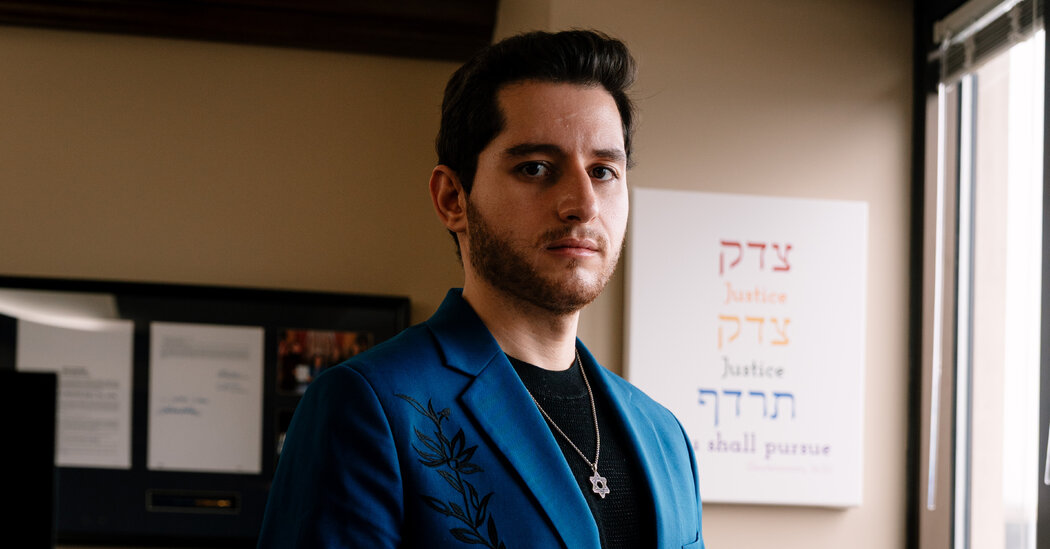
It had been less than a month since Noah Arbit’s childhood synagogue in West Bloomfield, Mich., was attacked by a man who rammed a truck through the entrance, forcing dozens of staff members and preschool children to flee the burning building. A letter he received left him outraged, and horrified.
“Let’s remember Jews brought this all upon themselves,” it read.
The letter, which was anonymous, denounced Israel’s treatment of Palestinians in Gaza and in the Israeli-occupied West Bank and then criticized a long list of well-known Jewish people.
Mr. Arbit, a Michigan state legislator who represents heavily Jewish suburbs of Detroit, had made fighting antisemitism a core to his platform since his first campaign in 2022. Critics had dismissed his concerns as overblown, he said, but now “there is a proof point I never wanted to be there.”
Across the country, at all levels of government, Jewish officeholders and candidates for public office — a majority of whom are Democrats — are facing a singular moment in recent history. At a time when incidents of antisemitism in the United States have risen sharply, Jewish politicians say they frequently find themselves personally targeted, according to interviews with nearly two dozen elected officials. They have faced antisemitic slurs and menacing voice mail messages, including threats of assassination. Protesters have called members of Congress “dirty Jews” during town hall events and thrown red liquid — meant to look like blood — on their front lawns.
The heightened antagonism has grown since Israel began its military campaign in Gaza in response to the Hamas-led attack on Israel, killing more than 70,000 people, according to the Gaza health ministry, and leveling entire cities and towns. As elements of the American left and right have grown increasingly critical of the Israeli government, Jewish politicians say they have been accused by some voters of being insufficiently supportive of Israel, while others say they’re insufficiently critical. They have been accused of having dual loyalties that pit their American identity against their support for Israel.
“It is excruciating and agonizing,” said Mr. Arbit, who has spent hours on phone calls and text chains with Jewish officeholders from across the country, as they trade their frustrations and feelings of isolation and despair.
“Across the board, we have never seen anything like this in my lifetime in public office,” said Representative Brad Sherman, who has represented Los Angeles for nearly three decades. “It’s like you turned the volume up from two to 10.”
All of this comes as the Democratic Party’s longstanding support for Israel has shattered. In a recent Pew Research Center survey, six in 10 Americans said they had a negative view of Israel; among Democrats, that number was eight in 10. This month, the majority of Democrats in the Senate voted to block further arms sales to Israel. Many Democratic leaders have fiercely criticized Israel’s conduct in the war in Gaza and violence in the West Bank. They have also blamed Prime Minister Benjamin Netanyahu for leading the United States into the war in Iran.
The policy debates have repeatedly spilled into intraparty politics. At a Michigan state convention this month, many Democrats booed and jeered at politicians who supported Israel.
While Jewish officials are among the most outspoken supporters of Israel, even those who are fiercely critical of the Jewish state have felt under attack. Despite being American elected officials, they are sometimes asked to answer for the Israeli government’s actions. For some, the line between anti-Israel protest and antisemitism feels increasingly blurred.
At the same time, there are no clear signs that this is dissuading Jews from entering politics. In Congress, Jews have been well represented for decades. While they make up roughly 2 percent of the adult population in the United States, they account for nearly 6 percent of the current members of Congress. A majority are Democrats.
And several Jewish Democrats, including Gov. Josh Shapiro of Pennsylvania, Gov. JB Pritzker of Illinois and Rahm Emanuel, the former mayor of Chicago, are considered potential 2028 presidential candidates, creating potentially the biggest field of Jewish Democrats at a particularly fraught time.
‘Fast and furious’
When Dana Nessel won her race for Michigan attorney general in 2018, she thought the most notable aspect of her biography was becoming the first openly gay person elected to a statewide office in Michigan.
She said she had received “far more” threats than her predecessors. “But I rarely, if ever, get threats for being gay or for being a woman,” she said. “They have been fast and furious and nearly always about me being Jewish.”
Often, such threats link Jewish politicians to the American Israel Public Affairs Committee, sometimes regardless of individual politicians’ connection to the group.
Ms. Nessel has no influence on foreign policy and, like all state officials, does not receive campaign donations from AIPAC, which lobbies for strong U.S.-Israel relations and pro-Israel policies. Still, she said, she has routinely been called an “AIPAC whore.”
The organization has played a central role in several congressional primaries this year, as super PACs aligned with it, including the United Democracy Project, have spent more than $20 million across several races. Now, anti-Israel activists are making the group itself into a campaign issue, and some candidates are publicly pledging not to take AIPAC money. But some Jewish politicians worry that the group has effectively become a stand-in to tar a broad section of Jewish donors, who fund a sizable chunk of Democratic campaigns.
“There are times when it feels like people don’t want you as part of the political system at all,” said Representative Greg Landsman, a Democrat from Ohio who was taken aback recently when a voter asked him: “Why do you take so much money from Israel?”
Mr. Landsman noted that he has deep ties to the American Jewish community but that the question falsely implied he had support from a foreign government, which is illegal. The voter apologized.
“Antisemitism has never disappeared — it’s always there,” said Representative Brad Schneider, who represents northern Chicago suburbs. “But there is no question that this is a completely different atmosphere.”
In July 2024, protesters showed up at Mr. Schneider’s home around 2 a.m., banging drums and blaring sirens before pouring red liquid on his lawn to mimic blood. Because his bedroom is in the back of the house, Mr. Schneider said, he and his wife did not hear the ruckus, but the protesters “terrorized the neighborhood” and several residents called the police. Mr. Schneider later hosted several neighbors in his backyard to listen to their concerns about Israel and Gaza. “In the end, I think they generated more support rather than less support of Israel.”
Critics on the left and the right
While Mr. Schneider is widely seen as a staunch advocate for Israel in Congress, some of the most vocal Jewish critics of Israel also say they have not been spared from antisemitic attacks.
This year, Scott Wiener, a California state senator running for Nancy Pelosi’s seat in the House, said that he believed that Israel’s actions in Gaza amounted to genocide. At the time, Mr. Wiener was serving as a chairman of the Jewish caucus in the State Legislature but stepped down after other Jewish leaders widely criticized him. Still, critics on the left blasted him for not taking a similar stance more quickly.
Weeks later, Mr. Wiener was walking near his home in San Francisco’s Castro District, the city’s historic gay neighborhood, and spotted a startling flier taped to phone pole. It featured a black and white image of his face with the words, “I put foreign state interests above your own!” coming out of his open mouth.
“It is a very complicated and hard time as a Jew to be running for Congress,” he said.
Mr. Wiener pointed to a Chinese American leader who is also running for office in San Francisco and noted that he had not heard her asked about China’s policy on anything. “I have not heard anyone somehow questioning her loyalty,” he said. “If anyone did, I would condemn that — and I think a lot of people would — as being completely racist. Yet for a Jewish candidate, that is now considered normal and unsurprising.”
The Anti-Defamation League, which monitors antisemitism in the United States, has asked survey respondents whether they believe “Jews are more loyal to Israel than to America” for more than four decades. The most recent survey, released in 2024, found that 45 percent believed that it was somewhat or mostly true, up from 24 percent in 2020 and a record.
In a memoir published this year, Mr. Shapiro described a contentious vetting process when he was being considered as a potential running mate for Kamala Harris in 2024. Her team, he said, zeroed in on his views on Israel and at one point asked if he had been an agent of the Israeli government — a line of questioning he found offensive.
Dan Gerstein, a former aide to Joe Lieberman, a Connecticut senator and prominent Jewish Democrat who was a party’s nominee for vice president in 2000, said such questions would have been “unimaginable” back then.
“The idea that you could have someone mainstream who was hostile to Israel was a nonstarter in national politics then, but that script has flipped,” Mr. Gerstein said. “Now support for Israel is regarded with a base line suspicion by much of the Democratic base.”
For Jewish elected officials trying to navigate this shift, the atmosphere has felt alienating.
“It is very isolating,” said Representative Josh Gottheimer, who represents northern New Jersey in Congress. “It’s like you’re losing your home in the Democratic Party and in the country.”

