



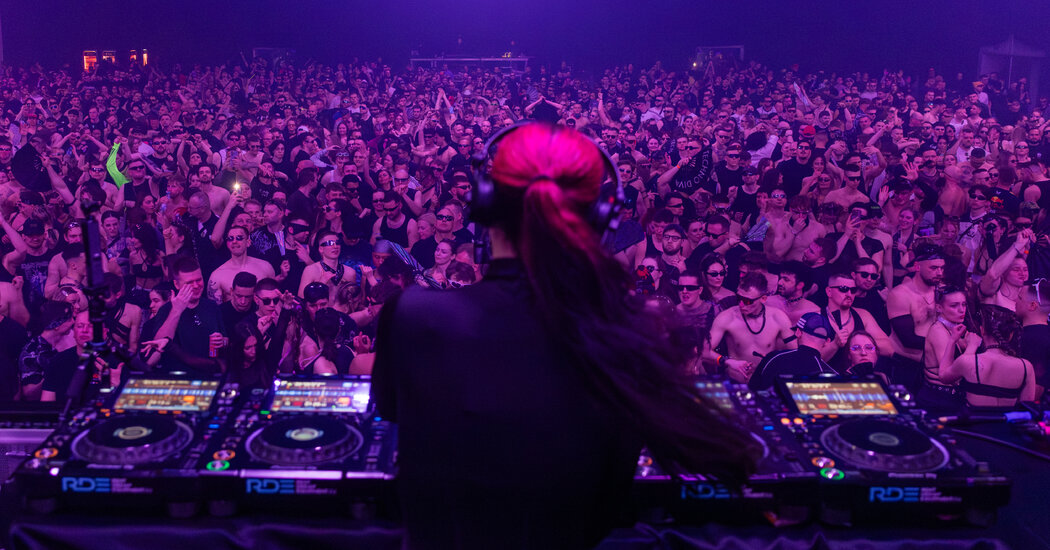
The clock struck midnight at the nightclub in Warsaw on a breezy Friday evening in April, but the party had barely begun.
Cool kids clad in oversize jackets and sensible sneakers were trickling into K-Bar, an unassuming club in the towers of a bridge. Inside, D.J.s played atmospheric, eclectic underground electronic music on foggy dance floors for a party that would go past 5 a.m.
I headed across the city to a rave in full swing. It was now a little after 1 a.m. Thousands of people packed a cavernous convention hall, dancing to intense, heart-racing hard-techno beats as if their lives depended on it. Clara Cuvé, a Berlin-based D.J., played a bracing remix of Papa Roach’s “Last Resort.” The crowd exploded, furiously fist-pumping the air and dancing so wildly that the D.J. platform shook.
This party, hosted by the event series Exist, attracted a crowd that had clearly come to be seen. Most attendees, wearing sunglasses and fetish-inspired clothing made of latex and leather, seemed prepared to dance past sunrise. Revelers were still bounding in as I climbed into a cab at 3:30 a.m. Later that morning, I woke up with the music echoing in my ears and wondered: Is the party still going?
House and techno music, created in the 1980s by artists in Black and queer communities as a form of resistance and escapism, have freedom and energy at their core. Both qualities are big draws for me, a regular New York City clubgoer.
In Warsaw, I found a scrappy, dynamic club culture fueled by local talent and experimental underground music collectives. Elaborately produced raves are proliferating in the city, world-famous D.J.s are taking notice and homegrown artists are going global.
Warsaw receives far more domestic tourists than international visitors, but a growing number of people from Western Europe, the United States and Israel have come over the past two years, according to the city’s tourism organization. In 2024, a record of more than 3.6 million international tourists visited, a nearly 60 percent increase from the previous year. By comparison, Berlin received 4.7 million international tourists in 2024, that city’s marketing agency said.
“Warsaw seems to be the new Berlin in techno tourism,” said Artur Wojtczak, a 50-year-old electronic music journalist based in the city. “We have something absolutely fresh,” he added. “We have lots of young energy.”
Julia Kaczmarczyk, a 26-year-old D.J. who performs as Hekato, said it all felt like a “sign we are doing something right.”
And these kinds of large-scale parties could soon be happening in Warsaw more regularly through a new mega-event series called Sektor 6D.
“In all capital cities, it’s kind of normal to have big-scale events almost every weekend,” said Sept (real name: Michel Morales), a 33-year-old Polish D.J. who lives in Berlin and is also the main booker for Exist and Sektor 6D. “This is what was kind of missing in Warsaw.”
Mateusz Cyryl Prus, a 40-year-old D.J. who runs the music collective Move Mozg with his partner, the D.J. Ola Teks, said that visitors are often surprised by what they find in Warsaw.
It’s changed a lot in 20 years, he said, adding, “We are a supermodern city and there are a lot of cool people here.”
‘Everyone Needs to Let Go’
A night out in Warsaw can start on Friday and last until Monday.
I spent Saturday night at Jasna 1, a moody, subterranean club in a former bank that is considered by many local D.J.s to be the city’s premier dance music destination.
The event on Saturday night was a 10th anniversary celebration for Eerste Communie, an Amsterdam-based event series.
I arrived at 1 a.m. as the club was starting to fill up. The bass lines reverberated across the foggy, red-lit dance floor. The warren-like space held surprises like a smoking den, a crowded gay bar called Metropolis and, downstairs, a bank vault that occasionally doubled as a dance floor.
I found Mr. Wojtczak, and we settled into a lounge area with muted lighting and billowing white textiles draped along the ceiling. He told me that dance music was a kind of compass for him.
“I felt from the first time I heard it that this was going to change my life,” he said, noting that he goes clubbing at least twice a week, often traveling across Poland for events.
I’d been apprehensive about clubbing solo as a woman in an unfamiliar city. But the night unspooled easily. People were eager to connect. Several others joined our conversation.
I headed alone to the dance floor and lost track of time. Fueled by many caffeinated beverages, I danced for hours to rolling, hypnotic bass lines. The percussive music was a physical sensation, too; the bass vibrated in my body. The D.J.s performed in a cube of metal scaffolding surrounded by the crowd. From inches away, I could see them cue up the next song.
It felt like existing in another dimension. It didn’t matter that I was alone.
I reflected on how Max Mehraliyev, 28, a brand manager for the Exist parties whom I’d met the previous night, described clubbing’s allure. “You kind of lose yourself in the music and then you find yourself,” he said. “Everyone needs to let go.”
Jedrzej Kowalczyk, Jasna 1’s artistic director and one of the club’s resident D.J.s, said that cultivating an open and accepting community was one of his biggest priorities. Jasna 1 has a strict no-discrimination policy and staffers regularly make safety checks throughout events. As at many other clubs, photography is prohibited.
“I’m super proud that finally we have this safe space and we have a real community around the club,” Mr. Kowalczyk, 34, said, noting that a recent influx of refugees from Ukraine and Belarus has infused a new energy into the city’s nightlife.
By 6 a.m., as Amoral, a Dutch D.J. who tours clubs worldwide, was shredding the decks, my trance was broken. Tiredness and hunger had won out.
Exiting the vespertine club and being greeted by the sunlight felt both transgressive and disorienting. I hopped into a cab, bound for the Puro Stare Miasto, a Scandinavian-design-inspired hotel. I stumbled zombielike into the lobby, as a spandex-clad fellow guest concluded his morning run. We both made a beeline for the breakfast buffet.
Discovering the Daytime City
Even though my reporting dictated that I experience Warsaw mostly by night, I made an effort to see as much of the daytime city as I could.
The immaculate parks and gardens teemed with locals of all ages, many with their dogs, enjoying the intoxicating sunshine of early spring in Eastern Europe. Lazienki Park, a sprawling complex that used to be a royal summer retreat, features a neo-Classical palace on an artificial island, miles of tree-lined walking paths and ponds filled with mandarin ducks.
I also sought out great meals. I ate the best pierogi of my life at Przegryz, a cozy bistro on the boutique-filled Mokotowska Street. Steamed, filled with melt-in-your-mouth tender duck and beef, and topped with herbs, the dish wouldn’t have been out of place at a fine dining restaurant, except for the price — less than $15.
The Old Town, a UNESCO World Heritage site, charmed me with stately townhouses that seemed centuries old. But a majority of the neighborhood was painstakingly rebuilt after World War II. At the Warsaw Rising Museum, I learned more about the Polish underground movement’s courageous but doomed attempt to fight the Nazis.
On Sunday, my last full day in Warsaw, I made an afternoon visit to Smolna, a club in a multistory neo-Classical townhouse. The party had been going since Friday afternoon. Inside, bleary-eyed people were splayed out on couches. Kendal, a French D.J., was playing upbeat Italo-disco tracks while several dozen people swayed on a dance floor padded with heavy carpets. Sunlight streamed in through a skylight.
Mr. Wojtczak was there. This time, he was beaming and dancing on a riser at his favorite spot — right by the speakers.
As I ended my exhilarating weekend in Warsaw, I paused outside the townhouse to take in the setting, blocks away from the city’s newly revitalized central square. A family with a young child in tow meandered by, peering curiously at the entrance.

