



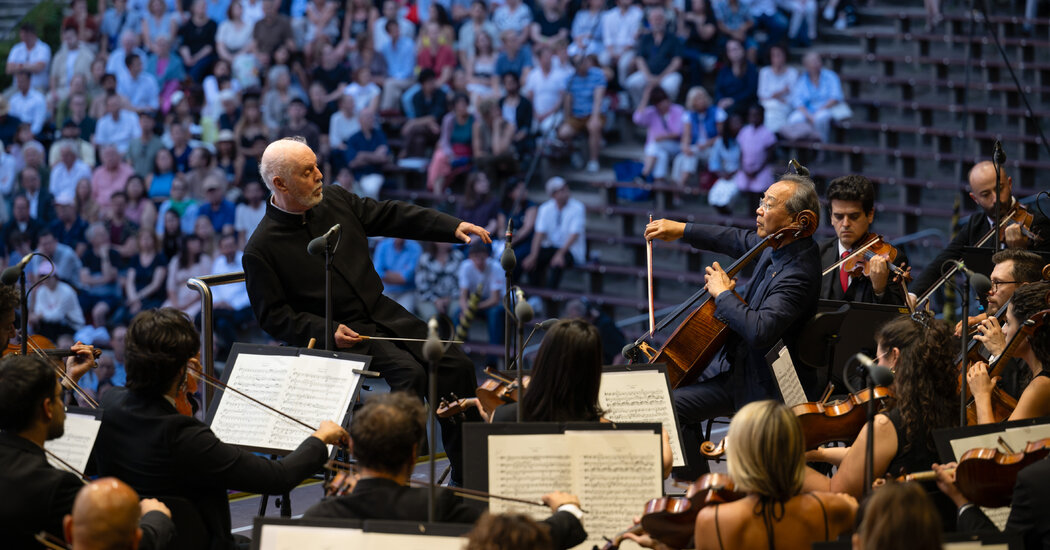
These understated gestures, though, were often extremely effective, and conductors have done more with even less: The example of Leonard Bernstein conducting a Haydn symphony with just his eyebrows comes to mind. When Bernstein did that, in 1984, he could rely on the well-oiled machine of the Vienna Philharmonic. Thursday’s players weren’t as well synchronized and couldn’t necessarily count Barenboim, who conducted seated, for clear guidance.
It was fortunate that Ma had just come from Tanglewood, where he had organized a conductor-less performance of Beethoven’s “Pastoral” Symphony. In a program note, he described it as “an example of what distributed leadership can sound like and a lesson in the practice of democratic responsibility.” This was exactly the responsibility that he and orchestra took in the concerto’s more intimate exchanges. The dialogue between cellist and woodwinds, and later, cellist and a solo violin, was pure chamber music.
Ma’s recent Tanglewood experiment aligns with the West-Eastern Divan’s musical and humanitarian ethos, which Barenboim articulated succinctly in the wake of the Hamas-led attack on Israel on Oct. 7, 2023: “We have to listen to each other.” At one point in the concert’s second half, during Schumann’s Symphony No. 3, Barenboim’s left hand pointed to his ear.
He has spent more than 25 years giving this orchestra what they could not get without him: a sound. Weighty but transparent. Old fashioned, in a way, but not fussy. It was there in the controlled explosions in the Schumann, the serenity of the counterpoint. It is undoubtedly Barenboim’s sound, but it’s also the orchestra’s to run with.
Barenboim seems to have recognized this. In the statement that announced he had Parkinson’s, he said he wanted “to ensure the orchestra’s long-term stability and development” and “take an active role in ensuring that the Divan has the opportunity of working with excellent conductors.”
But Barenboim’s first move in this direction was a rare misstep: hiring his close friend Zubin Mehta to direct a tour with the orchestra earlier this year. Mehta is excellent — but, at 90, he also conducts sitting down. This is not a plan for the future, nor a way to keep this symbol of imperiled international cooperation vital.

