



Phillis Wheatley, an enslaved woman in 18th-century Boston, was “the first American of her background” to publish a book of poetry. That background? Unclear.
Booker T. Washington, who was born into slavery, was “a classic example of how individual effort and a ‘can-do’ spirit can overcome any obstacle in a free society.” The obstacles he overcame? Unsaid.
And the Rev. Dr. Martin Luther King Jr.?
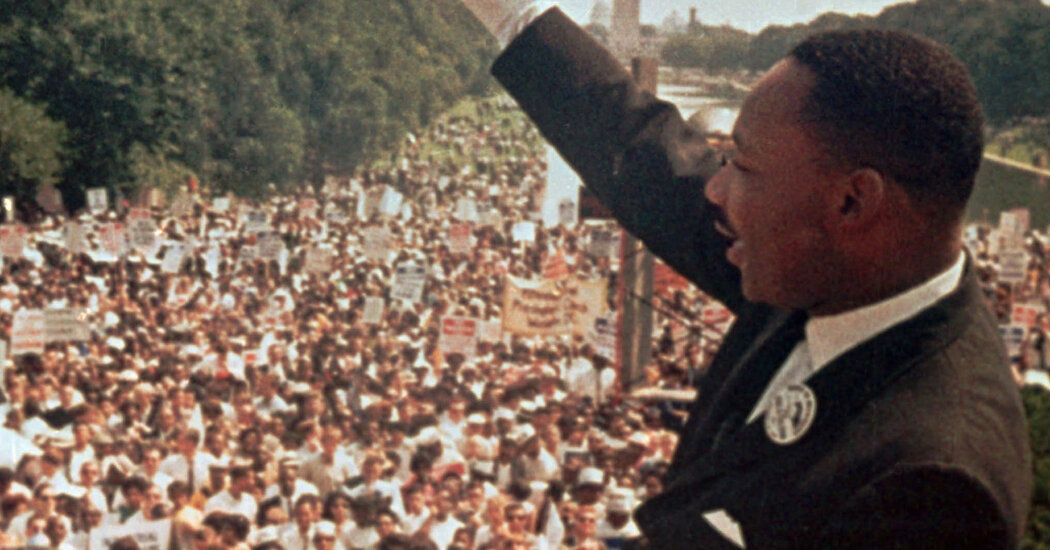
“With incredible can-do spirit, he led a movement to ensure that every citizen would be judged by the ‘content of their character’ rather than their outward appearance. His ‘I Have a Dream’ speech, delivered at the Lincoln Memorial, is one of the most powerful calls for national unity in our history.”
These snippets are part of guidelines for a new national student competition connected with President Trump’s proposed National Garden of American Heroes, and the latest window into the administration’s broader efforts to recast the country’s history in a sunnier key.
The American Heroes Student Art Contest was announced on Thursday in a video featuring Linda McMahon, the secretary of education. It is sponsored by Freedom 250, a group Mr. Trump created to promote his signature events commemorating this year’s 250th anniversary of the Declaration of Independence, which include a prayer rally on the National Mall in May and a Grand Prix car race around Washington in August.
The 168 first-place winners, from each state and territory, will be invited this summer to Washington, where their art will be displayed at the Great American State Fair, a Trump-backed event that will occupy the Mall from June 25 to July 10.
Freedom 250 did not immediately respond to a request for comment. The White House declined to to provide an update on the status of Mr. Trump’s patriotic sculpture garden, a project he teased in his first term and returned to in his second. While the administration had previously indicated it would be ready by July 4, no designs or even the location have been released.
But the art contest, which is open to students in grades 3-12, is being greeted skeptically by some historians and educators, who see it as missing more than just important facts.
“It removes the drama and energy and friction that makes history or personal stories interesting,” said John Dichtl, the president and chief executive of the American Association for State and Local History. “It doesn’t leave any place for an individual to connect with and make it part of their history of America.”
The garden project has inspired a mix of curiosity, speculation and, among historians, concern, including over how it will treat its eclectic mix of 250 heroes Mr. Trump has selected for recognition. The choices mix traditional American icons like George Washington, Abraham Lincoln, Babe Ruth and the Wright Brothers with figures like Kobe Bryant, Julia Child, Hannah Arendt and the “Jeopardy!” host Alex Trebek.
Questions about the numerous civil rights activists set for inclusion have been especially sharp, particularly as the Trump administration has begun removing references to slavery, civil rights and other subjects it sees as divisive from National Park Service sites across the country.
The 85 pages of biographies provided to help students with their entries, which must include a 200-word text, suggest an approach that emphasizes national unity, meritocracy and individual rights, while glossing over the fact that many of the heroes exemplify traditions of protest and dissent.
The words “slavery” or “slave” appear only twice, including in the entry on Frederick Douglass, who “escaped from slavery to become a leading voice for liberty.” Douglass is presented not as an opponent of slavery — the word “abolitionist” and its variants do not appear in the document — but as “a proud patriot who loved his country and wanted to see it become the best version of itself.”
The phrase “civil rights” appears in only one biography, for the actor Charlton Heston, who is described as “a strong supporter of the Civil Rights movement” who once marched with Dr. King, as well as an advocate for gun rights.
By contrast, references to the “can-do” American spirit appear 32 times, including in entries for Orville Wright, Sojourner Truth, Dolley Madison, Franklin D. Roosevelt and Dr. Seuss.
There is also no acknowledgment that some who fought to defend liberty, equality and national unity have faced violence from fellow Americans.
The entry for Abraham Lincoln, hailed as an example of how “a person of humble beginnings can rise to the highest office through character and merit,” refers to the Emancipation Proclamation. But it includes no reference to the fact that he was assassinated by a supporter of Southern slavery, a topic covered in children’s books.
The entries for Dr. King and the civil rights leader Medgar Evers, who is acknowledged for helping “spark a movement that strengthened the foundations of American liberty,” also make no reference to the fact that they were murdered.

