



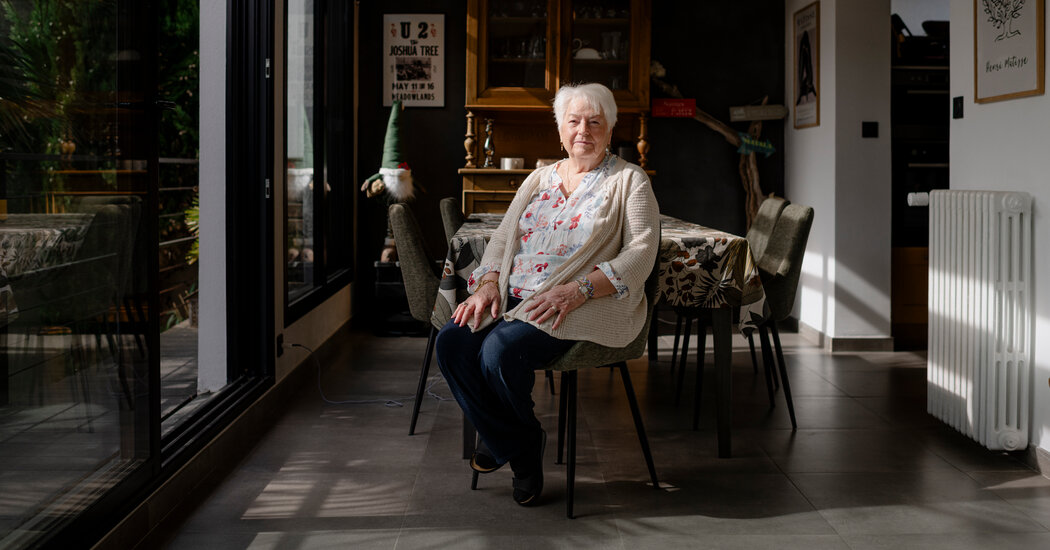
Marie-Thérèse Ross-Mahé was in bed at home in Anniston, Ala., when she was startled awake by banging. Men had surrounded the bungalow where Ms. Ross-Mahé, a French citizen, had lived with her American husband until he died in January. They were knocking loudly on the windows and doors.
When Ms. Ross-Mahé, 85, opened the door, they pushed inside, saying they were the immigration police, she said in an interview. They handcuffed her and took her to an unmarked car before driving her to a jail cell. She was still in her bathrobe, pajamas and slippers, she said.
“I didn’t know what was happening to me really,” she told me in France this week, in her first interview since being deported after a 16-day incarceration. “It was very humiliating. My hair had not even been combed. I was just getting out of bed.”
After her arrest on April 1, Ms. Ross-Mahé was swallowed into the country’s sprawling immigration detention system, where, she said, she was chained by her wrists and ankles to other inmates and loaded onto buses and a plane “like a potato sack.” After two weeks in detention in Alabama and Louisiana, she said, she feared she might die.
Her story gives a glimpse into the opaque labyrinth of immigrant-detention sites operated by the Trump administration, where many like her see no lawyer, have no sense of where they are and understand little of why they are held or, in her case, later released. It also raises questions about how that system may be weaponized: A judge said in a ruling that she believed that Ms. Ross-Mahé’s stepson Tony Ross, who had been fighting with her over her late husband’s estate, instigated her arrest.
The New York Times could not independently confirm the details of her experience in detention, but it aligns with the accounts of others who have been detained in similar circumstances. Tony and his brother, Gary Ross, did not respond to requests for comment, nor did their lawyer.
The experience stunned Ms. Ross-Mahé, who previously considered herself a supporter of President Trump and so admired his policy to deport illegal immigrants that she thought it should be adopted in France.
“I didn’t think these things existed,” she said of the immigration facilities she was held in. “I thought that when we arrested them, we would treat them properly. It really shocked me.”
She added, “They treat them like dogs, not in a human way.”
Asked for comment, the Homeland Security Department said in a statement that “all detainees are provided with proper meals, quality water, blankets, medical treatment, and have opportunities to communicate with their family members and lawyers.” It added that “ICE has higher detention standards than most U.S. prisons that hold actual U.S. citizens” and is “regularly audited and inspected by external agencies.”
Ms. Ross-Mahé said she and her American husband, Bill Ross, first dated in the 1950s, when they both worked at a NATO base on the outskirts of Nantes, in western France — she as a secretary, he as a soldier. Their romance was short-lived, she said, as he developed a relationship with one of her friends in town, Michèle Viaud, moving back to Alabama with her.
They stayed in touch over the decades as they built their lives and families. Mr. Ross married and raised two sons with Ms. Viaud, who died in 2018. Ms. Ross-Mahé had three children with her first husband, Bernard Goix, who died of lung cancer in 2022.
Mr. Ross sent her supportive messages when Bernard fell sick, she said.
Four months after Bernard died, Mr. Ross sent her a ticket to visit him in Alabama.
Their friendship quickly shifted to love. “Everything came back,” said Ms. Ross-Mahé. For almost two years, they flew between Alabama and France, visiting each other.
Last year, they married in Alabama in April 2025, first in a parking lot before a notary and then in a church.
Mr. Ross hired a lawyer to process her application for permanent residency, she said. She received an employment authorization document from U.S. Citizenship and Immigration Services, she added — a first step toward getting a Social Security number. Because she was a veteran’s spouse, the Department of Defense gave her an identification card, which The New York Times reviewed, that gave her grocery discounts at a nearby military base.
Weeks before her arrest, a neighbor took her to an appointment related to her application at the immigration office, she said.
“For me, I was legal,” she said. “I never thought this could happen.”
Mr. Ross died suddenly one night in January. Ms. Ross-Mahé said she found him in the bathroom, already cold. He left behind the bungalow with its backyard pool, worth about $173,000; two vehicles; and a bank account holding about $1,500, according to court records. He did not leave a will.
Soon, Ms. Ross-Mahé clashed with Mr. Ross’s sons, both in their 50s, over the inheritance.
The day after Mr. Ross’s death, his sons took his truck and car, according to a ruling by a county probate judge, making it hard for Ms. Ross-Mahé to leave the neighborhood. Court records said the sons forced her to give them her husband’s cellphone. That meant she couldn’t make local calls, she said, since she had only her French phone.
Ms. Ross-Mahé said they cut off her cable and internet, took their father’s credit cards and refused to help her fill her prescription for blood pressure medication.
Her neighbors came to her rescue, helping pay her electricity and water bills, she said. They took her to the hospital, bought her groceries and organized Wheels on Meals deliveries to the house, she added.
She found a second lawyer and changed the locks on the house so Mr. Ross’s sons couldn’t enter whenever they wanted, she said. She covered the windows with paper, so no one could see in.
“I didn’t want to let them win,” she said. “But I was not feeling good at all. I wasn’t eating. I wasn’t sleeping. I was scared to death.”
The probate court set a date for a hearing on April 9.
With eight days to go, Ms. Ross-Mahé was arrested by Homeland Security agents.
She said an ICE officer told her she had been illegally in the United States between September, when her 90-day visa ended, and early December, when her green card application was submitted. The Homeland Security Department initially said in a statement that she had overstayed a 90-day visa by roughly four months, but said in a later statement she had been in the country illegally for seven months.
In her ruling on April 10, the probate judge, Shirley A. Millwood, a Republican elected in 2024, accused Mr. Ross’s youngest son, Tony, a courthouse security officer and former state trooper, of initiating his stepmother’s arrest.
The judge said that U.S. marshals notified Tony the day before the arrest that she would be detained shortly. An hour after her detention, he received a text message confirming her arrest, the judge said.
At first, Ms. Ross-Mahé and her lawyer said, she was imprisoned in a filthy county jail, before being flown in chains to Louisiana and held in an ICE processing center.
Throughout the journey, she said, she was made to wait for hours without explanation on hard benches, dirty prison beds or in trucks.
“It was humiliation all the time,” she said. “They never talked, they were always yelling.”
The experience worsened her back pain and sciatica, making it hard for her to walk.
The other female inmates helped her move to the bathroom and shower, she said. They made her hot chocolate and offered her cookies. The night before Easter, she said, they sang hymns that brought her to tears.
“They were wonderful,” she said. “I found God in that jail through those women.”
After two weeks of detention, she said, she lost hope of being released and didn’t think she could survive much longer.
“I was waiting to die, really,” she said. “I knew I was not going to make it.”
On the morning of April 16, the 16th of her incarceration, she said, she was awakened at 2 a.m. by a guard and told she was leaving. She was frightened that she would be transferred to another facility. Instead, she was flown to Dallas and later taken to an American Airlines plane heading to Paris.
The French consul general in New Orleans, Rodolphe Sambou, who had lobbied for her release, said the American government had “decided to release her, given her age and medical condition.”
Back in France with her sons, Ms. Ross-Mahé is still in shock. She wears clothes bought at the mall on her way back from the airport, since her old belongings remain in Alabama. A doctor has diagnosed her with post-traumatic stress disorder, she said.
She learned about the judge’s ruling, and the suggestion that her stepsons instigated her arrest, only after her release.
“I didn’t think they were capable of doing something like that,” she said. “It has destroyed a part of me.”
Mr. Ross’s gold wedding ring hangs from a chain on her neck, together with a cross made of red gems.
“I will never be able to go back to my husband’s grave. I will not be able go back to see my friends there,” she said. “That really hurts.”
Nicholas Bogel-Burroughs contributed reporting from New York.

