



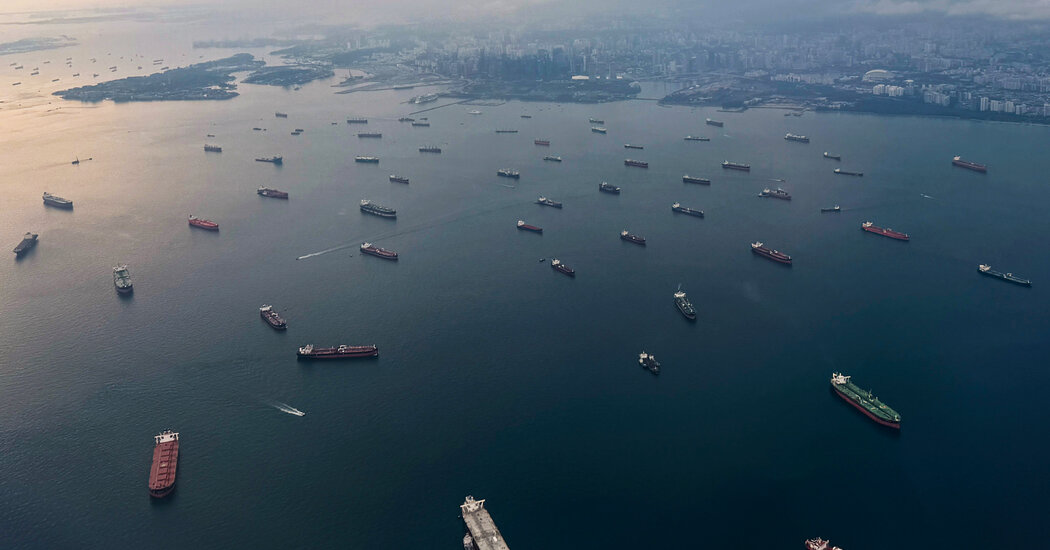
It’s probably fair to say that two months ago, most people didn’t think or talk much about the Strait of Hormuz. (At least I didn’t.) But now that it’s effectively closed, with implications for people around the globe, it’s hard to avoid.
Iran’s statements that it will start charging for passage have called into question long-held assumptions about freedom of transit. That has already led to other countries flirting with similar plans. Today I write about how the mere idea of a toll could change the world — even if it’s never imposed.
Strait ahead
Call it the Hormuz contagion effect.
Far away from the standoff in the Middle East, Indonesia’s finance minister made a seemingly offhand remark this month. He mused about imposing tolls on ships passing through the Malacca Strait, which, like the Strait of Hormuz, is one of the world’s busiest waterways.
“If we split it three ways between Indonesia, Malaysia and Singapore, that could be quite something, right?” he said.
The idea was swiftly shot down by Malaysia’s foreign minister, Singapore’s foreign minister and Indonesia’s own foreign minister alike. And yet the seed had been planted. It has been the subject of much discussion since.
Few observers really expect a toll in the Malacca Strait. But Iran’s proposed fee — and the experience of a global choke point being closed from one day to the next, causing an almost instant economic crisis — is shifting how companies and countries think about a handful of vital straits around the world.
These waterways are hugely beneficial to those using them for trade. For the countries that border them, they also represent a source of geopolitical power that has long sat dormant. But now their potential leverage is plain for all to see. And that has raised a new question for strait countries: What’s in it for us?
It has been done before
For centuries, the answer was, “a lot.”
I spoke to Natalie Klein, a professor of international law at University of New South Wales, Sydney, in Australia. She told me the Ottoman sultans had levied tolls on ships entering the Dardanelles toward the Black Sea. The Barbary pirates charged European and American vessels leaving the Mediterranean. And perhaps the most famous tolls in history are the Danish Sound dues.
In 1429, the King of Denmark introduced steep dues on the sound that separates Denmark and Sweden. At one point, Klein said, income from the dues made up two-thirds of Denmark’s revenue.
The Danes enforced their tolls at cannon point and defended them with arguments that feel familiar today. The strait was in Danish waters, they said, and those waters could not simply be declared toll-free just because other countries found that convenient.
The rise of industrial shipping in the 19th and 20th centuries changed the calculus. Even strait countries recognized the benefits of unimpeded global trade. That new consensus gradually gave rise to international norms that abolished strait tolls. In 1982 the United Nations Convention on the Law of the Sea codified free navigation of straits, which has largely held ever since.
“Our starting point for so long has been that ships need to be able to move freely through straits,” Klein said. “Iran’s idea to toll the Strait of Hormuz cuts against everything that the body of law has stood for.”
A toll order
But Iran is not a party to the U.N. Convention on the Law of the Sea. (Neither is the U.S., for that matter.) And the idea that all this might end with a toll on the Strait of Hormuz has gained traction. One analyst for the website Eurointelligence called it a “consensus view.”
Should that happen, the precedent would be a big deal. There are multiple straits around the globe that are critical for the movement of billions of dollars’ worth of goods every day, Klein said. Tolls would make shipping more expensive. Higher shipping costs would make goods more expensive. And that, she said, “has implications for all of our economies.”
Not everyone thinks that’s the most likely outcome. Alexander Lott, a professor at the Norwegian Centre for the Law of the Sea, noted that in its recent rhetoric, Iran itself has cited the Law of the Sea, which he takes as a sign that it won’t ultimately implement an explicit toll.
But that doesn’t mean Iran won’t try to get something else out of its control of the strait, he said. It is already using it as leverage in peace talks. And it still might find other ways to monetize it.
Japan has contributed to the maintenance of the Strait of Malacca for decades. Other Asian countries have entered into similar agreements more recently. (Maintenance can include paying for infrastructure like lighthouses and buoys.)
With the closure of the Strait of Hormuz as a backdrop, other countries might not even have to articulate a threat, said Dita Liliansa, a colleague of Klein’s at U.N.S.W. Sydney. “They could just say, ‘Look, we’re not going to impose a toll, but it would be really nice if you helped us financially.’”
After all, what is a maintenance fee but a toll with a nicer name?
Whatever the outcome in Iran, something has shifted. Shipping is already likely to become more expensive. Insurers may demand higher premiums as they try to price in new levels of geopolitical risk.
In Southeast Asia, in the aftermath of the Indonesian minister’s comments, this is already happening. One market analyst this week put a name to the rising costs of insuring, shipping and moving fossil fuels through the world’s other crucial waterway. He called it “the Malacca Premium.”
The Iran war has so far cost the U.S. $25 billion
The U.S. defense secretary, Pete Hegseth, made his first major appearance before Congress since the beginning of the war with Iran yesterday. He used the hearing as an opportunity to bash critics of the war.
The Pentagon’s finance comptroller said the war had cost the U.S. about $25 billion so far, most of which was spent on bombs and missiles. It was the first time the Defense Department has publicly provided a cost estimate for the war. Here are the takeaways.
The king and queen in New York
King Charles III and Queen Camilla spent the third day of their U.S. trip in Manhattan. In the morning, the royal couple laid a bouquet at the Sept. 11 memorial. Later, Charles met with young people at an urban farm in Harlem and fed chickens. And Queen Camilla visited Winnie-the-Pooh at the New York Public Library. Their day ended with a gala at Christie’s Auction House, attended by Lionel Richie, Anna Wintour and Donatella Versace.
Mayor Zohran Mamdani of New York, hours before he briefly met with the king, was asked what he would say to Charles if they were to have a private meeting. “I would probably encourage him to return the Koh-i-Noor Diamond,” he said, referring to the 105.6-carat diamond taken from India and presented to Queen Victoria.
TOP OF THE WORLD
The most clicked link in your newsletter yesterday was about the king’s state dinner at the White House.
OTHER NEWS
WHAT ELSE IS HAPPENING
SPORTS
Hockey: A U.S. crowd chimed in to sing “O Canada” after a mic failure at an N.H.L. playoff game, in a rare moment of U.S.-Canadian bonhomie.
Tennis: The irresistible rise of Rafael Jódar is upending Spain’s most famous tennis archetype — the grinder who turns his opponents’ legs to goo.
LAST WORDS OF THE DAY
That’s what Maynard Hirshon wrote in his short and quirky self-obituary, which appeared in The Tampa Bay Times in 2021. As newsroom staffs have shrunk, newspapers across the U.S. have turned to paid obituaries. The practice has led to some irreverent tributes filled with unvarnished truths.
Many content creators and influencers in the Arab world are meeting the turmoil in the Middle East with edgy humor. One popular video plays off the TV show “Arab Idol,” with anxious contestants awaiting results, comparing it to people across the region nervously waiting to see whether cease-fires will be reached.
The dark humor is part of a broader rise of comedy across the Middle East, flowing from an internet-savvy generation raised on social media. “We always like to cope through humor,” a 22-year-old Lebanese content creator said. Read more and see clips here.
AROUND THE WORLD
Why are top U.S. sushi restaurants so pricey?
Sushi began in Japan as a quick working-class meal, but it has since morphed in the U.S. into an elaborate pampering of well-heeled diners, with ingredients like Wagyu, truffles, gold leaf and caviar.
The result, our critic Ligaya Mishan writes, is omakase meals that often feature “pliant and unchallenging fish, occasional pyrotechnics and status-symbol frills on demand” — all at a cost of up to $1,200 per person. Read how sushi has become a delicious — but often boring — luxury experience.
RECOMMENDATIONS
Read: You can’t always get what you want, unless it’s a new Rolling Stones biography.
Refresh: Enjoy a nap or a shower after a long flight at these international airports with affordable arrivals lounges.
Listen: A new generation of musicians is discovering the Norwegian composer Geirr Tveitt, whose reputation was tarnished by his nationalist politics.
This traditional Armenian rice pilaf recipe has been passed down through the generations of one writer’s family. Peas, parsley and allspice have been added for extra flavor and color.

