



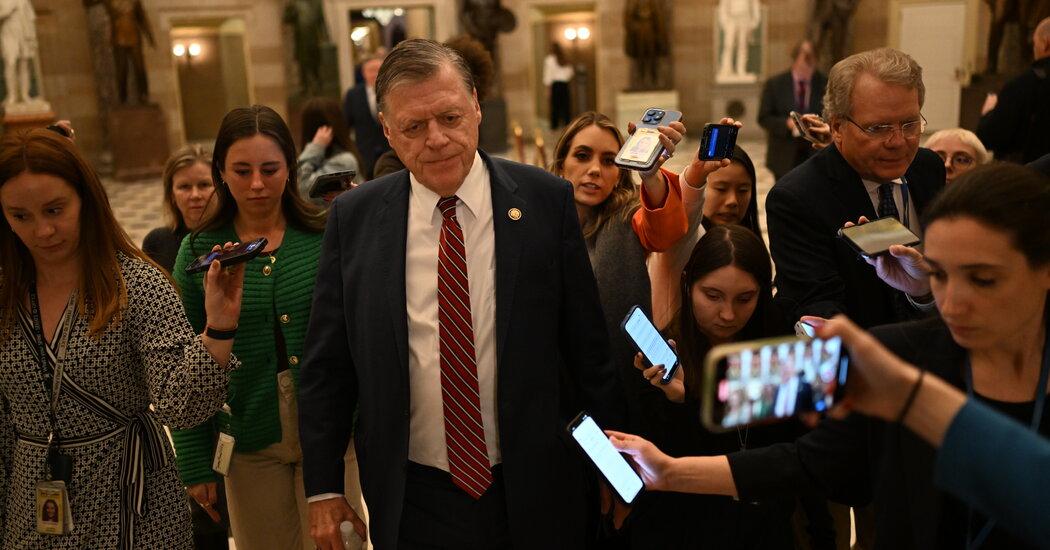
Representative Tom Cole, the Oklahoma Republican who leads the Appropriations Committee and is a longtime party political strategist, observed on Wednesday that congressional majorities are typically lost either through overreach or dysfunction.
Congressional Republicans seem to be opting for the latter.
“Right now we don’t look as functional as we need to look,” Mr. Cole acknowledged as the House and Senate strained to get some of their most basic work done in the face of bitter internal divisions and increased finger-pointing among Republicans.
With midterm elections approaching and control of both chambers at real risk, Republicans are struggling to pass essential legislation, let alone the political messaging bills typical of the months running up to Election Day.
The House floor was frozen on Tuesday and ground to a standstill for several hours on Wednesday as Republican leaders pleaded for votes and cut side deals. Two of those hours were spent laboring to win a preliminary vote to begin debate on a series of bills — what used to be considered a routine step until the current Republican majority assumed power and rank-and-file lawmakers, noting their party’s vanishingly slim margin of control, latched on to such moments as leverage.
Now the routine step has become an extraordinary travail for Speaker Mike Johnson, who is constantly toiling to please various Republican factions, cognizant that a misstep, or any reliance on Democratic votes to pass bills, could draw a challenge that could cost him his job.
“We live in a period where leaders are afraid of their members, and members are afraid of their voters,” said Mr. Cole.
On Wednesday, heated discussions were prevalent on the Republican side of the aisle. Lawmakers shouted at each other across the House floor. Mr. Johnson huddled with holdouts and defectors, beseeching them to get in line. Deals were cut, then reneged on and renegotiated, and even the G.O.P. budget plan — normally a unifying measure — stalled for more than five hours as unrelated disputes were hashed out behind closed doors.
“Guys, this is why they say lawmaking is like watching sausage be made,” a beleaguered Mr. Johnson told reporters at the Capitol on Wednesday evening.
Some Republicans even accused their colleagues of being in the pocket of the pesticide industry — the sort of pointed critique usually aimed at members of the opposing party if made at all, since lawmakers do not like to remind voters about the influence of political contributions.
Other Republicans shrugged off the escalating political combat as the way business is done these days.
“It should be a fist fight on everything,” said Representative Tim Burchett, Republican of Tennessee. “It shouldn’t be easy.”
But the congressional temperature was rising high enough that one former Republican House member from Texas, Mayra Flores, urged her ex-colleagues to take it behind closed doors.
“There is no reason to turn every issue into a public spectacle online,” Ms. Flores wrote on X, saying she was “honestly embarrassed” by the conduct of some of her former colleagues. “The country is facing real challenges, and constant public infighting only makes the work harder.”
Republican leaders, trying to break a logjam that threatened to derail their entire immediate agenda, relented on Wednesday and agreed to rework a major farm policy measure that is historically one of the more popular bills before Congress. But its path remained unclear because of a dispute over ethanol tax credits and opposition from a handful of Republican lawmakers who opposed a liability shield for pesticide producers that has outraged the Make America Healthy Again movement.
“This is causing cancer and it is making people sick,” Representative Anna Paulina Luna, Republican of Florida, said as she urged reporters to investigate members of the Agriculture Committee and the donations they get from pesticide producers.
After sundown, Republicans got stuck on the budget resolution providing the framework for $70 billion in funding for President Trump’s immigration crackdown as they tried to quell protests over Mr. Johnson’s handling of the farm bill. The budget outline finally passed on a party-line vote, but it was a mark of the G.O.P. difficulties that a surge of money for tough immigration enforcement embraced by nearly all Republicans was almost sidelined by the farm bill furor.
The House voted to extend a surveillance law that the intelligence community says is critical to identifying potential terrorist attacks, but the Senate almost immediately said the House bill was unacceptable and that it would be sending back an alternative with barely 24 hours left before the statute was set to lapse.
What lawmakers were not talking about was how to break loose bipartisan legislation, passed in the Senate but stalled in the House, that would fund most of the Department of Homeland Security after a more than 70-day shutdown, as the administration warned that funding for paying workers was again about to run out.
Top House Republicans blamed Senate Republican leaders for mishandling the legislation and then trying to jam it down the throat of the House. They said the fact that the measure explicitly says that “zero” dollars should be expended for Immigration and Customs Enforcement and border patrol is untenable for some Republicans, who fear they could be attacked for defunding the police.
Mr. Cole said the House wants changes, which could again slow the bill in the Senate.
“All of this is created by bad management in the Senate and by not being open and transparent with us in the House,” he said.
But Senate Republicans believe they had a deal with Mr. Johnson to pass the spending bill weeks ago, when he publicly endorsed it.
The standoff has tested the patience of the usually even-tempered Senator John Thune, Republican of South Dakota and the majority leader, who reacted testily this week when Mr. Johnson suggested that his chamber wanted unspecified modifications.
“You’d have to figure out what they were doing and whether or not it materially affects in any way the bill that we passed not once, but twice, by unanimous consent,” Mr. Thune said, noting that he and Mr. Johnson jointly announced an agreement to pass the funding legislation on April 1, and that it still had not reached the House floor.
Should it get there, it would likely attract sufficient Democratic support to offset any Republican defections. But that is one of the reasons Mr. Johnson has been reluctant to move forward, since turning to Democrats to help pass legislation can upset his right wing and lead to a challenge to his leadership.
As he assessed the situation, Mr. Cole said that splintered Republicans had a clear choice: put aside their differences and move ahead, or face the consequences.
“You can either be part of a functional majority and get almost everything you want,” he said, “or you can hold out and get nothing and be in the minority next time.”
Megan Mineiro and Michael Gold contributed reporting.

