



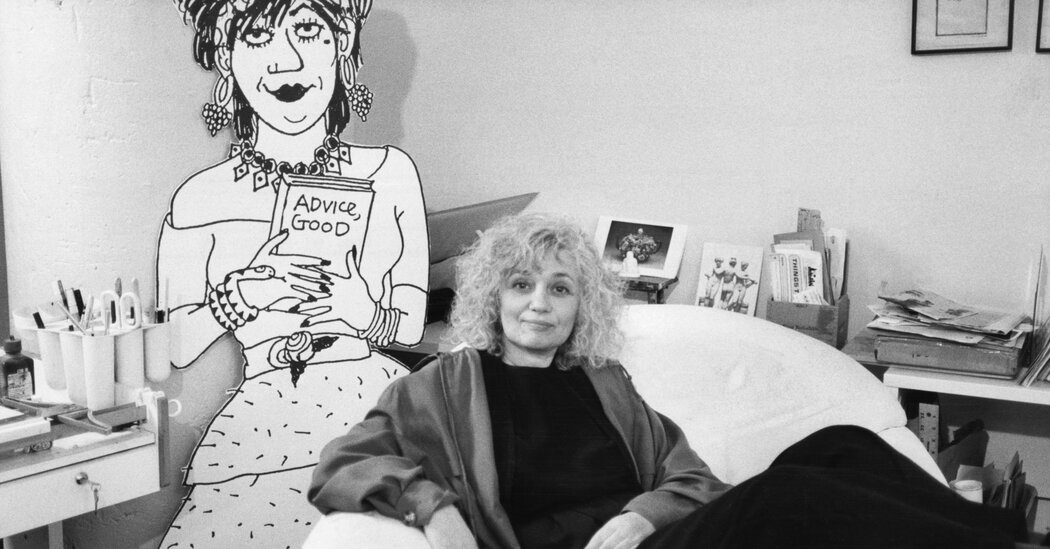
Nicole Hollander, a biting cartoon artist whose comic strip “Sylvia,” about a big-haired, cigarette-smoking, cat-loving, hyper-opinionated feminist, made her a singular voice on the funny pages for more than 30 years, died on April 23 in Chicago. She was 86.
Her death, in an assisted-living center, was confirmed by her friend and executor Tom Greensfelder, who said he did not know the cause but that she had been treated for respiratory issues and dementia.
With a loose drawing style that echoed Jules Feiffer’s, Ms. Hollander made Sylvia, who got her own strip in 1980, a tart-tongued, witty, loquacious single mother who held court — sometimes from her bathtub — on sex and relationships as well as politics, health care reform, the environment and other hot-button issues.
“It was really radical feminism in the daily paper,” Alison Bechdel, who created the “Dykes to Watch Out For” comic strip and the graphic memoir “Fun Home,” said in an interview.
In one of her “How Well Do You Know Your Genders?” quizzes, Sylvia typed, “What do you say about the first woman president of Harvard, the first woman speaker of the House Nancy Pelosi and Hillary Clinton?” With boxes labeled “M” and “F,” the responses were: “You go, girl” and “A little abrasive for my taste.”
In another, Sylvia sat at a bar, listening to a television news report that said, “Studies show that women with ‘sexy’ names like Dawn and Cheryl are less likely to be promoted to managerial jobs than women with names like…,” to which she added: “Bill or Roger.”
Ms. Bechdel noted that while “Sylvia” was influenced by Mr. Feiffer, he was published in The Village Voice, an alternative weekly, with an audience “that was open to those wordy, intellectual and politically provocative comics. Nicole was putting it out into the mainstream.”
Perhaps because of its subject matter, “Sylvia” was not nearly as broadly syndicated as “Peanuts” or “Garfield,” but it was read in as many as about 80 newspapers from 1980 to 2012. Ms. Hollander published more than a dozen collections, including “The Sylvia Chronicles: 30 Years of Graphic Misbehavior from Reagan to Obama” (2010), for which Mr. Feiffer wrote the foreword.
“Nicole’s M.O. is that when it comes to powerlessness she performs as critic and collaborator, pacifist and bomb-thrower,” Mr. Feiffer wrote, adding, “She is a radical social critic who is certain that nothing works, and so what? — a revolutionary who believes in the hell with it, I’m going shopping.”
Nicole Marilyn Garrison was born on April 25, 1939, in Chicago, the elder of two daughters of Henry Garrison, a carpenter and deli owner, and Shirley (Mazur) Garrison, a hospital administrator. From an early age, Nicole recognized that the women around her, particularly her mother and her mother’s friends Esther and Olga, were funny.
“I loved to listen to their conversations — all the jokes and irreverence and backbiting,” she said in a 2010 interview with the online publication Tablet.
She drew as a child, and later said that she discovered her career by watching one of the regulars at her father’s deli. The man “seemed to have all the time in the world to stare into his coffee cup,” Ms. Hollander wrote. “I found out he was a freelance book illustrator. I had no idea that was a job. I was hooked.”
She studied painting at the University of Illinois Urbana-Champaign, graduating in 1960 with a Bachelor of Fine Arts degree, and she married Paul Hollander in 1962. Four years later, she earned a Master of Fine Arts degree from Boston University and divorced her husband.
“I thought, ‘OK, I’m an adult, I have a married name, I proved that I could do it, and now I don’t have to do it ever again,’” she told The Chicago Tribune in 1990. (She didn’t.)
After a succession of jobs — in a bakery, a day care center, a hat store and a bank, among others — she became a graphic artist and found her way to The Spokeswoman, a feminist newsletter in Chicago that she redesigned as a magazine.
While there, she created a comic strip called “Feminist Funnies,” where Sylvia first appeared. It drew the attention of Doubleday, the book publisher, which ultimately decided it didn’t want to put out a volume of feminist cartoons. St. Martin’s published the book in 1979 as “I’m Training to Be Tall and Blonde.”
She was soon asked by the Universal Press Syndicate to start a strip starring Sylvia. She didn’t get very far with Universal, which felt the strip was, in her recollection, “deep but too narrow.” She moved “Sylvia” to a Canadian syndicate, then the Field Newspaper Syndicate, before she began selling it to newspapers on her own. Later, it was carried by The Los Angeles Times Syndicate and Tribune Media Services.
“Nicole was a rarity in what had historically been a male-dominated profession,” Caitlin McGurk, the curator of comics and cartoon art at the Billy Ireland Cartoon Library & Museum at Ohio State University, wrote in an email. “What made her especially rare was her refusal to adhere to societal norms and expectations for women. She was brazenly feminist but, above all, brazenly herself.”
Ms. Hollander’s work influenced comic artists like Ms. Bechdel and Liza Donnelly, best known for her work in The New Yorker and a director of a short 2025 documentary, “Women Laughing,” about female cartoonists.
“I learned about Nicole from her first book and was just blown away,” Ms. Donnelly said in an interview. “She was pushing the envelope and saying something about systemic sexism. She affected my snarky cartoons with women making fun of men.”
In one such cartoon by Ms. Hollander, a man says to Sylvia: “Admit it, Syl, you need us. Can you imagine a world without men?”
“No crime and lots of happy, fat women,” Sylvia responds.
When the novelist Mordecai Richler reviewed Ms. Hollander’s “The Whole Enchilada: A Spicy Collection of Sylvia’s Best” (1987) in The New York Times Book Review, he wrote, “Please send me more feminists like the saucy Nicole Hollander.”
Ms. Hollander collaborated on two musicals based on “Sylvia,” “Sylvia’s Real Good Advice” (1991) and “Female Problems: An Unhelpful Guide” (1998). She discontinued the strip in 2012, as the number of newspapers carrying it dwindled, and wrote and illustrated “We Ate Wonder Bread: A Memoir of Growing Up on the West Side of Chicago” (2018).
She is survived by her sister, Jana Carpenter.
More recently, Ms. Hollander kept drawing despite her dementia, with help from her caregiver, Karen Czernek, and even had a gallery show at her assisted-living center.
“The drawings had a more surreal quality and were less tied to a character,” her friend Mr. Greensfelder said, adding that they were “odd but beautiful.”

