



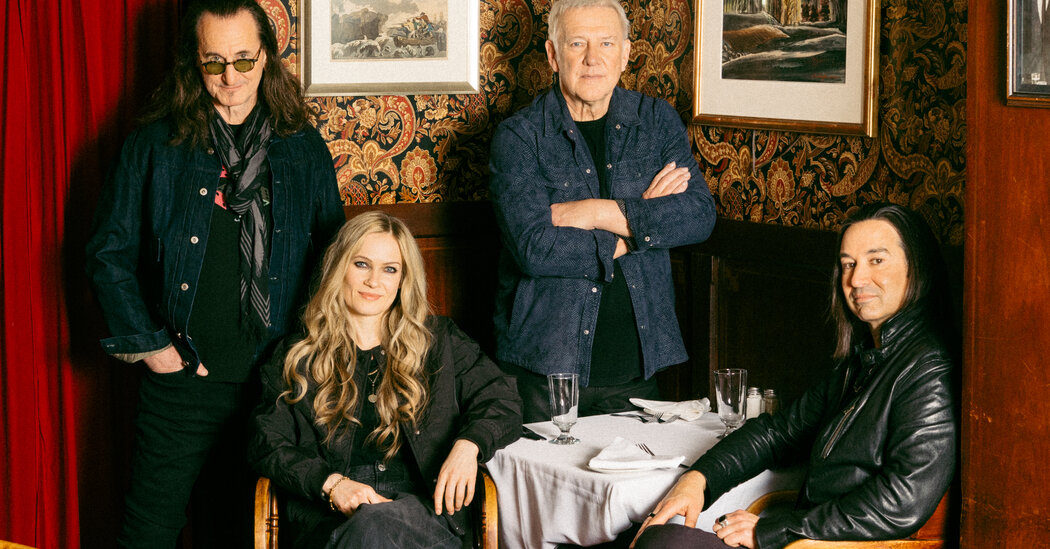
In late March, tucked into a small studio on a quiet Toronto side street, Rush was doing something the storied prog-rock outfit hadn’t done in more than a decade: rehearsing for a tour.
After losing their drummer Neil Peart to brain cancer in 2020, the Canadian trio had gone silent. But on this rainy Sunday, the group — with a new touring member, Anika Nilles, behind the kit — was running through an epic early ’80s deep cut, preparing for its Fifty Something Tour, a worldwide trek that includes nearly 90 dates and kicks off June 7 outside Los Angeles.
After they wrapped up, the vocalist and bassist Geddy Lee huddled in the control room with another new touring recruit, the keyboardist Loren Gold, to iron out a sticky transition. Lee — in tinted glasses, his brown hair hanging shoulder-length and his signature soul patch now fully gray — soon emerged upbeat. He then corralled bandmates, crew members and several visitors to screen an iPhone video, shot by his wife, that showed him holding Dottie Wasserman, his beloved Norwich terrier, as she howled along to his vocal warm-up routine.
“She’s never done this before,” Lee, 72, said, beaming at the interspecies duet.
Throughout the afternoon, Rush tore through around 11 of the 38 songs the band is relearning, the titles all a closely guarded secret. Between takes, the musicians prioritized rapid-fire comic banter. (“That song has so many words,” Lee mock-groaned after one rendition. “This guitar has so many strings,” Alex Lifeson, also 72, and Lee’s best friend and bandmate of around 60 years, deadpanned back.)
The next day, during an extended sit-down along with Lifeson at Barberian’s — a historic steakhouse in the band’s Toronto hometown where Lee’s favorite booth features a small gold badge bearing his birth name, Gershon Weinrib — Lee summed up Rush’s M.O.
“The way we work best is to be intense and pay attention to detail,” he said, “and then the minute the song is over, get as ridiculous as you can be.”
The levity in the Rush camp was noteworthy, given the formidable task at hand. The upcoming shows will be the group’s first in 11 years. And they will be the first in five decades without Peart, whose hyper-meticulous playing style and probing, philosophical lyrics made him an icon to generations of brainy rock introverts. The tour will explicitly honor him during its evening-length, two-set shows.
“In the back of my mind and in the back of my heart, it’s felt like unfinished business, like we owed him a proper thank you and a celebration,” Lee said. “Not a morbid, funereal type of thing. We want to celebrate the wonderful music the three of us spent almost 50 years writing together.”
In 2022, Lee and Lifeson reunited with guest drummers including Dave Grohl and Tool’s Danny Carey for mini sets at two all-star tributes to the Foo Fighters drummer Taylor Hawkins, held at London’s Wembley Stadium and the Forum in Inglewood, Calif. The events energized them, especially after another guest star, Paul McCartney, urged them to get back out on the road.
“Never argue with a Beatle,” Lifeson joked.
In a video interview, Stewart Copeland, the Police drummer and a friend of Peart’s who also appeared at the Hawkins tributes, recalled the good will that surrounded Lee and Lifeson there. “I think it reminded them of what they were missing, just to be playing in front of a big crowd, because they were extremely warmly received and embraced,” he said. “Backstage, all the musicians were just full of warm fuzzies for Alex and Geddy.”
Casual jams in Lee’s basement ensued, and talk of a reunion grew more serious. Lifeson, managing digestive issues and persistent arthritis, hesitated but eventually signed on. Around this time, Lee pulled up video of Nilles, a German drummer 30 years his junior whom his longtime bass tech, John McIntosh (known as Skully), had gotten to know on a Jeff Beck tour and enthusiastically recommended.
“This is a deep talent,” Lee recalled thinking. “Can she play Rush? We had no idea.”
Nilles, who found online fame in the early 2010s with tasteful playthroughs of her own jazz-fusion originals, had barely heard Rush before Skully tipped her off that Lee and Lifeson wanted to chat. (Growing up, her drumming hero was Jeff Porcaro, the Toto member and studio legend known for his sleek, hard-grooving style.) She crash-coursed on their music, then jumped on a Zoom while on tour in Germany, staying in a subpar hotel.
“I’m having a call with the two most iconic guys in a really trash room,” she recalled with a mortified laugh during a separate interview at Barberian’s.
They invited her to Toronto in the spring of 2025 to play a handful of Rush songs across five days. After the fourth day, Lee said, “There was a sliver of doubt,” not about her overall abilities but about her grasp of the tiny nuances of Peart’s style — as Lifeson put it, the “stuff in between all those big rolls.” But, Lifeson added, “something clicked with her that when we rehearsed on the fifth day, she just nailed it.”
The official invite came at the end of the trip, but Nilles, 42, said she only really realized the magnitude of what she was stepping into on the flight home. “I had a sip of wine in the airplane,” she said. “I flew over Toronto and I saw the skyline and everything. I was like, ‘Crazy.’”
At the rehearsal in March, Lee played and sang from inside an isolation booth, but he had Nilles in his sightline, and the two shared a palpable camaraderie, exchanging animated looks as they navigated the songs’ daredevil twists. Occasionally, they derailed, but the overall mood was one of exhilaration, not stress. “I can’t keep up with you!” Lee told Nilles warmly at the conclusion of one of Rush’s knottiest showpieces. On their way into the control room for a break, the two high-fived.
“I’m going to be a bit sad when we hit the stage and I’m facing the audience and not facing her because I’m having so much fun playing along with her,” Lee said.
Superfans minding the endless micro-flourishes of Peart’s parts will find them well accounted for in Nilles’s renditions. But overall, her approach — a blend of jazzy finesse and pile-driving power — focuses more on in-the-moment energy than forensic faithfulness.
A good indicator of how well she has acclimated: frequent approving nods from Lorne Wheaton — Peart’s trusted former drum tech, known as Gump — who came out of retirement to work with Nilles on the tour. At the rehearsal, sitting to Nilles’s right, he gave off the aura of a Jedi master watching a new recruit wield the Force.
Wheaton is fully aware of the tightrope that Nilles is walking as she prepares to face what is perhaps the most air-drum-prone fan base in rock.
“There’s certain signature songs that have got to have the same parts,” he said during an interview at the studio, “because there’s going to be those kids and adults and girls flailing their arms around and they’re going to have every note for note and they’re going to go, ‘Oh, that didn’t happen. What’s going on?’”
Reflecting on Peart’s death, Wheaton became emotional. “It still kicks in,” he said. But working with Anika, he said, “kind of revives the excitement.”
Nilles said that, during her Rush experience so far, “if I am not sure, I’m texting Gump, and he’s always there to help me out with ideas or share his perspective or experience in working with Neil.”
Lee and Lifeson have been similarly hands-on in helping her adjust. At early sessions, she said, “I got a really good idea of what Neil was to the guys as a band member, but also as a friend. So you cannot replace that, you know? I’m basically here to help them to get their music back onstage and make it feel right for them and make it feel right for the fans.”
Beyond his enthusiasm for playing with Nilles, Lee said that the presence of Gold — the keyboardist who will take over the complex array of background textures that Lee used to trigger with foot pedals — is allowing him to focus on the more fun parts of his job: “I want to offload that to somebody else so I can just focus on playing bass, singing and then getting away from my mic so I can go meet up with this guy in the center of the stage ——”
“We’ll do some dancing,” Lifeson interjected, sparking laughter from Lee.
(Another source of excitement for both Lee and Lifeson: the impressive state of Lee’s famously agile voice, which he credits to recent work with a vocal coach. “He’s brought back part of my range that I thought had left,” Lee said.)
The tour has the support of Peart’s family. His widow, Carrie Nuttall-Peart, endorsed the run in a joint statement with their daughter, Olivia, and she will contribute an essay to the official program. In a video interview, Nuttall-Peart contrasted Lee and Lifeson’s continued verve for live performance with a reluctance on Peart’s part that developed near the end of his touring days, when Rush’s standard of note-perfect three-hour shows — which Peart once likened to “running a marathon while solving equations” — was “really taking its toll physically,” she said.
“He was the one that was ready to retire, anyhow, and they really were not,” she added. She also mentioned Rush’s 1981 classic “Limelight,” which frankly addressed Peart’s conflicted relationship with fame.
“‘Limelight,’ Olivia and I have always said, is Daddy’s theme song,” Nuttall-Peart said, “because he really did not enjoy being in the public eye and he was quite an introvert and it was hard on him touring.” Speculating on how Peart might have reacted to Lee and Lifeson touring without him, she said she could imagine him asking, with good-natured exasperation, “Why?” “Or, ‘You guys are just nuts,’” she said, laughing. “But in a loving way.”
It’s clear that, for Lee and Lifeson, their optimism about Rush’s new chapter is a welcome relief after a long, dark period that followed Peart’s illness and death.
“I think for a while we put Rush in a box and put that box in our closet, and it’s almost like we felt weird to open the closet and open that box,” Lee said. But playing at the Hawkins tributes, he continued, “taught us something really important about music. A band can end, but the music lives on. And I think we were kind of afraid to take ownership of songs that we wrote with him together, songs that we did together, and that performance, the first one, especially in Wembley, felt so good and right.”
“It’s like we had taken the box out of the cupboard and we had opened it up,” he added. “And you know what? It was OK.”

