



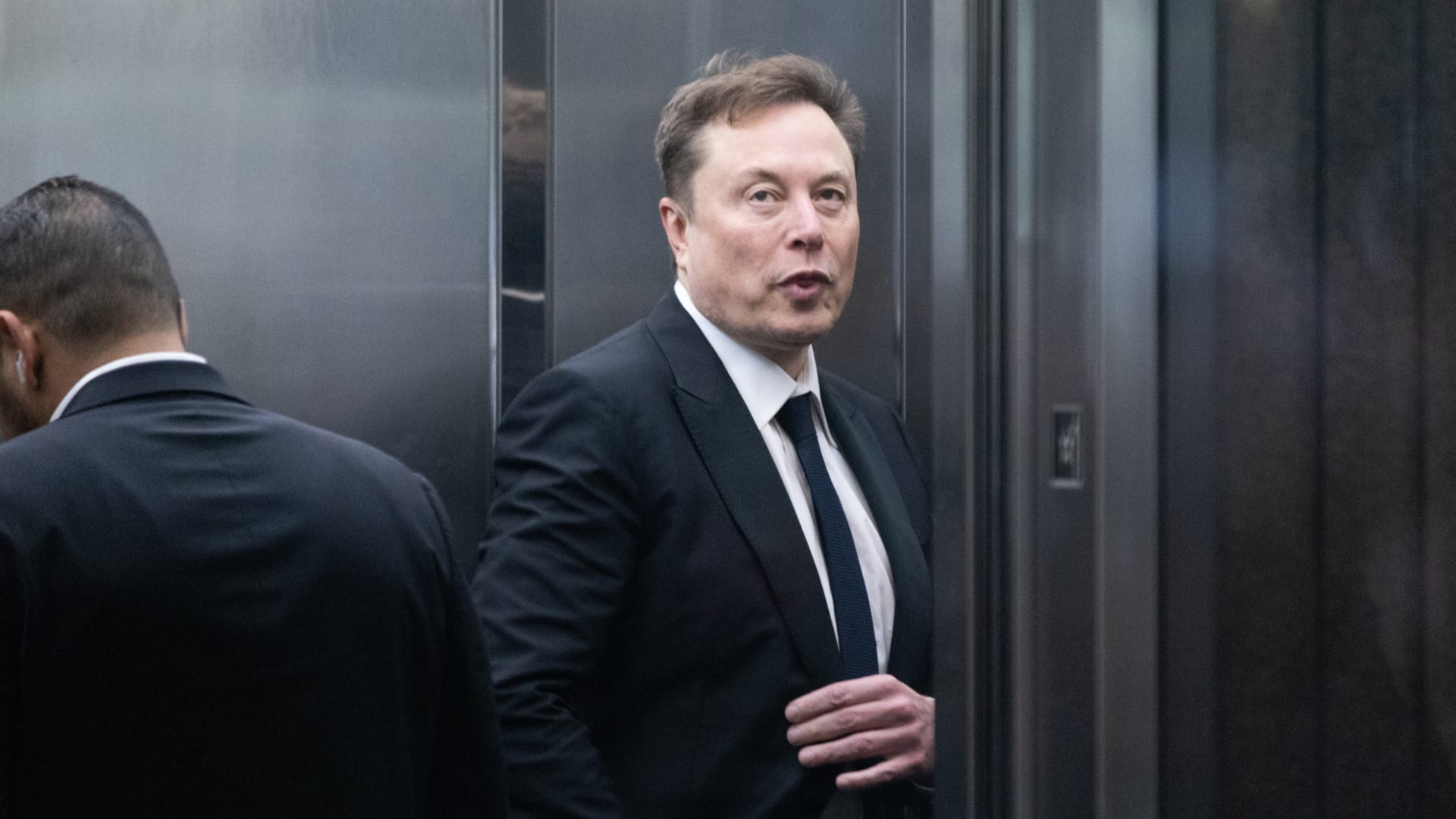
Elon Musk arrives to court at the Ronald V. Dellums Federal Building on April 30, 2026 in Oakland, California.
Benjamin Fanjoy | Getty Images
A week into the Musk v. Altman trial, which features two towering figures in the tech industry facing off in a case that could have major implications for OpenAI, the plaintiff has made his central message clear to the jury.
„You can’t just steal a charity,“ Elon Musk, the world’s richest person, said repeatedly during his time on the stand at a federal courthouse in Oakland, California.
Musk’s testimony was the centerpiece of the trial’s first week. It comes two years after the Tesla and SpaceX CEO first sued OpenAI CEO Sam Altman and Greg Brockman, the company’s president, alleging they went back on their promises to keep the artificial intelligence startup a nonprofit and to follow its charitable mission.
Musk, who helped start OpenAI in 2015 as a nonprofit, claims that the roughly $38 million he donated to the project was used for unauthorized commercial purposes. OpenAI, now valued at over $850 billion by private investors, has called Musk’s allegations „baseless.“ Musk left OpenAI’s board in 2018, and five years later started xAI as a competitor, before merging that business with SpaceX in February.
The trial began Monday with the seating of a nine-person jury. Attorneys for both parties presented opening arguments on Tuesday. The main event was Musk’s testimony, which stretched over the course of three days, wrapping up on Thursday.
The courtroom was dark on Friday, and proceedings will resume next week, with Judge Yvonne Gonzalez Rogers, an appointee of former President Barack Obama, presiding over the case. Altman and Brockman are expected to testify later this month.

After Musk left OpenAI, the AI lab began moving more towards commercialization, creating a for-profit subsidiary in 2018. The business started booming after the launch of ChatGPT in late 2022, and the subsequent raising of $10 billion in equity from Microsoft.
Musk testified that he is not entirely against OpenAI having a for-profit unit, but he said it became „the tail wagging the dog.“ He repeatedly accused Altman and Brockman of enriching themselves from a charity while also reaping the positive associations that come from running a nonprofit.
„What you can’t do is have your cake and eat it too,“ Musk said from the stand.
Musk said he started OpenAI to serve as a „counterweight“ to Google, which he viewed as having insufficient concerns surrounding AI safety. Musk said he got into an argument about the subject with Google co-founder Larry Page, a former friend, who called him a „speciesist for being pro-human.“
Musk said OpenAI wouldn’t exist without him.
„I came up with the idea, the name, recruited the key people, taught them everything I know, provided all the initial funding,“ Musk said.
Musk’s xAI interests
During cross-examination, Musk repeatedly clashed with OpenAI lead counsel William Savitt of Wachtell Lipton. He accused Savitt of lying and asking misleading questions that were „designed to trick“ him.
Savitt asked Musk about his involvement in negotiations to establish OpenAI’s for-profit arm, as well as what he knew about the nonprofit’s recent initiatives. He also asked about his competing AI company, xAI, which Musk passed off as being a fraction the size of OpenAI with minimal market share, even though he valued it a $250 billion in the merger with SpaceX.
Musk revealed that it’s „partly“ true that xAI used some of OpenAI’s technology to train its own models, a process known as distilling. He downplayed xAI’s reliance on OpenAI and said, „It is standard practice to use other AIs to validate your AI.“
Musk told the jury that while he had been growing „uncomfortable“ with Altman and Brockman’s behavior around 2017, he didn’t think he had a basis to sue until much later.
„I would’ve filed a lawsuit sooner if I thought they’d stolen the charity sooner,“ Musk said.

In a January filing, Musk’s attorneys said their client should receive up to $134 billion in damages from OpenAI and Microsoft, which is also named as a defendant. Musk’s team now says any „ill-gotten gains“ should be returned to OpenAI’s foundation.
Musk is also seeking to have Altman and Brockman removed from their roles and to „unwind OpenAI’s for-profit conversion and restructuring.“
All that’s happening while Musk and Altman are pushing their respective companies towards public offerings that could be the largest in history. SpaceX has already filed confidentially with the SEC and is reportedly expected to launch its roadshow in mid-June for an IPO that could value the company in the trillions of dollars.
Following the end of Musk’s testimony on Thursday, his lawyers called Jared Birchall, who manages Musk’s family office, as their next witness.
Birchall testified about the specific donations Musk made to OpenAI, as well as his knowledge about Musk’s multibillion-dollar bid to acquire OpenAI last year. In February of 2025, Musk led a group of investors in offering to buy control of OpenAI for $97.4 billion, an effort that Altman immediately rejected.
Before the proceedings kicked off on Monday, Gonzalez Rogers opted to split the trial into two parts: a liability phase to determine whether any wrongdoing occurred, and a remedies phase to decide the appropriate outcomes and next steps. Gonzalez Rogers expects the former to conclude by May 21
The jury will weigh in during the liability phase only, and its verdict will be advisory, which means Gonzalez Rogers will make the final decision.
—CNBC’s Lora Kolodny contributed to this report.
WATCH: Musk fires back at OpenAI attorney


