



More than a hundred reproductive health physicians were gathered in Washington, D.C., on Friday afternoon, listening to an update on the shifting legal landscape of reproductive health care.
The presentation was delivered by Molly Meegan, the chief legal officer of the American College of Obstetricians and Gynecologists, who had no idea that another ruling on the abortion pill mifepristone had arrived as she spoke, temporarily blocking the drug’s prescription by telemedicine and delivery by mail.
“This is not a ruling based in evidence, science or best interests of women,” she said, after learning of the decision by a panel of the U.S. Court of Appeals for the Fifth Circuit.
The order is already being challenged, but if the Supreme Court lets it stand, it would upend access to a means of abortion that has been steadily growing in recent years. The ruling has also thrust abortion into the national spotlight in advance of the midterm elections, as organizations that provide and support abortion services and those that oppose abortions unleashed a flurry of responses.
“This decision represents the most sweeping threat to abortion since the overturning of Roe v. Wade,” said Kelly Baden, vice president for public policy at the Guttmacher Institute, a research organization that supports abortion rights. “If allowed to stand, it would severely restrict access to mifepristone in every state, including those where abortion is broadly legal and where voters have acted to protect abortion rights.”
Louisiana, which has a near-total ban on abortion, went to court to stop distribution of the drug by mail. The appeals court said that while that lawsuit proceeded, the Food and Drug Administration needed to reinstate a requirement that patients visit medical providers in person to obtain mifepristone.
A mifepristone manufacturer filed an emergency appeal to the Supreme Court on Saturday asking it to restore full access to mifepristone. A second mifepristone maker said it would file a similar appeal. The Trump administration has so far declined to comment on the ruling or what steps it might take.
Anti-abortion groups celebrated the ruling. Marjorie Dannenfelser, president of Susan B. Anthony Pro-Life America, called the court’s decision “a huge victory for victims and survivors of Biden’s reckless mail-order abortion drug regime.”
Carol Tobias, president of National Right to Life, said in a news release that the ruling “recognizes that the FDA cannot simply sweep legitimate safety concerns aside in favor of politics.”
Abortion opponents have argued that the F.D.A.’s decision to allow abortion pills to be available by mail posed safety risks to women and violated the sovereignty of states that had banned abortion. Major medical organizations and supporters of reproductive rights have pointed out that more than 100 studies have found the pills to be safe and effective, with serious side effects being rare.
Medication is now the method used in nearly two-thirds of abortions in the United States, and is typically delivered in the form of a two-drug regimen through the first 12 weeks of pregnancy.
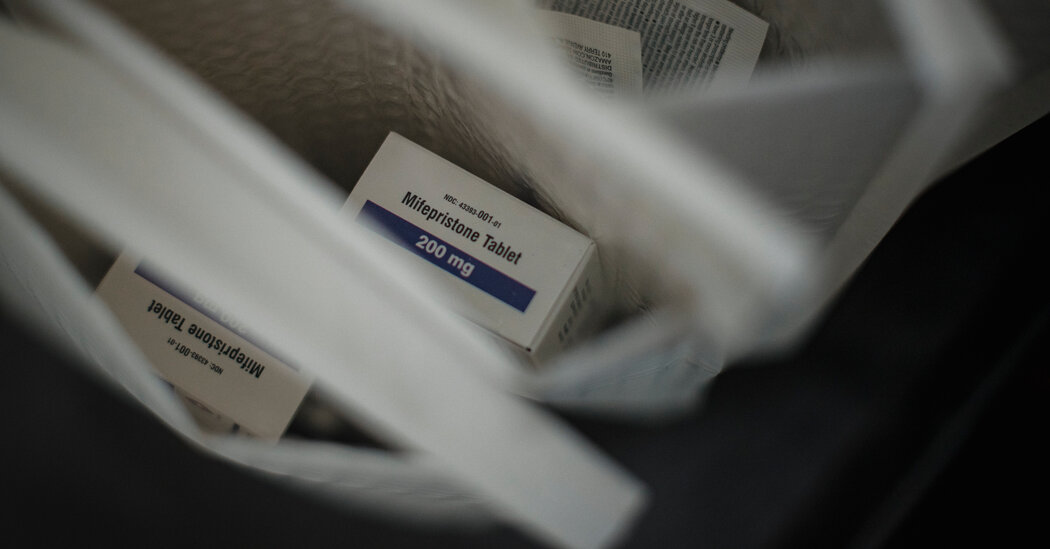
The first of those drugs is mifepristone, which was approved in 2000, and blocks a hormone needed for a pregnancy to develop. The second drug, misoprostol, has many other medical uses and was not affected by the Fifth Circuit ruling.
Typically, misoprostol, which causes contractions similar to a miscarriage, is taken 24 to 48 hours after mifepristone. But several providers said they were prepared to continue telemedicine services prescribing only misoprostol, which can be used on its own for abortion, although it is considered somewhat less effective and more likely to have side effects.
Earlier on the day of the ruling, Planned Parenthood of Greater New York had announced an expansion of its telemedicine abortion service. After the Fifth Circuit decision, the organization said it would continue to provide telehealth abortion with misoprostol.
“In the wake of yesterday’s harmful decision by the Fifth Circuit, Planned Parenthood Direct is mailing misoprostol-only prescription kits,” said Jacquelyn Marrero, a spokesperson for Planned Parenthood of Greater New York.
Telemedicine abortion has steadily increased since the F.D.A. began allowing it in 2021. As of the first six months of 2025, more than one-fourth of abortions in the country were provided via telemedicine, according to a report from a reproductive rights research group.
Although abortion is currently banned or restricted in 20 states, over 100,000 patients per year in those states have been receiving pills through the mail. Those pills are prescribed and shipped by medical practitioners in states that have abortion shield laws. Officials in those shield-law states are prevented from obeying subpoenas, extradition requests and other legal actions that states with bans take against abortion providers.
The laws are being tested by several cases that are expected to lead to a constitutional showdown over whether states must honor one another’s abortion laws. Some abortion providers said they had anticipated the Fifth Circuit’s ruling, given the court’s conservative leanings, and many had already developed contingency plans.
Julie Burkhart, who runs Wyoming’s only abortion clinic, said that the Fifth Circuit’s ruling was “devastating, but it’s not surprising.” Ms. Burkhart said her clinic had temporarily suspended telehealth medication abortion appointments in response to the decision, but hoped to quickly reopen them.
“We’re trying to move very quickly to get something into place so we can have that continuity of care, but we want to be also thoughtful and intentional, so that we are giving the best possible care to our patients,” she said.
Dr. Angel Foster, co-founder of The Massachusetts Medication Abortion Access Project, which operates under that state’s shield law, said in a statement that her organization was consulting legal experts about the ruling’s implications and that the group would “do everything in our power to continue providing care to people in all 50 states.”
Dr. Jodi Abbott, a specialist in high-risk pregnancies who is a consultant to the Massachusetts project, said that like some other providers, the organization would shift to prescribing and mailing only misoprostol for abortions. “We have no concerns about its safety or efficacy,” Dr. Abbott, who is also a clinical professor at Boston University, said of using misoprostol alone. “But we also know it’s not optimal.”
Kate Zernike contributed reporting.

